Category
page 1Persian mythology

One Thousand and One Nights
collection of Middle Eastern folk stories

Shahnameh
thumb|Plate with a hunting scene from the tale of Bahram V|Bahram Gur and Azadeh. The imagery on this plate represents the earliest known depiction of a well-known episode from the story of Bahram Gur, which seems to have been popular for centuries, but was only recorded in the Shahnameh, centuries after this plate was created. Iran, [[Metropolitan Museum of Art]]

Persian cat
cat breed

Scheherazade
Sheherazade ( also spelled Scheherazade, Shahrazad, or Šahrzād) is the legendary narrator and central framing character of One Thousand and One Nights (), a collection of Middle Eastern, South Asian, and North African folktales compiled in Arabic between roughly the 8th and 14th centuries. Sheherazade is the wife of King Shahryar and saves herself, and ultimately the women of the kingdom, from execution by recounting a continuous sequence of interlinked stories over the course of 1,001 nights.
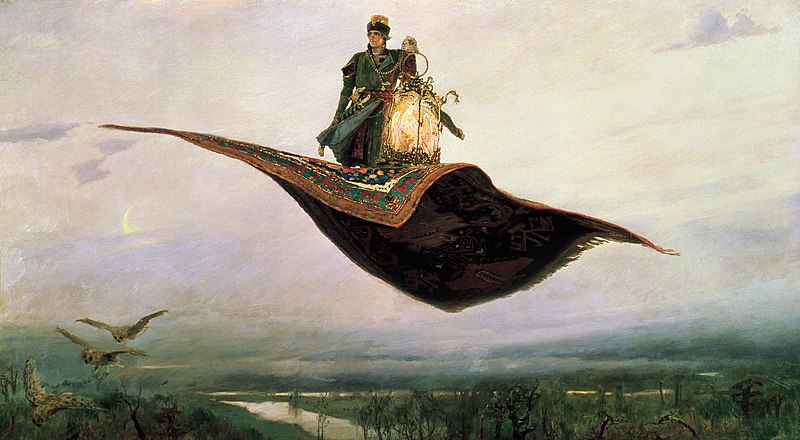
magic carpet
legendary carpet used for transportation
Persian mythology
traditional legends and stories etc. from the Persian culture
Fereydun
use both this parameter and |birth_date to display the person's date of birth, date of death, and age at death) -->
| death_place =
| death_cause =
| resting_place =
| resting_place_coordinates =
| burial_place =
| other_names = Afereydun(آفریدون)
| known_for = Victory over Azhi Dahaka
| spouse = ArnavazShahrnaz
| partner =
| children = SalmTurIraj
| parents =
| mother = Faranak
| father = Abtin
| relatives =
Khosrow and Shirin
Persian tragic romance by Nizami Ganjavi
Kaveh the Blacksmith
legendary figure

parī
A parī or peri is a supernatural entity originating from Persian tales and distributed into wider Asian folklore. The parīs are often described as winged creatures of immense beauty who are structured in societies similar to that of humans. Unlike jinn, the parīs usually feature in tales involving supernatural elements.
huma bird
Iranian mythological creature
Airyanem Vaejah
mythological homeland of the early Iranians
Kayanian dynasty
legendary dynasty of Persian/Iranian tradition and folklore

Atar
Atar () is the Zoroastrian concept of holy fire, sometimes described in abstract terms as "burning and unburning fire" or "visible and invisible fire" (Mirza, 1987:389). It is considered to be the visible presence of Ahura Mazda and his Asha through the eponymous Yazata. The rituals for purifying a fire are performed 1,128 times a year.
Vis and Rāmin
poem

Zabulistan
Zabulistan (, Zābolistān, Zāwulistān or simply ), is an ancient and medieval name for a historical region that included mainly southern Afghanistan as well as southeastern Iran.

Haoma
'''''' (; Avestan: ) is a divine plant in Zoroastrianism and in later Persian culture and mythology. has its origins in Indo-Iranian religion and is the cognate of Vedic .
Mount Qaf
legendary mountain
Pishdadian dynasty
mythical Persian dynasty
Kay Kāvus
fictional king from the Iranian/Persian epic
Azerbaijani folklore
folk tradition

Sohrab
thumb|250px|Persian manuscript painting: Rostam lamenting Sohrab

Rudaba
Rūdāba or Rudâbe ( ) is a Persian mythological female figure in Ferdowsi's epic Shahnameh. She is the princess of Kabul, daughter of Mehrab Kaboli and Sindukht, and later she becomes married to Zal, as they become lovers. They had two children, including Rostam, the main hero of the Shahnameh.
Rakhsh
In the Persian national epic Shahnameh by the poet Ferdowsi, Rakhsh (, meaning "luminous") is the stallion of the protagonist Rostam.
Apam Napat
Deity in the Indo-Iranian pantheon

Khumban
Humban (, dhu-um-ban, also dhu-ban, Huban) was an Elamite god. He is already attested in the earliest sources preserving information about Elamite religion, but seemingly only grew in importance in the neo-Elamite period, in which many kings had theophoric names invoking him. He was connected with the concept of kitin, or divine protection.
Cup of Jamshid
cup of divination in Persian mythology
Shahbaz
fabled bird
Amir Arsalan
19th century Persian epic
Tahmina
use both this parameter and |birth_date to display the person's date of birth, date of death, and age at death) -->
| death_place = Kingdom of Samangan
| body_discovered =
| resting_place =
| resting_place_coordinates =
| burial_place =
| burial_coordinates =
| monuments =
| nationality =
| other_names =
| siglum =
| citizenship =
| education =
| alma_mater =
| occupation =
| years_active =
| era =
| employer =
| organization =
| agent =
| known_for = Rostam and Sohrab
| notable_works =
| style =
| net_worth =
| height =
| television =
| title =
| term =
| predecessor
Faramarz
thumb|right|Kay Bahman's attack on [[Sistan and defeat of Faramarz in the Jami al-tawarikh, written by Hafiz-i Abru. (Held in the Metropolitan Museum of Art)]]
Cypress of Kashmar
sacred tree in Zoroastrian legend
Rostam's Seven Labours
one of the Shahnameh story, seven difficult stages that Rostam went through
Marzubannama
The Marzbān-nāma () is an early 13th-century Persian prose work. It consists of "various didactic stories and fables used as illustrations of morality and right conduct", and belongs to the "mirror for princes" literary genre. It was written in 1210–1225 by Sa'ad al-Din Varavini, under the patronage of Abu'l-Qasem Harun, the vizier of the Eldiguzid ruler (atabeg) Muzaffar al-Din Uzbek (1210–1225).
Zafar-Nameh
by the Persian epic poet Hamdollah Mostowfi
Sheshe
Sheshe () in Persian mythology is a jinni-like creature that strangles newborn babies on 6th day of their lives.
Bijan and Manijeh
Love story in Shahnameh epic poem
Div-e-Sepid
mythical character
Darab Nama
The Darab-nama () (Book of Daaraab) is a Persian prose romance, written by the 12th-century writer Abu Tahir Tarsusi, in which the adventures of the Kayanid Iranian King Darab are recounted.
Zarik
In Persian mythology, Zarik (or Zarich) is a Daeva in the service of Ahriman.
Royal stars
Persian definition in astronomy
Zaratosht-nama
Zaratosht-nama or Cangranghaca-nama () is a religious epic poem in Persian language composed in 13th century CE. The poem is about the life of Zoroaster, the founder of Zoroastianism. The author of the poem is Kay Kavus pur-i Khosrow. The poem is erroneously attributed to Zartosht Bahram-e Pazhdo who is actually the copier of the first surviving manuscript of the work. The poem contains 600 distichs and is composed in the same meter as Shahnameh of Ferdowsi. The work is based on the oral narratives of Zoroastrians and has a lot of similarities with Middle Persian literature such as the Denkard
Bibi Seshanbe
Central Asian and Iranian female saint, patroness of the spinners

Avestan period
early period in the history of the Iranian peoples
Shamshir-e Zomorrodnegar
Legendary Persian sword
Gaokerena
In Persian and Zoroastrian legends, the mighty Gaokerena was a mythic Haoma plant that had healing properties and gave immortality to the resurrected bodies of the dead when eaten. It is also said to have the seeds of all trees on Earth and that the juice from its fruit gave the elixir of immortality. The name Gaokerena means "ox horn" or "cow ear".
== Simurgh roosting on the tree ==
Farhad
mythical Iranian character
Ashkbous
thumb|right|Ashkbous in the Shahnameh of Shah Tahmasp
Ashkbous () is a Keshanian hero in Shahnameh who fights with Iranians in the Battle of Kamous-e Kashani. In Bondari's translation of Shahnameh into Arabic, his name is given as Askbos. In the story of Kamous, Ashkbous first fights with Rohham and defeats him, but he himself was defeated and killed by Rostam who was fighting on foot without Rakhsh. The battle of Rostam and Ashkbous was a popular choice in Persian miniature. It has been suggested that Kashanians or Koshanians are related to Kushan Empire.
Bahman Nama
thumb|right|"Azar Barzin killing a dragon", folio from the Bahman-nameh, presumably interpolated into a Shahnameh manuscript. Created in [[Qazvin, Safavid Iran, dated ]]
The Bahman-nameh () is a Persian epic poem of around 9500 lines, which describes the exploits of Kay Bahman, the son of Esfandiyar of the royal Kayanid dynasty. The earliest attestation of this work is in the book Mojmal al-tawarikh, which gives the author as Iranshan ibn Abi'-Khayr (Iranshah).
Haftvād
thumb|A Persian miniature from a 15th-century manuscript of the [[Shahnameh depicting Ardashir killing Hafvād's worm.]]
Kush Nama
Persian epic