Category
page 1Philosophical arguments
.svg)
analogy
Analogy is a comparison or correspondence between two things (or two groups of things) because of a third element that they are considered to share.

Russell's Teapot
analogy devised by Bertrand Russell
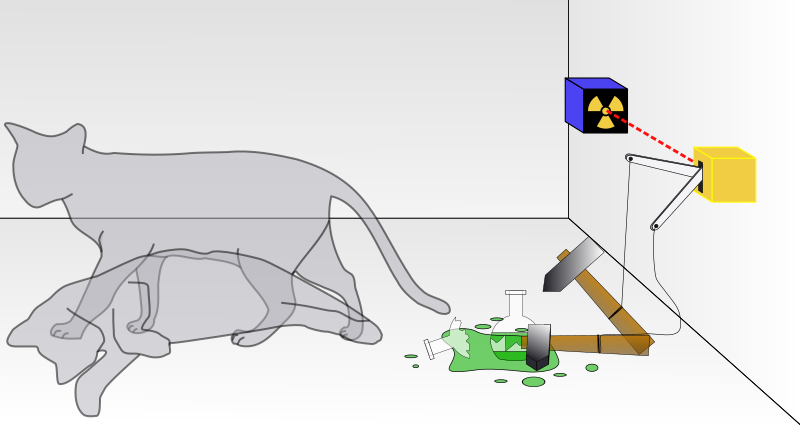
thought experiment
considering hypothesis, theory, or principle for the purpose of thinking through its consequences

Chinese room
thought experiment arguing that a computer cannot exhibit "understanding"

Pascal's Wager
argument that posits that humans bet with their lives that God either exists or does not
fine-tuned universe
the proposition that the occurrence of life in the universe is very sensitive to the values of certain fundamental physical constants and that the observed values are, for some reason, improbable
Münchhausen trilemma
thought experiment about the impossibility of proving any truth: in response to repeated "but why?"s, only the circular argument, infinite regress, or axiomatic argument are possible
eristic
In philosophy and rhetoric, eristic (from Eris, the ancient Greek goddess of chaos, strife, and discord) refers to an argument that aims to successfully dispute another's argument, rather than searching for truth. According to T.H. Irwin, "It is characteristic of the eristic to think of some arguments as a way of defeating the other side, by showing that an opponent must assent to the negation of what he initially took himself to believe." Eristic is defined by Rankin as arguing for the sake of conflict, as opposed to resolving conflict.
infinite regress
philosophical problem
philosophical zombie
thought experiment in philosophy
Myth of Er
legend
Analogy of the divided line
Platonic philosophical analogy
Quinque viae
5 logical arguments for the existence of God made by Thomas Aquinas in his book Summa Theologica: the argument from motion; the argument from causation; the argument from contingency; the argument from degree; the argument from final cause
argument from analogy
type of inductive argument, whereby perceived similarities are used as a basis to infer some further similarity that has yet to be observed
turtles all the way down
expression of the problem of infinite regress
Alvin Plantinga's free will defense
logical argument
private language argument
argument by Wittgenstein that the concept of a language understandable by only a single individual is incoherent
argument from marginal cases
philosophical argument for animal rights stating that, since human marginal cases (infants, the senile, the comatose, and the cognitively disabled) have direct moral status, so do animals
regress argument
problem in epistemology that any proposition can be endlessly questioned
China brain
thought experiment
Cartesian circle
potential mistake in reasoning attributed to René Descartes
experience machine
thought experiment about a machine that provides any pleasurable experience one wants
argument from illusion
argument for the existence of sense-data
open-question argument
philosophical argument put forward by British philosopher G. E. Moore, to refute the equating of the property of goodness with some non-moral property, X, whether naturalistic (e.g. pleasure) or supernatural
Consequence argument
philosophical argument against compatilibism by Peter van Inwagen
utility monster
thought experiment critiquing utilitarianism