Category
page 1Philosophy of artificial intelligence

Turing test
test of a machine's ability to exhibit intelligent behaviour equivalent to, or indistinguishable from, that of a human

transhumanism
Transhumanism is a philosophical movement that advocates the enhancement of the human condition by developing and making widely available new and future technologies to enhance longevity, cognition, and well-being. Influenced by seminal works of science fiction, the transhumanist vision of a transformed future humanity has many supporters and detractors from a wide range of perspectives, including philosophy and religion. Some critics argue that transhumanism amounts to little more than a "rebranding" of eugenics.

technological singularity
hypothetic future event in which artificial intelligence iteratively redesigns itself to rapidly become more intelligent, causing technological and social change beyond prediction

Luciano Floridi
Italian philosopher

Chinese room
thought experiment arguing that a computer cannot exhibit "understanding"
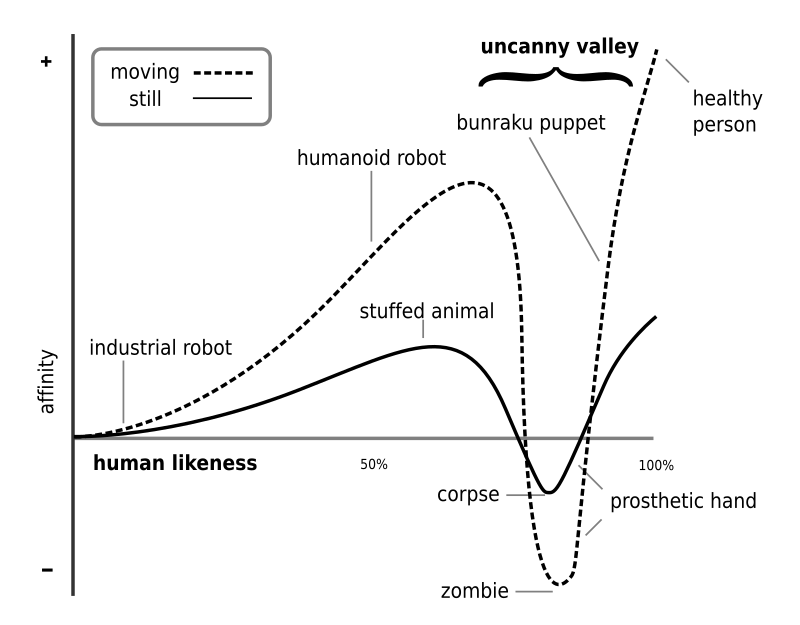
uncanny valley
hypothesis that human replicas which appear almost like real human beings elicit revulsion
hallucination
confident unjustified claim by an AI
ethics of artificial intelligence
ethics of technology specific to robots and other artificially intelligent beings

Vilém Flusser
Czech philosopher and photographer
philosophy of artificial intelligence
area of philosophical inquiry
philosophy of information
branch of philosophy

LaMDA
LaMDA (Language Model for Dialogue Applications) is a family of conversational large language models developed by Google. Originally developed and introduced as Meena in 2020, the first-generation LaMDA was announced during the 2021 Google I/O keynote, while the second generation was announced the following year.
Moravec's paradox
observation that perception requires more computation than reasoning
Hubert Dreyfus
American philosopher (1929–2017)
dataism
Dataism is a term that has been used to describe the mindset or philosophy created by the emerging significance of big data. It was first used by David Brooks in The New York Times in 2013. The term has been expanded to describe what historian Yuval Noah Harari, in his book Homo Deus: A Brief History of Tomorrow from 2015, calls an emerging ideology or even a new form of religion, in which "information flow" is the "supreme value". In art, the term was used by Albert-Laszlo Barabasi to refer to an artist movement that uses data as its primary source of inspiration.

connectionism
thumb|A 'second wave' connectionist (ANN) model with a hidden layer
Connectionism is an approach to the study of human mental processes and cognition that utilizes mathematical models known as connectionist networks or artificial neural networks.
friendly artificial intelligence
hypothetical artificial general intelligence that would have a positive effect on humanity
algorithmic bias
systematic and repeatable errors in a computer system that create unfair outcomes, such as privileging one arbitrary group of users over others
AI alignment
alignment of AI systems towards human goals, preferences and ethical principles
Dartmouth workshop
1956 AI workshop
embodied cognition
interdisciplinary theory
Roko's basilisk
AI thought experiment
computational theory of mind
theory proposing that the mind works similar to a computer
Computing Machinery and Intelligence
1950 article by Alan Turing on artificial intelligence that introduced the Turing test
stochastic parrot
metaphor to describe the theory that large language models, though able to generate plausible language, do not understand the meaning of the language they process

The Outer Limits
television series originally broadcast from 1995 to 2002
roboethics
ethical problems related to robots
singularitarianism
Singularitarianism is a movement defined by the belief that a technological singularity—the creation of superintelligence—will likely happen in the medium future, and that deliberate action ought to be taken to ensure that the singularity benefits humans.

physical symbol system
system

machine ethics
part of the ethics of artificial intelligence
computational creativity
multidisciplinary endeavour
effective accelerationism
philosophical and social movement advocating for a pro-technology stance that seeks to maximize the probability of a technocapital singularity
suffering risks
risks of astronomical suffering
synthetic intelligence
alternate term for or form of artificial intelligence
The Emperor's New Mind
essay by Roger Penrose
fairness in machine learning
trait of an algorithm, whose results are independent of given variables, e.g. gender, ethnicity, sexual orientation, disability
AI capability control
hypothetical isolated computer hardware system where a possibly dangerous artificial intelligence is kept constrained in a virtual prison and not allowed to manipulate events in the external world

Golem XIV
collection of philosophical essays by a fictional supercomputer, written by Stanisław Lem
China brain
thought experiment
Moral circle expansion
Broadening of moral considerations
artificial stupidity
stupidity exhibited by an artificial intelligence
Asilomar Conference on Beneficial AI
held at the Asilomar Conference Grounds in January 2017
artificial imagination
artificial simulation of human imagination
TESCREAL
TESCREAL is a neologism proposed by computer scientist Timnit Gebru and philosopher Émile P. Torres. An acronym, it stands for Transhumanism, Extropianism, Singularitarianism, (modern) Cosmism, Rationalists (the internet community, not to be confused with other uses of the term), Effective Altruism, and Longtermism. Gebru and Torres argue that these ideologies should be treated as an "interconnected and overlapping" group with shared origins. They claim these constitute a movement that allows its proponents to use the threat of human extinction to justify expensive or detrimental projects and