Category
page 1Philosophy of technology

reality
Reality is the state of everything that exists, not how they might be imagined. Different cultures and academic disciplines conceptualize it in various ways.

phenomenology
early 20th century philosophical movement that seeks to describe the universal features of consciousness without assumptions about the external world, aiming to describe phenomena as they appear and exploring the significance of lived experience

transhumanism
Transhumanism is a philosophical movement that advocates the enhancement of the human condition by developing and making widely available new and future technologies to enhance longevity, cognition, and well-being. Influenced by seminal works of science fiction, the transhumanist vision of a transformed future humanity has many supporters and detractors from a wide range of perspectives, including philosophy and religion. Some critics argue that transhumanism amounts to little more than a "rebranding" of eugenics.

Dyson sphere
hypothetical megastructure, originally described by Freeman Dyson

critical sociology
philosophy that sociological understanding's primarily use should be social reform
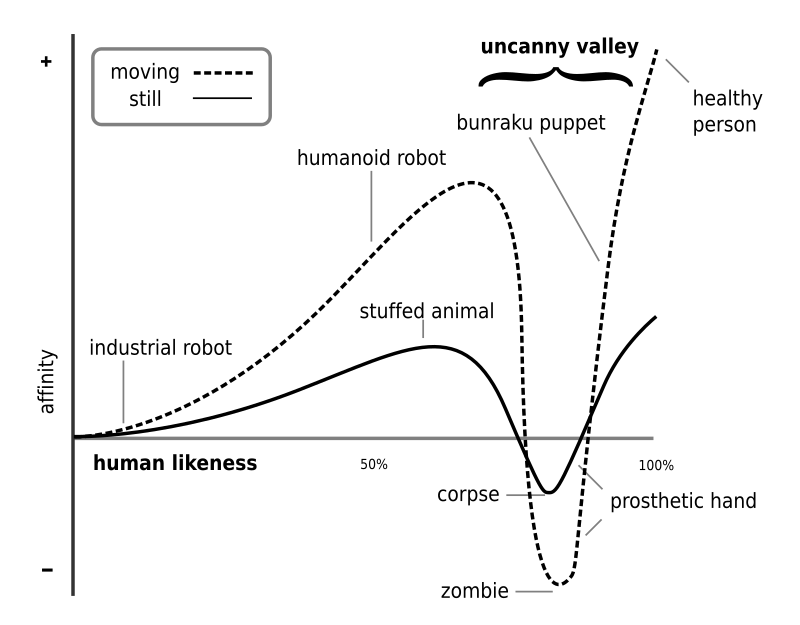
uncanny valley
hypothesis that human replicas which appear almost like real human beings elicit revulsion

technological determinism
theory holding that social progress is shaped by technological progress

technophobia
thumb|240x240px|Computers, among many other technologies, are feared by technophobes.
Technophobia (from Greek τέχνη technē, "art, skill, craft" and φόβος phobos, "fear"), also known as technofear, is the fear or dislike of, or discomfort with, advanced technology or complex devices, especially personal computers, smartphones, and tablet computers. A 2018 study proposed a new conceptual and empirical definition of technophobia based on a critical literature review and data analysis results:
science and technology studies
field of study in which society, politics and culture are studied in how scientific research and technological innovation affect them
actor–network theory
theory within social science
material culture
physical aspect of culture in the objects and architecture that surround people
individuation
The principle of individuation, or '''''''''', describes the manner in which a thing is identified as distinct from other things.

Episteme
In philosophy, '''' (; ) is knowledge or understanding. The term epistemology'' (the branch of philosophy concerning knowledge) is derived from .
philosophy of artificial intelligence
area of philosophical inquiry
accelerationism
Accelerationism is a range of ideologies that call for the use of capitalism and associated processes to create radical social transformations. Broadly, accelerationism engages with antihumanism, as well as posthumanism, and seeks to accelerate desired tendencies within capitalism at the expense of negative ones, though variants differ greatly on which tendencies and if this will lead beyond capitalism or further into it.
posthumanism
Posthumanism or post-humanism (meaning "after humanism" or "beyond humanism") is an idea in continental philosophy and critical theory responding to the presence of anthropocentrism in 21st-century thought.

bricolage
thumb|A maker space with potential bricolage material
In the arts, bricolage (French for "DIY" or "do-it-yourself projects"; ) is the construction or creation of a work from a diverse range of things that happen to be available, or a work constructed using mixed media.
.jpg)
hyperreality
Hyperreality is a concept in post-structuralism that refers to the process of the evolution of notions of reality, leading to a cultural state of confusion between signs and symbols invented to stand in for reality, and direct perceptions of consensus reality. Hyperreality is seen as a condition in which, because of the compression of perceptions of reality in culture and media, what is generally regarded as real and what is understood as fiction are seamlessly blended together in experiences so that there is no longer any clear distinction between where one ends and the other begins.
biopolitics
Biopolitics is a major paradigm in the social sciences and humanities, which begins from the premise that life is central to modern politics. In the early nineteenth century, biopolitics emerged as a specific form of politics with a series of concerns over "life", such as concerns with overpopulation, public hygiene, pseudo-scientific theories such as biological racism, and into state forms of biological domination such as Nazi Germany. More recently, contemporary issues such as combating climate change, preventing the global spread of infectious diseases and pandemics, as well as rethinking t
philosophy of technology
sub-field of philosophy field that studies the nature of technology and its social effects
media ecology
media evolution
rhizome
theory and research that allows for multiple, non-hierarchical entry and exit points in data representation and interpretation
risk society
manner in which modern society organizes in response to risk
Omega Point
spiritual belief and a scientific speculation that everything in the universe is fated to spiral towards a final point of divine unification
Social construction of technology
theory within the field of Science and Technology Studies
speculative realism
movement in contemporary Continental-inspired philosophy
governmentality
Governmentality is a theory of power developed by French philosopher Michel Foucault, which analyses "governmental" power through both the power states have over the population and the means by which subjects govern themselves.
biopower
Biopower (or biopouvoir in French), coined by French social theorist Michel Foucault, refers to various means by which modern nation states control their populations. In Foucault's work, it has been used to refer to practices of public health, regulation of heredity, and risk regulation, among many other regulatory mechanisms often linked less directly with literal physical health. Foucault first used the term in his lecture courses at the Collège de France, and the term first appeared in print in The Will to Knowledge, Foucault's first volume of The History of Sexuality. It is closely related
sociotechnical system
type of system that includes social and technological elements, enabling society's complex infrastructures, organizations and interactions
technophilia
Technophilia (from Greek τέχνη - technē, "art, skill, craft" and φίλος - philos, "beloved, dear, friend") refers generally to a strong attraction for technology, especially new technologies such as personal computers, the Internet, mobile phones, and home cinema. The term is used in sociology to examine individuals' interactions with society and is contrasted with technophobia.

body without organs
concept of a deeper reality underlying a well-formed whole constructed from fully functioning parts, or a relationship to one's literal body
criticism of technology
overview about the criticism of technology
media archaeology
sub-discipline of archaeology
technorealism
Technorealism is an attempt to expand the middle ground between techno-utopianism and Neo-Luddism by assessing the social and political implications of technologies so that people might all have more control over the shape of their future. An account cited that technorealism emerged in the early 1990s and was introduced by Douglas Rushkoff and Andrew Shapiro. In the Technorealism manifesto, which described the term as a new generation of cultural criticism, it was stated that the goal was not to promote or dismiss technology but to understand it so the application could be aligned with basic h
object-oriented ontology
metaphysical theory
dispositif
Dispositif is one of the most prevalent concepts in 20th and 21st century philosophy, especially in Continental philosophy. As a philosophical term, dispositif has been introduced into the English language via the work of Michel Foucault, although there is now an extensive literature covering the much broader genealogy of dispositifs in contemporary philosophy. In general, they are a complex arrangement of discursive and non-discursive elements, which produce our world, subject positions, and ways of understanding. In the words of Gilles Deleuze, they are "machines that make one see and speak.
Decidim
Decidim describes itself as a "technopolitical network for participatory democracy". It combines a free and open-source software (FOSS) software package together with a participatory political project and an organising community, "Metadecidim". Decidim participants describe the software, political and organising components as "technical", "political" and "technopolitical" levels, respectively. Decidim's aims can be seen as promoting the right to the city, as proposed by Henri Lefebvre. , Decidim instances were actively in use for participatory decision-making in municipal and regional governme
Philosophy of design
study of the definitions, assumptions, and implications of design
Theories of technology
attempts to explain the factors that shape technological innovation and the impact of technology on society and culture
Gestell
thumb|right|alt=Image of Martin Heidegger|Martin Heidegger
' (or Ge-stell, translated as "Enframing" or "positioning'") is a German word used by twentieth-century German philosopher Martin Heidegger to describe what lies behind or beneath modern technology. Heidegger introduced the term in 1954 in The Question Concerning Technology, a text based on the lecture "The Framework" ("Das Gestell") first presented on December 1, 1949, in Bremen. It was derived from the root word stellen, which means "to put" or "to place" and combined with the German prefix Ge-, which denotes a form of "gathering" or
TESCREAL
TESCREAL is a neologism proposed by computer scientist Timnit Gebru and philosopher Émile P. Torres. An acronym, it stands for Transhumanism, Extropianism, Singularitarianism, (modern) Cosmism, Rationalists (the internet community, not to be confused with other uses of the term), Effective Altruism, and Longtermism. Gebru and Torres argue that these ideologies should be treated as an "interconnected and overlapping" group with shared origins. They claim these constitute a movement that allows its proponents to use the threat of human extinction to justify expensive or detrimental projects and