Category
page 1Phyllopharyngea

Suctoria
Suctoria are ciliates that become sessile in their developed stage and then lose their redundant cilia. They feed by extracellular digestion. They were originally thought to feed by suction – hence their name. In fact, they use specialized microtubules to ensnare and manipulate their prey. They live in both freshwater and marine environments, including some that live on the surface of aquatic animals, and typically feed on other ciliates. Instead of a single cytostome, each cell feeds by means of several specialized tentacles. These are supported by microtubules and phyllae, and have toxic ext
Phyllopharyngea
The Phyllopharyngea are a class of ciliates, some of which are extremely specialized. Motile cells typically have cilia restricted to the ventral surface, or some part thereof, arising from monokinetids with a characteristic ultrastructure. In both chonotrichs and suctoria, however, only newly formed cells are motile and the sessile adults have undergone considerable modifications of form and appearance. Chonotrichs, found mainly on crustaceans, are vase-shaped, with cilia restricted to a funnel leading down into the mouth. Mature suctorians lack cilia altogether, and initially were not classi
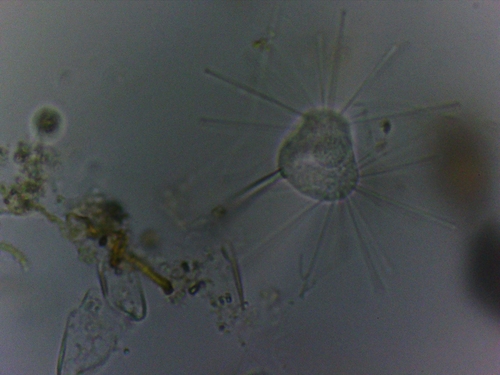
Tokophrya
Tokophrya is a genus of suctorians. An example is Tokophrya lemnarum. The genus used to belong to the family Dendrosomatidae, but now it belongs to its own family, the family Tokophryidae Jankowksi in Small & Lynn, 1985.