Category
page 1Physical activity and dexterity toys

kite
right|thumb|Various kites being flown

boomerang
thumb|An Egypt|Egyptian boomerang; [[National Archaeological Museum, Athens, Greece.]]
thumb|Australian Aboriginal boomerangs
A boomerang () is a thrown tool typically constructed with airfoil sections and designed to spin about an axis perpendicular to the direction of its flight, designed to return to the thrower. The origin of the word is from an Aboriginal Australian language of the Sydney region. Its original meaning, which is preserved in official competitions, refers only to returning objects, not to throwing sticks, which were also used for hunting by various peoples both in Australia

swing
hanging seat

marble
small, hard spherical toy

yo-yo
thumb|A plastic yo-yo
A yo-yo (also spelled yoyo) is a toy consisting of an axle connected to two disks, and a string looped around the axle, similar to a spool. It is an ancient toy documented since 440 BC. It was also called a bandalore in the 18th century.

flying disc
thumb|upright=1.35|A flying disc with the Wham-O registered trademark "Frisbee"
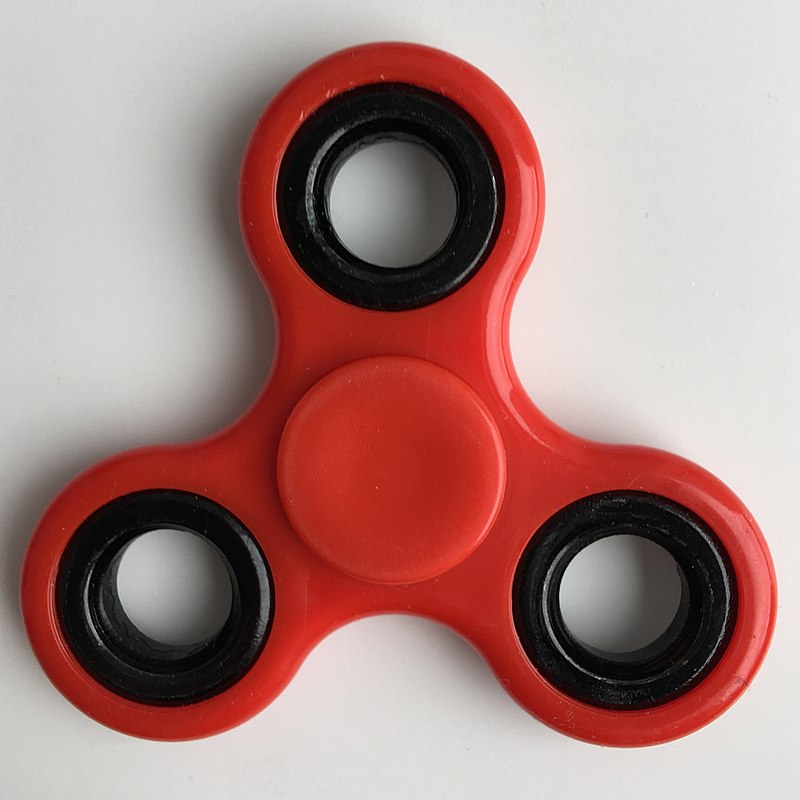
fidget spinner
spinning toy

skipping rope
game in which one or more participants jump over a swung rope

soap bubble
thin film of soapy water enclosing air

tricycle
A tricycle, sometimes abbreviated to trike, is a human-powered (or gasoline or electric motor-powered or assisted, or gravity-powered) three-wheeled vehicle.

stilts
thumb|Children of the Banna people in Ethiopia on stilts
thumb|upright|Plasterer's (drywall) stilts
thumb|upright|A French postman on stilts, early 20th century
thumb|upright|Stilts from China in late Qing dynasty
Stilts are poles, posts or pillars that allow a person or structure to stand at a height above the ground.

unicycle
A unicycle, also monocycle is a vehicle that touches the ground with only one wheel. The most common variation has a frame with a saddle, and has a pedal-driven direct-drive. A two speed hub is commercially available for faster unicycling. Unicycling is practiced professionally in circuses, by street performers, in festivals, and as a hobby. Unicycles have also been used to create new sports such as unicycle basketball and unicycle hockey. In recent years, unicycles have also been used in mountain unicycling, an activity similar to mountain biking or trials.
thumb|A unicycle
hula hoop
toy
%20-%20Knucklebones.jpg)
knucklebones
thumb|Pieter Bruegel the Elder – ''Children's Games (detail) – Knucklebones
Knucklebones, also known as scatter jacks, snobs, astragaloi (singular'': astragalus), tali, dibs, fivestones, jacks, jackstones, or jinks, among many other names, is a game of dexterity played with a number of small objects that are thrown up, caught, and manipulated in various manners. It is ancient in origin and is found in various cultures worldwide.

kendama
thumb|309x309px|Kendama
rocking horse
child's toy
pen spinning
game of skill
poi
balls swung rhythmically on strings
pogo stick
device for jumping off the ground in a standing position
fingerboard
miniature skateboard controlled by the fingers
soapbox car
motorless racing vehicle capable of holding a driver
hoop rolling
sport and a child's game
balance bike
training bicycle for children
devil sticks
set of juggling sticks
card manipulation
branch of magical illusion that deals with sleight of hand involving playing cards
Gyroscopic exercise tool
trademark
clackers
Clackers (also known as Clankers, Ker-Bangers, latto-latto in the Philippines and most of Southeast Asia, and numerous other names) are toys that were popular in the late 1960s and early 1970s.
swim ring
inflatable water toy
bouncy ball
small rubber toy ball
water ball
large inflatable sphere that allows an occupant to traverse a water surface

cardistry
thumb|An advanced two-handed flourish
Begleri
thumb|A modern set of Greek begleri.
thumb|Slinging a Begleri
Begleri (Greek: μπεγλέρι) is a small skill toy consisting of one or more beads at either end of a short string or chain. It can be flipped and twirled around the fingers to perform tricks. The begleri originated in Greece, and was originally derived from the komboloi, which serves the function of worry beads, and are often flipped around to pass the time or keep the hands busy. While komboloia have beads forming a closed circle, begleri beads are threaded on an open strand, usually in a symmetrical formation, with equal weighting at
sport stacking
sport where the player must stack plastic cups
pool noodle
cylindrical piece of buoyant polyethylene foam, sometimes hollow
bean bag
sealed bag containing dried beans or pellets
Astrojax
right|frame|Astrojax Plus
thumb|220px|A light trail from an Astrojax Saturn
Astrojax, invented in 1986 by Larry Shaw, is a toy consisting of three balls on a string. In the original version of the toy, one ball is fixed at each end of the string, and the center ball is free to slide along the string between the two end balls. Inside each ball is a metal weight. The metal weight lowers the moment of inertia of the center ball so it can rotate rapidly in response to torques applied by the string. This prevents the string from snagging or tangling around the center ball.
Perplexus
Perplexus, originally released as Superplexus, is a 3-D ball-in-a-maze puzzle or labyrinth game enclosed in a transparent plastic sphere. By twisting and turning it, players try to maneuver a small steel ball through a complex maze along narrow plastic tracks. The maze has many steps (varying across puzzles). The number of steps ranges from 30 in the Perplexus Twist to 225 in the Perplexus 3x3 Rubik's cube Hybrid. Some levels drop the ball into a cup or a small rim to utilize its 3-D nature. Players must complete obstacles varying in difficulty to reach the end.
space hopper
ball that the user sits on and while holding on to the ball's handles, bounces around.
labyrinth
game of skill
paddle ball
game
Ball-in-a-maze puzzle
dexterity puzzle involving a ball in a maze
Aerobie
thumb|An Aerobie ring
fidget toy
a product typically used for stimming