Category
page 1Placozoa

Placozoa
Placozoa ( ; ) is a phylum of free-living (non-parasitic) marine invertebrates. They are blob-like animals composed of aggregations of cells. Moving in water by ciliary motion, eating food by engulfment, and reproducing by fission or budding, placozoans are described as "the simplest animals on Earth". Structural and molecular analyses have supported them as among the most basal animals, thus constituting a primitive metazoan phylum.
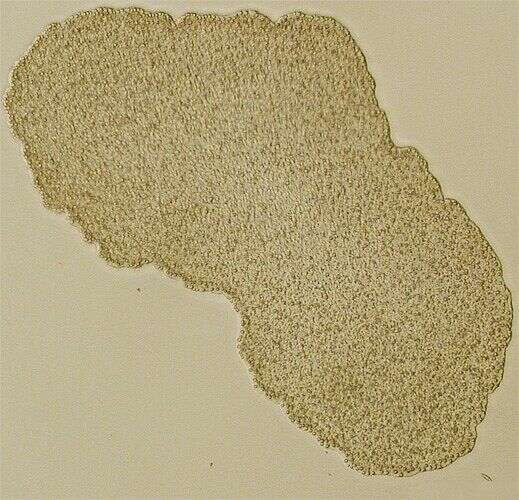
Trichoplax adhaerens
species of Placozoa
Trichoplax
Trichoplax is a genus placed in the phylum Placozoa. There are four species, named Trichoplax adhaerens, Hoilungia hongkongensis, Polyplacotoma mediterranea and Cladtertia collaboinventa. Placozoa is a basal group of multicellular animals, possible relatives of Cnidaria. Trichoplax are very flat organisms commonly less than 4 mm in diameter, lacking any organs or internal structures. They have two cellular layers: the top epitheloid layer is made of ciliated "cover cells" flattened toward the outside of the organism, and the bottom layer is made up of cylinder cells that possess cilia use
Hoilungia hongkongensis
Hoilungia is a genus that contains one of the simplest animals and belongs to the phylum Placozoa. Described in 2018, it has only one named species, H. hongkongensis, although there are possible other species. The animal superficially resembles another placozoan, Trichoplax adhaerens, but genetically distinct from it as mitochondrial DNA analysis revealed.
Trichoplacidae
REDIRECT Trichoplax