Category
page 1Planets

planet
thumb|upright=1.5|The eight planets of the Solar System with size to scale (up to down, left to right): [[Saturn, Jupiter, Uranus, Neptune (outer planets), Earth, Venus, Mars, and Mercury (inner planets)]]
A planet is a large, rounded astronomical body that is generally required to be in orbit around a star, stellar remnant, or brown dwarf, and is not one itself. The Solar System has eight planets by the most restrictive definition of the term: the terrestrial planets Mercury, Venus, Earth, and Mars, and the giant planets Jupiter, Saturn, Uranus, and Neptune. The best available theory of plane

planetesimal
thumb|300px|right|Debris disks detected in HST archival images of young stars, HD 141943 and HD 191089, using improved imaging processes (24 April 2014).
thumb|486958 Arrokoth, the first pristine planetesimal visited by a spacecraft.

Titius–Bode law
discredited hypothesis about Solar System planets' orbits
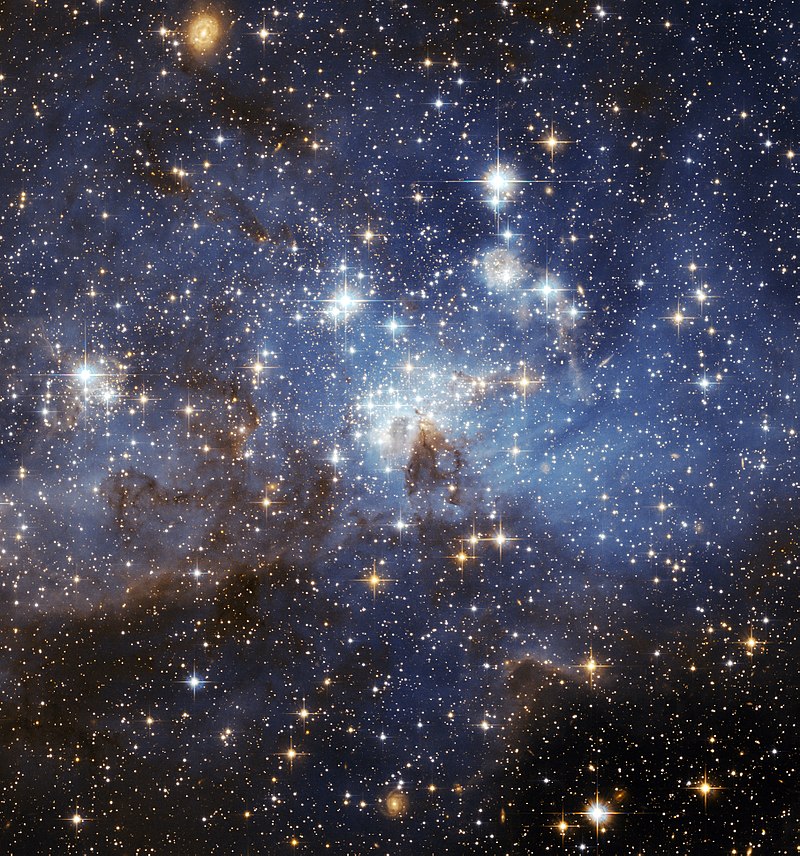
nebular hypothesis
astronomical theory that the Solar System formed from nebulous material
planetary-mass object
any celestial object massive enough to achieve hydrostatic equilibrium, but not enough to sustain core fusion like a star
definition of planet
history and evolution of the term planet
IAU definition of planet
definition of a planet as a body orbiting the Sun, in hydrostatic equilibrium, having cleared the neighborhood around its orbit; ratified by the IAU in August 2006, thereby reclassifying Pluto as a dwarf planet instead
substellar object
astronomical object with insufficient mass to sustain nuclear fusion
equatorial bulge
outward bulge around a planet's equator due to its rotation
list of planet types
Wikimedia list article
Habitability in yellow dwarf systems
area of study
planetary-mass moon
moons comparable in size to small planets