Category
page 1Plant cells

xylem
thumb|323x323px|Xylem (blue) transports water and minerals from the roots upwards.|alt=

stomata
thumb|Stoma in a tomato leaf shown via colorized [[scanning electron microscope image]]
thumb|A stoma in horizontal cross section
thumb|The underside of a leaf. In this species (Tradescantia zebrina), the guard cells of the stomata are green because they contain chlorophyll while the epidermal cells are chlorophyll-free and contain red pigments.

plant cell
eukaryotic cell present in green plants
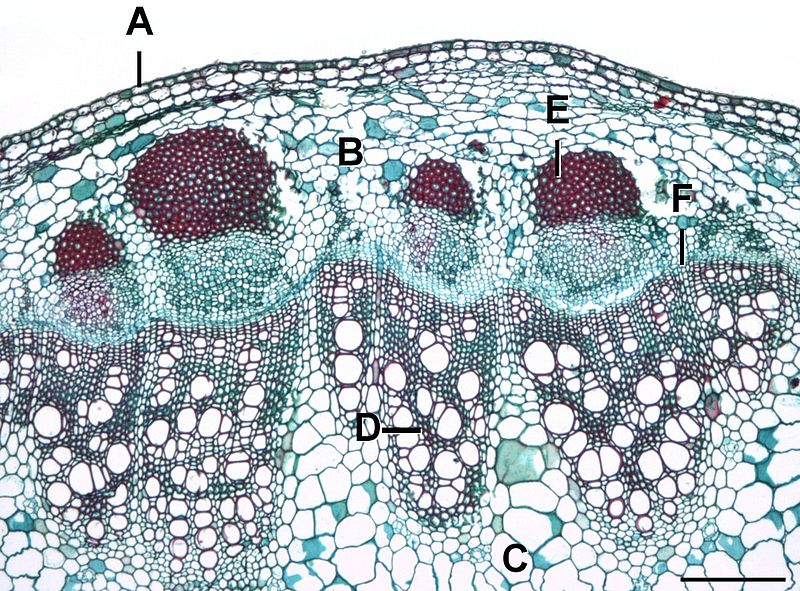
vascular cambium
part of a plant

leucoplast
thumb|250px|Leucoplasts, specifically, amyloplasts
Leucoplasts ("formed, molded") are a category of plastid and as such are organelles found in plant cells. They are non-pigmented, in contrast to other plastids such as the chloroplast.
amyloplast
right|thumb|Amyloplasts in a potato cellAmyloplasts are a type of plastid, double-enveloped organelles in plant cells that are involved in various biological pathways. Amyloplasts are specifically a type of leucoplast, a subcategory for colorless, non-pigment-containing plastids. Amyloplasts are found in roots and storage tissues, and they store and synthesize starch for the plant through the polymerization of glucose. Starch synthesis relies on the transportation of carbon from the cytosol, the mechanism by which is currently under debate.

aerenchyma
thumb|alt=Aerenchyma of Schoenoplectus tabernaemontani|Aerenchyma in stem cross section of a typical wetland plant
Aerenchyma or aeriferous parenchyma or lacunae is a modification of the parenchyma to form a spongy tissue that creates spaces or air channels in the leaves, stems, and roots of some plants, which allows the exchange of gases between the shoot and the root. The channels of air-filled cavities (see image to right) provide a low-resistance internal pathway for the exchange of gases such as oxygen, carbon dioxide, and ethylene between the plant above the water and the submerged tissu
ground tissue
ground tissue is one of three main tissue systems: protective, ground, and vascular, each tissue system has a different role and functionality inside plant tissues

elaioplast
right|thumb|220px|The differentiation of Elaioplasts
thumb|right|Illustration from Collegiate Dictionary, FA Brockhaus and IA Efron, circa 1905. Cell of very young leaf of Vanilla planifolia; E - elaioplasts; Л - the nucleus; Я - leucoplasts; B - vacuoles

sclereid
thumb|Fresh mount of a sclereid in a banana fruit
Sclereids are a reduced form of sclerenchyma cells with highly thickened, lignified cellular walls that form small bundles of durable layers of tissue in most plants. The presence of numerous sclereids form the cores of apples and produce the gritty texture of guavas.

phragmoplast
thumb|300px|Phragmoplast and cell plate formation in a plant cell during cytokinesis. Left side: Phragmoplast forms and cell plate starts to assemble in the center of the cell. Towards the right: Phragmoplast enlarges in a donut-shape towards the outside of the cell, leaving behind mature cell plate in the center. The cell plate will transform into the new cell wall once cytokinesis is complete.
palisade cell
type of cell found in plant leaf just below the epidermis

Statocyte
thumb|Root tip: 1. meristem 2. columella (statocytes with statoliths at the bottom of the cell) 3. side of the [[root cap 4. dead cells 5. cell elongation zone. Optical microscope 100x]] thumb|Statocyte: 1.cell wall 2.[[endoplasmic reticulum 3.plasmodesma 4.cell nucleus 5.mitochondrion 6.cytoplasm 7.statolith 8.root 9.columella 10.statocyte]] Statocytes are gravity-sensing (gravitropic) cells in higher plants. They contain amyloplasts-statoliths – starch-filled amyloplastic organelles – which sediment at the lowest part of the cells. In the roots, sedimentation of the statoliths towards the lo
Tannosome
Tannosomes are organelles found in plant cells of vascular plants.
guard cell
one of a pair of crescent-shaped cells that surround a plant's stoma; changes in the turgidity of the cells cause the opening and closing of the stoma.
Embryonic sac
term in biology
Phragmosome
thumb|Phragmosome formation in a highly vacuolated plant cell. From top to bottom: 1) Interphase cell with large central vacuole. 2) Cytoplasmic strands starting to penetrate vacuole. 3) Nucleus migration into center and formation of the phragmosome. 4) Phragmosome formation completed and formation of preprophase band marking future cell division plane.
Bulliform cell
Plant cell type
cell plate
nascent cell membrane and cell wall structure that forms between two daughter nuclei near the center of a dividing plant cell
preprophase band
dense band of microtubules, 1-3 pm wide, that appears just beneath the cell membrane before the start of cell division in the cells of higher plants. It precedes the onset of prophase and then disappears as mitosis begins, yet it somehow determines
Phycoplast
thumb|Schematic representation of types of cytokinesis in the green algae: 1) Phycoplast formation with cleavage furrow (e.g. Chlamydomonas); 2) Cleavage furrow and persistent telophase spindle (e.g. Klebsormidium); 3) Phycoplast and cell plate formation (e.g. Fritschiella); 4) Persistent telophase spindle/phragmoplast with cell plate formation (e.g. [[Coleochaete)]]
Preprophase
350px|right|thumb|Microtubule dynamics during preprophase and prophase in plant cell mitosis, modified from Donukshe et al. The images follow a Tobacco BY-2 cells|tobacco BY-2 cell through the first stages of mitosis (c. 12 minutes). The growing ends of microtubules are shown in green (labeled with [[green fluorescent protein fused to the microtubule plus end binding protein EB1 of Arabidopsis thaliana). N = Nucleus, V = Vacuole, PPB = Preprophase band, MTN = Microtubule nucleation starts at the nuclear envelope, NEB = Nuclear envelope breakdown at the onset of prometaphase. Also see the movie
Acid growth
plant cell ability to expand quickly at low pH
Oleosin
Oleosins are structural proteins found in vascular plant oil bodies and in plant cells. Oil bodies are not considered organelles because they have a single layer membrane and lack the pre-requisite double layer membrane in order to be considered an organelle. They are found in plant parts with high oil content that undergo extreme desiccation as part of their maturation process, and help stabilize the bodies.