Category
page 1Pleistocene Artiodactyla
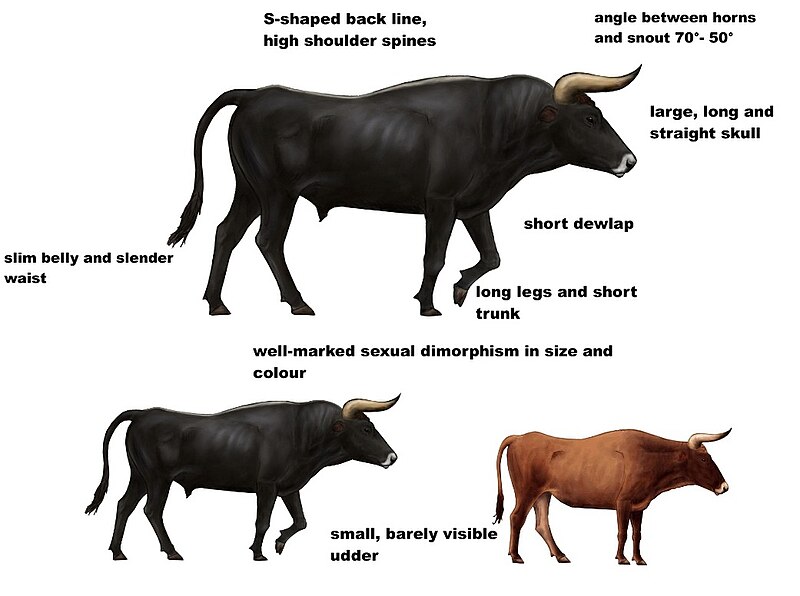
aurochs
The aurochs (Bos primigenius; or ; pl.: aurochs or aurochsen; also ure or urus) is an extinct species of bovine, considered to be the wild ancestor of modern domestic cattle. With a shoulder height of up to in bulls and in cows, it was one of the largest herbivores in the Holocene; it had massive elongated and broad horns that reached in length.

Megaloceros giganteus
extinct species of cervid (deer)

Sivatherium
Sivatherium ("Shiva's beast", from Shiva and therium, Latinized form of Ancient Greek θηρίον - thēríon) is an extinct genus of giraffid that ranged throughout Africa and Eurasia. The species Sivatherium giganteum is, by weight, one of the largest giraffids known, and also one of the largest ruminants of all time. Sivatherium originated during the Late Miocene (around 7 million years ago) in Africa and survived through to the late Early Pleistocene (Calabrian) until around 1 million years ago.

Camelops
Camelops is an extinct genus of camel that lived in North and Central America from the middle Pliocene (from around 4-3.2 million years ago) to the end of the Pleistocene (around 13-12,000 years ago). It is more closely related to living camels than to lamines (llamas, alpacas, vicuñas, and guanacos), making it a true camel of the Camelini tribe. Its name is derived from the Ancient Greek (, "camel") and (, "face"), i.e. "camel-face". Camelops lived across Western North America, ranging from the Pacific Coast to the Great Plains, southwards to Honduras and northwards to Alaska. Camelops became

Megaloceros
Megaloceros (from Greek: + , literally "Great Horn"; see also Lister (1987)) is an extinct genus of deer whose members lived throughout Eurasia from the Pleistocene to the early Holocene. The type and only undisputed member of the genus, Megaloceros giganteus, vernacularly known as the "Irish elk" or "giant deer", is also the best known. Fallow deer are thought to be their closest living relatives. Megaloceros has been suggested to be closely related to other genera of "giant deer", like the East Asian genus Sinomegaceros and the largely European Praemegaceros, the species of both genera havin
Hippopotamus gorgops
species of mammal (fossil)

Hexaprotodon
Hexaprotodon is an extinct genus of hippopotamid known from Asia and possibly Africa and Europe. The genus name Hexaprotodon comes from Ancient Greek ἑξα- (hexa-), meaning "six", πρῶτος (prôtos), meaning "first", and ὀδούς (odoús), meaning "tooth", therefore, "six front-teeth" as some of the fossil forms have three pairs of incisors. The pygmy hippopotamus was historically placed in the genus, but today is generally placed in its own genus. The core Asian members of the genus ranged from the Indian subcontinent to Southeast Asia, and are thought to have had an aquatic ecology similar to that o
Hippopotamus antiquus
species of mammal (fossil)
Bison latifrons
species of mammal (fossil)
Bison antiquus
species of mammal (fossil)
Cyprus dwarf hippopotamus
species of mammal (fossil)
Hippopotamus creutzburgi
species of mammal (fossil)

Metridiochoerus
Metridiochoerus is an extinct genus of swine known from the Pliocene and Pleistocene of Africa. It is also known as the giant warthog.

Pelorovis
Pelorovis is an extinct genus of African wild cattle which existed during the Pleistocene epoch. Originally believed to be a giant member of Caprinae, related to modern sheep, it is now known to be a relative of cattle and buffalos. The best known and type species is Pelorovis oldowayensis, from the Early Pleistocene of Olduvai Gorge, Tanzania, though two others, P. turkanensis and P. howelli, are currently recognised. A fourth, P. praeafricanus, may exist, or it may represent the same species as P. oldowayensis. "Pelorovis" antiquus, from the Late Pleistocene-Holocene, and "P." kaisensis, hav
Hippopotamus pentlandi
species of mammal (fossil)
Hippopotamus melitensis
species of mammal (fossil)
Titanotylopus
Titanotylopus is an extinct genus of camel (tribe Camelini), endemic to North America from the late Hemphillian stage of the Miocene through the Irvingtonian stage of the Pleistocene. It was one of the last surviving North American camels; after its extinction, only Camelops remained.
Camelini
Camelini is a tribe of camelids including all camelids more closely related to modern camels (Camelus) than to Lamini (which contains llamas, alpacas, vicuñas, and guanacos), from which camelines split approximately 17 million years ago. The tribe originated in North America, with the genus Paracamelus migrating over the Bering Land Bridge into Eurasia during the Late Miocene, around 6 million years ago, becoming ancestral to Camelus. The last member of Camelini in North America was Camelops, which became extinct as part of the Quaternary extinction event at the end of the Late Pleistocene, ar

Platygonus
Platygonus ("flat head" in reference to the straight shape of the forehead) is an extinct genus of herbivorous peccaries of the family Tayassuidae, endemic to North and South America from the Miocene through Pleistocene epochs (10.3 million to 11,000 years ago), existing for about . P. compressus stood tall.
Cervalces
Cervalces is an extinct deer genus that lived during the Pliocene and Pleistocene epochs. Cervalces gallicus is either classified as a species of the related Libralces, or an ancestral species to other members of Cervalces. It lived in Europe from the Pliocene to the Pleistocene. Cervalces scotti, the stag-moose, lived in Pleistocene North America. Cervalces latifrons, the broad-fronted moose, and Cervalces carnutorum were found in Pleistocene Europe and Asia. The genus has been suggested to be paraphyletic and ancestral with respect to Alces, the genus which contains the modern moose, and as
Giraffa jumae
species of mammal (fossil)
Bison occidentalis
species of mammal (fossil)

Kolpochoerus
Kolpochoerus is an extinct genus of the pig family Suidae related to the modern-day genera Hylochoerus, Phacochoerus, and Potamochoerus. It is believed that most of them inhabited African forests, as opposed to the bushpig and red river hog that inhabit open brush and savannas. There are currently eleven recognized species.
Bubalus mephistopheles
species of mammal (fossil)

Bubalus cebuensis
species of mammal of the family Bovidae
Euceratherium
Euceratherium, also called the shrubox, is an extinct genus of ovibovine caprine known from the Pleistocene of North America and China. Two species have been proposed: the type species Euceratherium collinum named in 1904, and a second species Euceratherium bizzelli, named in 1937. Some researchers have expressed that the differences between these species may actually be individual variation, or variation within a single species.

Leptobos
Leptobos is an extinct genus of large bovines, known from the Late Pliocene and Early Pleistocene of Eurasia, extending from the Iberian Peninsula and Britain to the Indian subcontent and northern China. It is widely posited to be the ancestor of bison.
Paracamelus
Paracamelus is an extinct genus of camel in the family Camelidae. It originated in North America and crossed the Beringian land bridge into Eurasia during the Late Miocene, about 6 million years ago (Ma). It is the presumed ancestor to living camels of the genus Camelus.

Palaeolama
Palaeolama () is an extinct genus of lamine camelids that existed from the Pleistocene to the Holocene (). Their range extended from North America to the intertropical region of South America.

Mylohyus
Mylohyus is an extinct genus of peccary found in North and Central America. It first evolved during the Late Miocene and became extinct at the end of the Pleistocene, around 12,000 years ago, during the Late Pleistocene megafaunal extinction.
Capromeryx minor
species of mammal (fossil)
Megalotragus
Megalotragus (from Greek mega (μέγα) 'great' and tragos (τράγος) 'goat') is an extinct genus of very large African alcelaphines that lived from the Pliocene to early Holocene. Its skull resembled that of modern hartebeests, but it differed in having a larger body size and wildebeest-like proportions. Megalotragus includes some of the largest bovid species in the subfamily Alcelaphinae, reaching a shoulder height of . The genus consists of three species of which Megalotragus priscus survived until the early Holocene 7.500 C14yBP.
Hemiauchenia
Hemiauchenia is an extinct genus of lamine camelids that evolved in North America in the Miocene epoch about 10 million years ago. This genus diversified and entered South America in the Late Pliocene about three to two million years ago, as part of the Great American Biotic Interchange. The genus became extinct at the end of the Pleistocene. The monophyly of the genus has been considered questionable, with phylogenetic analyses finding the genus to paraphyletic or polyphyletic, with some species suggested to be more closely related to living lamines (llamas and relatives) than to other Hemiau
Candiacervus
Candiacervus is an extinct genus of deer native to Pleistocene Crete. Due to a lack of other herbivores, the genus underwent an adaptive radiation, filling niches occupied by other taxa on the mainland. Due to the small size of Crete, some species underwent insular dwarfism, the smallest species, C. ropalophorus, stood about at the shoulders when fully grown, while other species were relatively large and comparable in size to mainland deer species. Some species (C. ropalophorus) are noted for their peculiar, elongate club-shaped antlers, though other species have more normal antlers.
Bos acutifrons
species of mammal (fossil)
Soergelia
Soergelia is a genus of extinct ovibovine caprine that was common across Europe, North America and Asia in the Pleistocene epoch.
Celebochoerus
Celebochoerus is an extinct genus of giant suid artiodactyl that existed during the Pliocene and Pleistocene in Sulawesi, Indonesia (Celebochoerus heekereni), and the middle Pleistocene of Luzon, in the Philippines (Celebochoerus cagayanensis).
Sus strozzi
species of mammal (fossil)
Hayoceros
Hayoceros is an extinct genus of the artiodactyl family Antilocapridae, endemic to North America during the Pleistocene epoch (1.8 mya—300,000 years ago), existing for about 1.5 million years.

Cervalces scotti
extinct species of deer (Cervidae)
Gazella borbonica
species of mammal
Antifer
Antifer is an extinct genus of large herbivorous deer belonging to the tribe Odocoileini native to South America during the Pleistocene, becoming extinct around 12,000 years ago. It was one of the largest South American deer genera, with an estimated body mass of up to , comparable to red deer, considerably exceeding the marsh deer, the largest living South American deer species in size. The genus has large antlers that could reach a length of over .
Harrington's mountain goat
species of mammal (fossil)
Eulamaops parallelus
Eulamaops is an extinct genus of camelid belonging to the tribe Lamini, endemic to South America during the Pleistocene (Lujanian, 781,000—12,000 years ago), existing about . Fossil remains of Eulamaops have been found in the Luján Formation in Argentina in areas that would have been open grass and shrub land. It is estimated to have weighed 150 kilograms
Bos palaesondaicus
species of mammal
Morenelaphus
Morenelaphus is an extinct genus of capreoline deer that lived in South America during the Pleistocene, ranging from the Pampas to southern Bolivia and Northeast Brazil. There is only a single recognised species, Morenelaphus brachyceros. It was a large deer, with some specimens estimated to exceed 200 kilograms in body mass. The antlers were over 70 cm in length, and are superficially similar those of deer belonging to the subfamily Cervinae, like red deer. Fossils of the genus have been recovered from the Agua Blanca, Fortín Tres Pozos and Luján Formations of Argentina, the Ñuapua Formation
Damalops
Damalops is an extinct genus of alcelaphine antelope. It lived during the Pliocene and Pleistocene in southern Asia, where the species Damalops palaeindicus is known from the Siwaliks in the northern part of the Indian Subcontinent.
thumb|left|Skull
Odocoileus lucasi
species of mammal
Makapania
Makapania is an extinct genus of large caprine or ovibovine from the Pliocene and Pleistocene of southern and East Africa. It is remarkable in that its horns were positioned laterally. Its body weight is estimated to have been about 263 kg.
Cervus astylodon
species of mammal (fossil)
Syncerus antiquus
extinct species of buffalo
Sivacobus
Sivacobus is an extinct genus of antelope that lived in South Asia during the Plio-Pleistocene.
Long-nosed peccary
extinct species of mammal
Parmularius
Parmularius is a genus of large extinct African alcelaphines from the Pliocene and Pleistocene. It is a close relative of topi and hartebeest. One species is noticeable by its long, weakly curved horns.
Bootherium
Bootherium (Greek: "ox" (boos), "beast" (therion)) is an extinct bovid genus from the Middle to Late Pleistocene of North America which contains a single species, Bootherium bombifrons. Vernacular names for Bootherium include '''Harlan's muskox, woodox, woodland muskox, helmeted muskox, or bonnet-headed muskox'''.
Giraffa sivalensis
species of mammal
Bubalus teilhardi
species of mammal (fossil)
Syncerus acoelotus
extinct species of buffalo
Haploidoceros
Haploidoceros is an extinct genus of deer that lived in Europe from the late Middle Pleistocene to early Late Pleistocene. It contains a single species, '''Haploidoceros mediterraneus.''' It had a distribution limited to southern France and the Iberian Peninsula.
Giraffa pygmaea
species of mammal (fossil)