Category
page 1Pliocene Artiodactyla
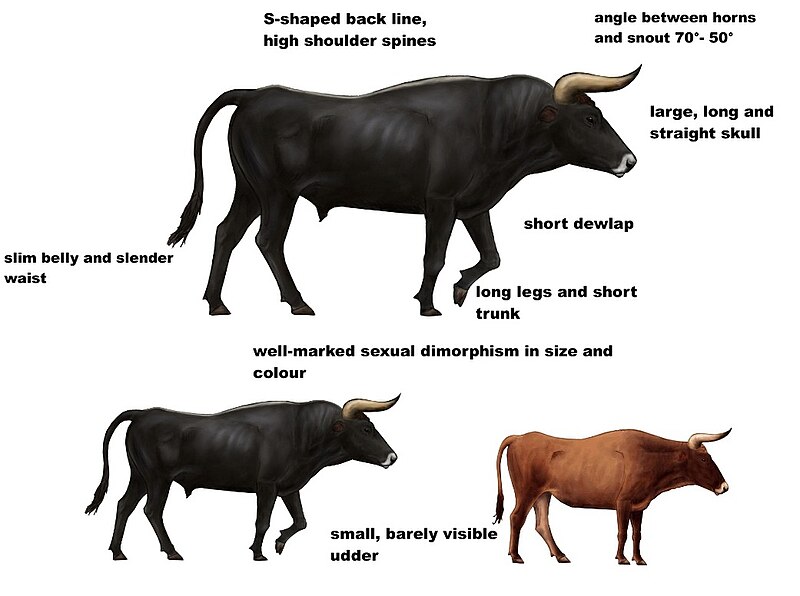
aurochs
The aurochs (Bos primigenius; or ; pl.: aurochs or aurochsen; also ure or urus) is an extinct species of bovine, considered to be the wild ancestor of modern domestic cattle. With a shoulder height of up to in bulls and in cows, it was one of the largest herbivores in the Holocene; it had massive elongated and broad horns that reached in length.

Sivatherium
Sivatherium ("Shiva's beast", from Shiva and therium, Latinized form of Ancient Greek θηρίον - thēríon) is an extinct genus of giraffid that ranged throughout Africa and Eurasia. The species Sivatherium giganteum is, by weight, one of the largest giraffids known, and also one of the largest ruminants of all time. Sivatherium originated during the Late Miocene (around 7 million years ago) in Africa and survived through to the late Early Pleistocene (Calabrian) until around 1 million years ago.

Camelops
Camelops is an extinct genus of camel that lived in North and Central America from the middle Pliocene (from around 4-3.2 million years ago) to the end of the Pleistocene (around 13-12,000 years ago). It is more closely related to living camels than to lamines (llamas, alpacas, vicuñas, and guanacos), making it a true camel of the Camelini tribe. Its name is derived from the Ancient Greek (, "camel") and (, "face"), i.e. "camel-face". Camelops lived across Western North America, ranging from the Pacific Coast to the Great Plains, southwards to Honduras and northwards to Alaska. Camelops became

Odobenocetops
Odobenocetops () is an extinct genus of small toothed whale known from Chile and Peru. Its fossils are found in Miocene-aged marine strata of the Bahía Inglesa Formation and Pisco Formation. Two species of Odobenocetops are currently recognized, O. peruvianus and the slightly younger O. leptodon.
Hippopotamus gorgops
species of mammal (fossil)

Samotherium
Samotherium ("beast of Samos") is an extinct genus belonging to the family Giraffidae from the Miocene and Pliocene of Eurasia and Africa. Samotherium had two ossicones on its head and possessed long legs. The ossicones usually pointed upward, and were curved backwards, with males having larger, more curved ossicones, though in the Chinese species, S. sinense, the straight ossicones point laterally, not upwards. The genus is closely related to Shansitherium. Fossil evidence suggests that Samotherium had a rounded muzzle, which would suggest a grazing lifestyle and a habitat composed of grassla
Protoceratidae
Protoceratidae is an extinct family of herbivorous North American artiodactyls (even-toed ungulates) that lived during the Eocene through Pliocene. While early members of the group were hornless, in later members males developed elaborate cranial ornamentation. They are variously allied with Ruminantia or Tylopoda.

Metridiochoerus
Metridiochoerus is an extinct genus of swine known from the Pliocene and Pleistocene of Africa. It is also known as the giant warthog.
Titanotylopus
Titanotylopus is an extinct genus of camel (tribe Camelini), endemic to North America from the late Hemphillian stage of the Miocene through the Irvingtonian stage of the Pleistocene. It was one of the last surviving North American camels; after its extinction, only Camelops remained.

Bramatherium
Bramatherium (Brahma’s beast) is an extinct genus of giraffids that ranged from India to Turkey in Asia. It is closely related to the larger Sivatherium.

Platygonus
Platygonus ("flat head" in reference to the straight shape of the forehead) is an extinct genus of herbivorous peccaries of the family Tayassuidae, endemic to North and South America from the Miocene through Pleistocene epochs (10.3 million to 11,000 years ago), existing for about . P. compressus stood tall.
Camelini
Camelini is a tribe of camelids including all camelids more closely related to modern camels (Camelus) than to Lamini (which contains llamas, alpacas, vicuñas, and guanacos), from which camelines split approximately 17 million years ago. The tribe originated in North America, with the genus Paracamelus migrating over the Bering Land Bridge into Eurasia during the Late Miocene, around 6 million years ago, becoming ancestral to Camelus. The last member of Camelini in North America was Camelops, which became extinct as part of the Quaternary extinction event at the end of the Late Pleistocene, ar
Cervalces
Cervalces is an extinct deer genus that lived during the Pliocene and Pleistocene epochs. Cervalces gallicus is either classified as a species of the related Libralces, or an ancestral species to other members of Cervalces. It lived in Europe from the Pliocene to the Pleistocene. Cervalces scotti, the stag-moose, lived in Pleistocene North America. Cervalces latifrons, the broad-fronted moose, and Cervalces carnutorum were found in Pleistocene Europe and Asia. The genus has been suggested to be paraphyletic and ancestral with respect to Alces, the genus which contains the modern moose, and as

Kolpochoerus
Kolpochoerus is an extinct genus of the pig family Suidae related to the modern-day genera Hylochoerus, Phacochoerus, and Potamochoerus. It is believed that most of them inhabited African forests, as opposed to the bushpig and red river hog that inhabit open brush and savannas. There are currently eleven recognized species.
Paracamelus
Paracamelus is an extinct genus of camel in the family Camelidae. It originated in North America and crossed the Beringian land bridge into Eurasia during the Late Miocene, about 6 million years ago (Ma). It is the presumed ancestor to living camels of the genus Camelus.

Archaeopotamus
thumb | right | Archaeopotamus
Archaeopotamus is an extinct genus of Hippopotamidae that lived between 7.5 and 2.58 million years ago in Africa and the Middle East. The genus was described in 2005 to encompass species of hippos that were previously grouped in Hexaprotodon.

Hoplitomeryx
Hoplitomeryx is a genus of extinct deer-like ruminants which lived on the former Gargano Island during the Miocene and the Early Pliocene, now a peninsula on the east coast of Southern Italy. Hoplitomeryx, also known as "prongdeer", had five horns and sabre-like upper canines similar to a modern musk deer.
Merycopotamus
Merycopotamus is an extinct genus of Asian anthracothere that appeared during the Middle Miocene, and died out in the Late Pliocene. At the height of the genus' influence, species ranged throughout South Asia and South East Asia (Indonesia, Myanmar, and Thailand). With the extinction of the last species, M. dissimilis, the lineage of anthracotheres came to an end. Merycopotamus was closely related to the anthracothere genus Libycosaurus, which, unlike the former, never left Africa. In fact, some African fossils originally placed in Merycopotamus, but are now referred to Libycosaurus.

Mylohyus
Mylohyus is an extinct genus of peccary found in North and Central America. It first evolved during the Late Miocene and became extinct at the end of the Pleistocene, around 12,000 years ago, during the Late Pleistocene megafaunal extinction.
Sus strozzi
species of mammal (fossil)
Celebochoerus
Celebochoerus is an extinct genus of giant suid artiodactyl that existed during the Pliocene and Pleistocene in Sulawesi, Indonesia (Celebochoerus heekereni), and the middle Pleistocene of Luzon, in the Philippines (Celebochoerus cagayanensis).
Megalotragus
Megalotragus (from Greek mega (μέγα) 'great' and tragos (τράγος) 'goat') is an extinct genus of very large African alcelaphines that lived from the Pliocene to early Holocene. Its skull resembled that of modern hartebeests, but it differed in having a larger body size and wildebeest-like proportions. Megalotragus includes some of the largest bovid species in the subfamily Alcelaphinae, reaching a shoulder height of . The genus consists of three species of which Megalotragus priscus survived until the early Holocene 7.500 C14yBP.
Aepyceros datoadeni
extinct species of antelopes
Megacamelus
Megacamelus is an extinct genus of terrestrial herbivore in the family Camelidae, endemic to North America from the Miocene through Pliocene 10.3—4.9 mya, existing for approximately .
Megatylopus
Megatylopus (also known as the North American camel) is an extinct genus of large camel, endemic to North America from the Late Miocene to the Pliocene, existing for approximately . Fossil distribution ranged from North Carolina to California. It stood about tall.
Mitilanotherium
Mitilanotherium is an extinct genus of giraffes from the Pliocene and Pleistocene of Europe.
Antifer
Antifer is an extinct genus of large herbivorous deer belonging to the tribe Odocoileini native to South America during the Pleistocene, becoming extinct around 12,000 years ago. It was one of the largest South American deer genera, with an estimated body mass of up to , comparable to red deer, considerably exceeding the marsh deer, the largest living South American deer species in size. The genus has large antlers that could reach a length of over .
Damalops
Damalops is an extinct genus of alcelaphine antelope. It lived during the Pliocene and Pleistocene in southern Asia, where the species Damalops palaeindicus is known from the Siwaliks in the northern part of the Indian Subcontinent.
thumb|left|Skull
Hippohyus
Hippohyus is an extinct genus of pig-like animals that lived during the Pliocene in India.
Kyptoceras amatorum
Kyptoceras was a small extinct artiodactyl ungulate mammal of the family Protoceratidae, endemic to southeastern North America from the Miocene to Early Pliocene epoch 23.03—3.6 Ma, existing for approximately . The species name, amatorum, comes in honor of all amateur fossil collectors, including Frank Garcia (Ruskin, Florida) the amateur who found it and donated it to the Florida Museum of Natural History.
Makapania
Makapania is an extinct genus of large caprine or ovibovine from the Pliocene and Pleistocene of southern and East Africa. It is remarkable in that its horns were positioned laterally. Its body weight is estimated to have been about 263 kg.
Giraffa pygmaea
species of mammal (fossil)
Sivacobus
Sivacobus is an extinct genus of antelope that lived in South Asia during the Plio-Pleistocene.
Notochoerus
Notochoerus is an extinct genus of very large pigs from the subfamily Tetraconodontinae. Fossils have been found in Africa, notably Uganda and Ethiopia.
Propotamochoerus
Propotamochoerus is an extinct genus of pig-like animals that lived from the Miocene to the Pliocene of Algeria, India, Moldova, China, Russia, Ukraine, Georgia, Greece, Hungary, Myanmar, Thailand, Tunisia and Pakistan.
Parmularius
Parmularius is a genus of large extinct African alcelaphines from the Pliocene and Pleistocene. It is a close relative of topi and hartebeest. One species is noticeable by its long, weakly curved horns.
Syncerus acoelotus
extinct species of buffalo
Croizetoceros
Croizetoceros is an extinct genus of deer which lived throughout much of Europe, first appearing during the last stages of the Miocene and living until the Early Pleistocene.
Libralces
Libralces was a dubious genus of Eurasian deer that lived during the Pliocene epoch. It is notable for its 2+ meter wide antlers, comparable in size to those of Megaloceros.
Cranioceras
Cranioceras is an extinct genus of artiodactyl from the Miocene to the Pliocene in the United States.
Giraffa sivalensis
species of mammal