Category
page 1Podocarpaceae genera

Podocarpus
Podocarpus () is a genus of conifers, the most numerous and widely distributed of the podocarp family, the Podocarpaceae. Podocarpus species are evergreen shrubs or trees, usually from tall, known to reach at times. The cones have two to five fused cone scales, which form a fleshy, berry-like, brightly coloured receptacle at maturity. The fleshy cones attract birds, which then eat the cones and disperse the seeds in their droppings. Plants of the World Online accepts 116 species. Other authorities place 97 to 107 species in the genus depending on the circumscription of the species.

Dacrydium
Dacrydium is a genus of conifers belonging to the podocarp family Podocarpaceae. Sixteen species of evergreen dioecious trees and shrubs are presently recognized. The genus was first described by Solander in 1786, and formerly included many more species, which were divided into sections A, B, and C by Florin in 1931. The revisions of de Laubenfels and Quinn (see references), reclassified the former section A as the new genus Falcatifolium, divided Section C into new genera Lepidothamnus, Lagarostrobos and Halocarpus, and retained Section B as genus Dacrydium.
%20-%20UC%20Santa%20Cruz%20Arboretum%20-%20DSC07551.JPG)
Phyllocladus
Phyllocladus, the celery pines, is a small genus of conifers, now usually placed in the family Podocarpaceae. Species occur mainly in New Zealand, Tasmania, and Malesia in the Southern Hemisphere, though P. hypophyllus ranges into the Philippines, a short way north of the equator.

Afrocarpus
Afrocarpus is a genus of conifer of the family Podocarpaceae. Five species are recognized. They are evergreen trees native to Africa. Afrocarpus was designated a genus in 1989, when several species formerly classified in Podocarpus and Nageia were reclassified.
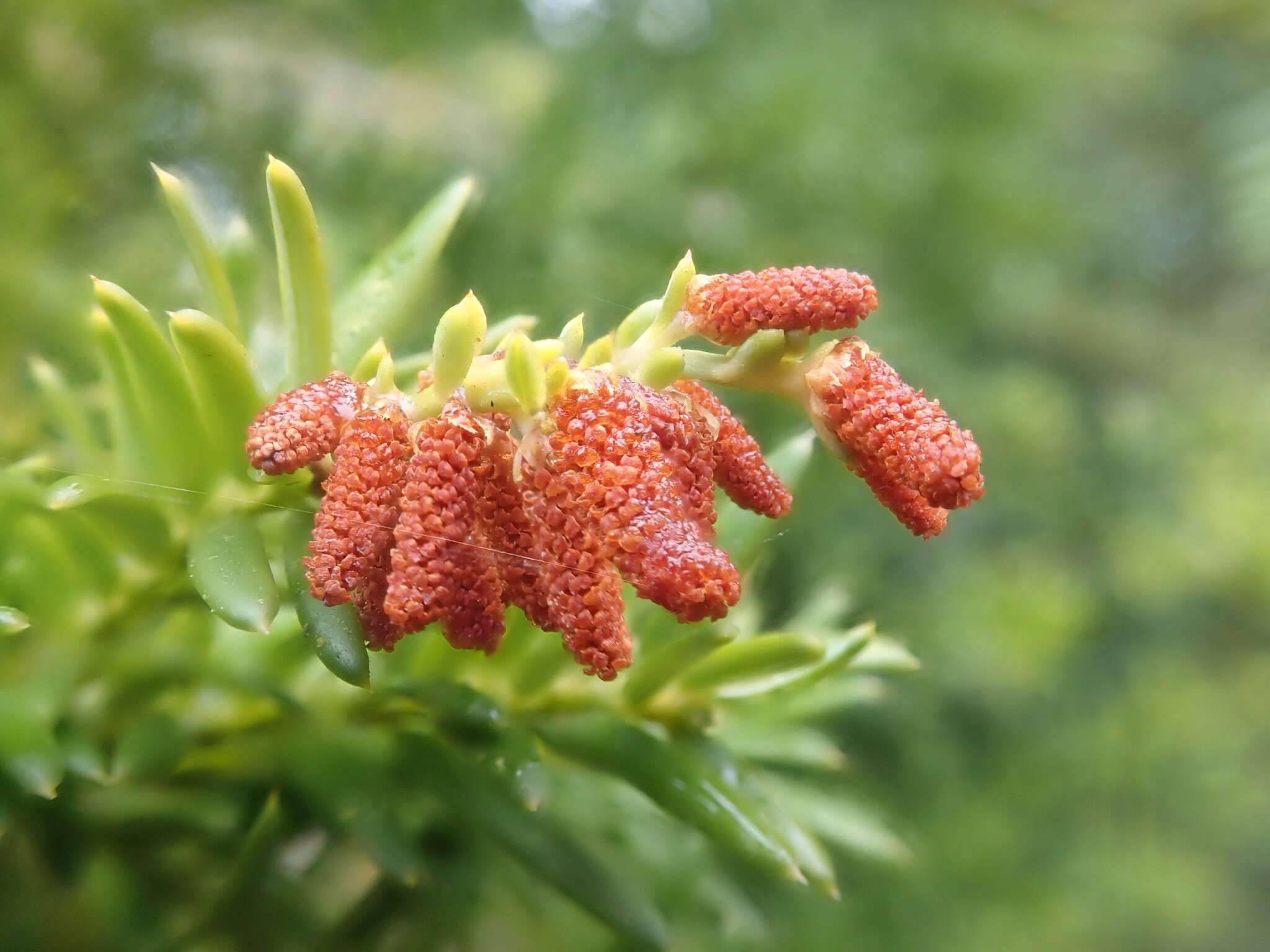
Saxegothaea conspicua
Saxegothaea is a genus comprising a single species, Saxegothaea conspicua. It is a conifer in the podocarp family Podocarpaceae, native to southern South America. It grows in Chile and Argentina from 35° to 46° South latitude; in its northernmost natural distribution it grows between 800 and 1000 (2600–3300 ft) m above sea level and in the south it lives at sea level. The species is most often known by its genus name, or sometimes as female maniu (a translation of its name in Spanish) and '''Prince Albert's yew; in South America it is known as mañío hembra or maniú hembra'''.
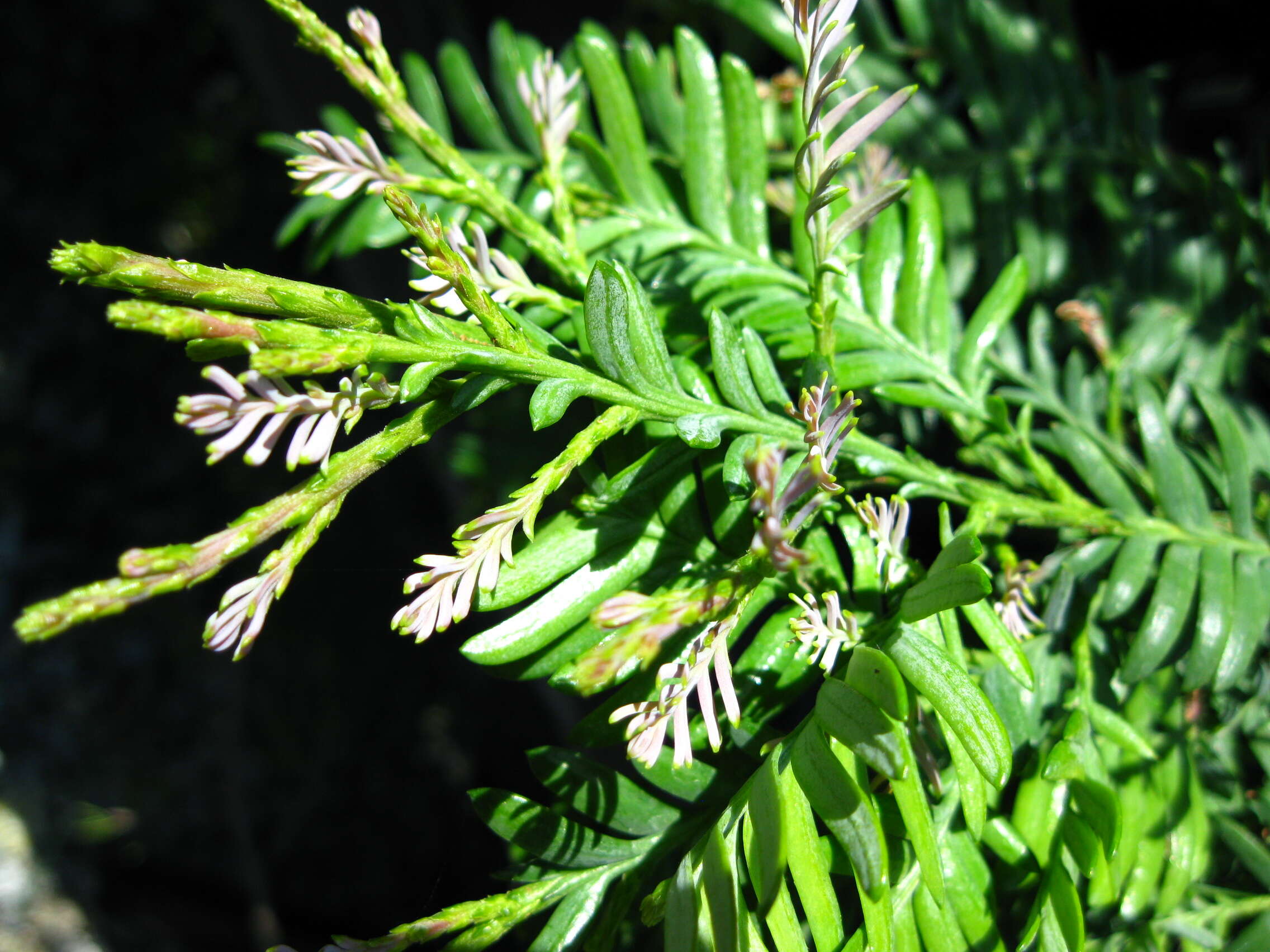
Acmopyle
Acmopyle is a genus of conifers belonging to the family Podocarpaceae. It includes two species of evergreen trees, each endemic to separate islands of the southwestern Pacific Ocean.
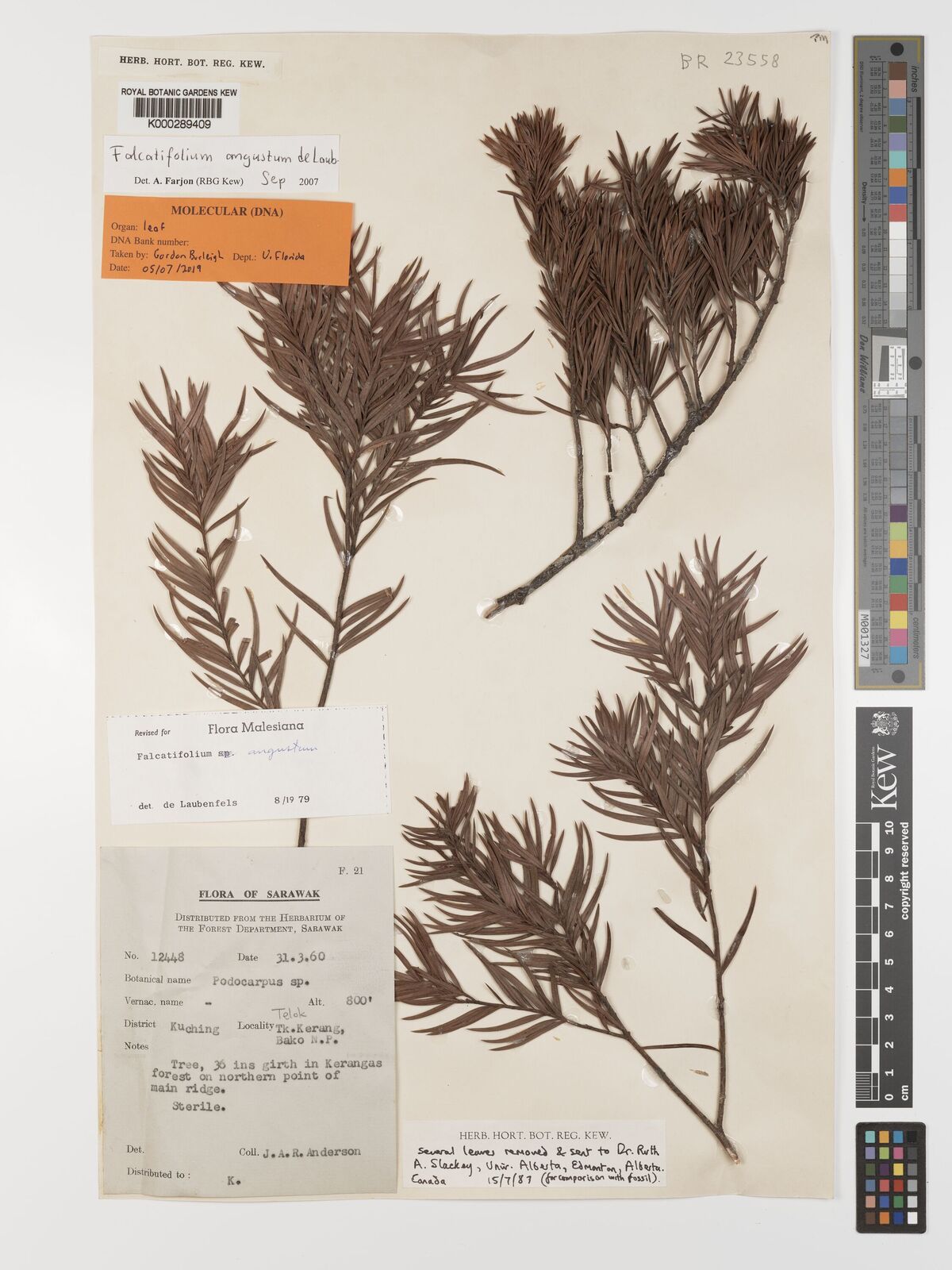
Falcatifolium
Falcatifolium is a genus of conifers of the family Podocarpaceae. The genus includes evergreen dioecious shrubs and large trees of up to . Five species are presently recognized. The genus was first described by de Laubenfels in 1969, and is composed of species formerly classified in genus Dacrydium.

Microcachrys tetragona
Microcachrys tetragona, known as creeping pine or creeping strawberry pine, is a species of dioecious conifer belonging to the podocarp family (Podocarpaceae). It is the sole species of the genus Microcachrys. The plant is endemic to western Tasmania, where it is a low shrub growing to 1 m tall at high altitudes. Its leaves are scale-like, arranged (unusually for the Podocarpaceae) in opposite decussate pairs, superficially resembling those of the unrelated Diselma archeri (Cupressaceae). It shares the common name Creeping pine with several other plants. Females produce tiny, red, edible berri

Nageia
Nageia is a genus of conifers belonging to the podocarp family Podocarpaceae. Nageia includes evergreen shrubs and trees, from one to 54 meters in height. A 2009 treatment of the genus recognized five species. Some authors consider Nageia formosensis to be a separate species from Nageia nagi, thus recognizing six species. The podocarp genera have been reshuffled by various botanists. Most recently, several species formerly classed as Nageia were moved to the new genus Retrophyllum, while Nageia falcata and Nageia mannii were moved to the new genus Afrocarpus.

Dacrycarpus
Dacrycarpus is a genus of conifers belonging to the family Podocarpaceae. The genus includes nine species of dioecious evergreen trees and shrubs to in height.
.jpg)
Lagarostrobos franklinii
Lagarostrobos franklinii is a species of conifer native to the wet southwestern corner of Tasmania, Australia. It is often known as the Huon pine or Macquarie pine, although it is actually a podocarp (Podocarpaceae), not a true pine (Pinaceae). It is the sole species in the genus Lagarostrobos; one other species L. colensoi (endemic to New Zealand) formerly included has been transferred to a new genus Manoao. The genus was also formerly included in a broader circumscription of the genus Dacrydium.

Prumnopitys
thumb|Adult leaves of Prumnopitys taxifolia|P. taxifolia
%20(cropped).JPG)
Retrophyllum
Retrophyllum is a genus of conifers in the family Podocarpaceae. It contains five generally recognized extant species with a disjunct distribution in the Southern Hemisphere, found in Papuasia and also in South America. Retrophyllum are evergreen trees typically occurring in tropical rainforests and cloud forests.
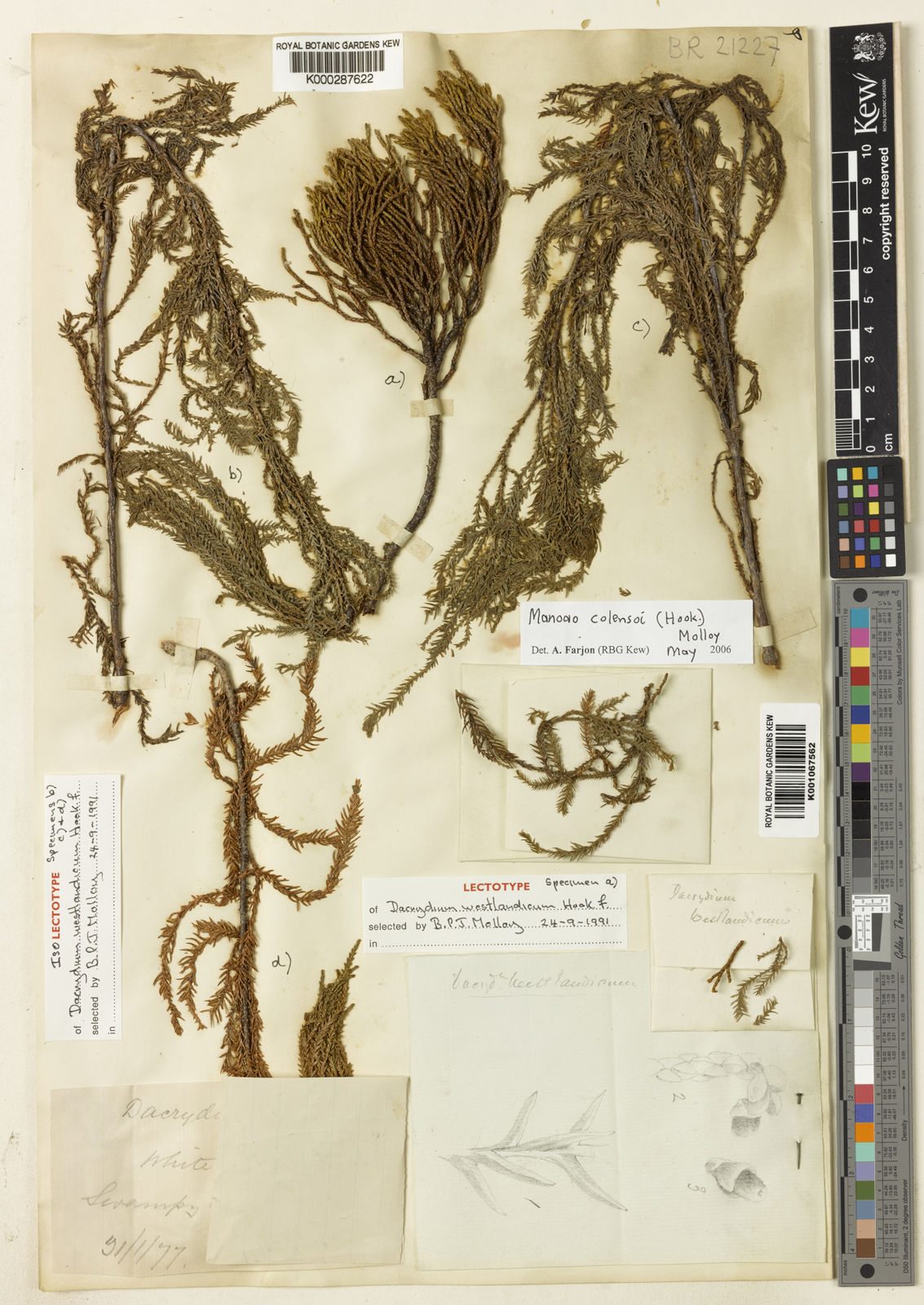
Manoao colensoi
Manoao ( ) is a monotypic genus in the family Podocarpaceae. The single species, M. colensoi, commonly known as manoao (from Māori), silver pine, Westland pine, or white silver pine, is endemic to New Zealand. Before 1996 it was classified in genus Dacrydium or Lagarostrobos, but has recently been recognised as a distinct genus; some botanists still treat it in Lagarostrobos on the basis that it is not phylogenetically distinct from that genus. In molecular phylogenetic analyses Manoao was found to be related to Parasitaxus (a parasitic and monotypic genus from New Caledonia) and Lagarostrobos

Halocarpus
Halocarpus is a genus of conifers of the family Podocarpaceae. The genus includes three closely related species of evergreen trees and shrubs, all endemic to New Zealand.
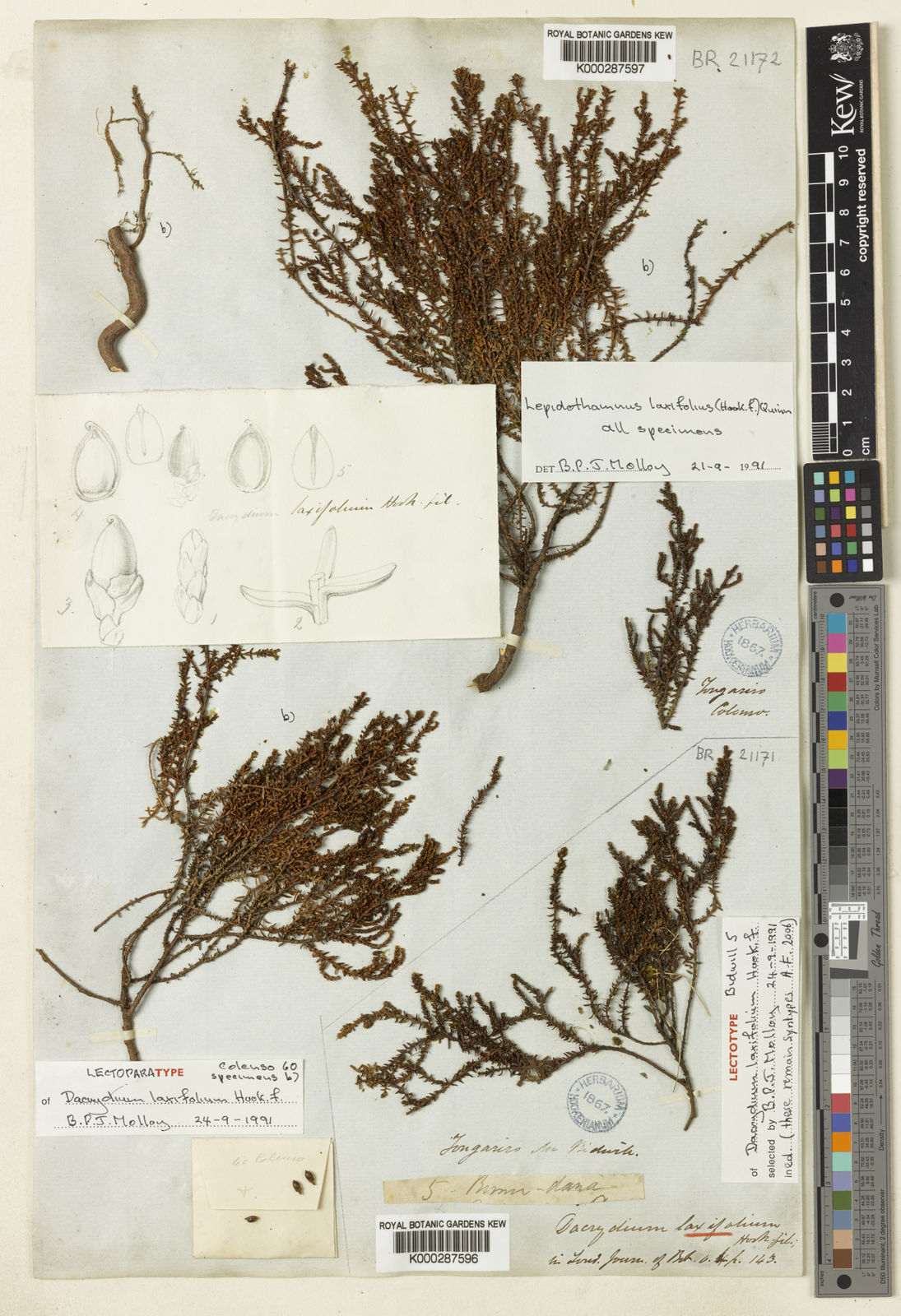
Lepidothamnus
Lepidothamnus is a genus of conifers belonging to the podocarp family Podocarpaceae. The genus includes three species of dioecious or monoecious evergreen trees and shrubs, and creepers. L. intermedius and L. laxifolius are native to New Zealand. L. fonkii is native to the Magellanic subpolar forests ecoregion of southern Argentina and Chile, where it grows as a low shrub or creeper in moorlands and bogs.
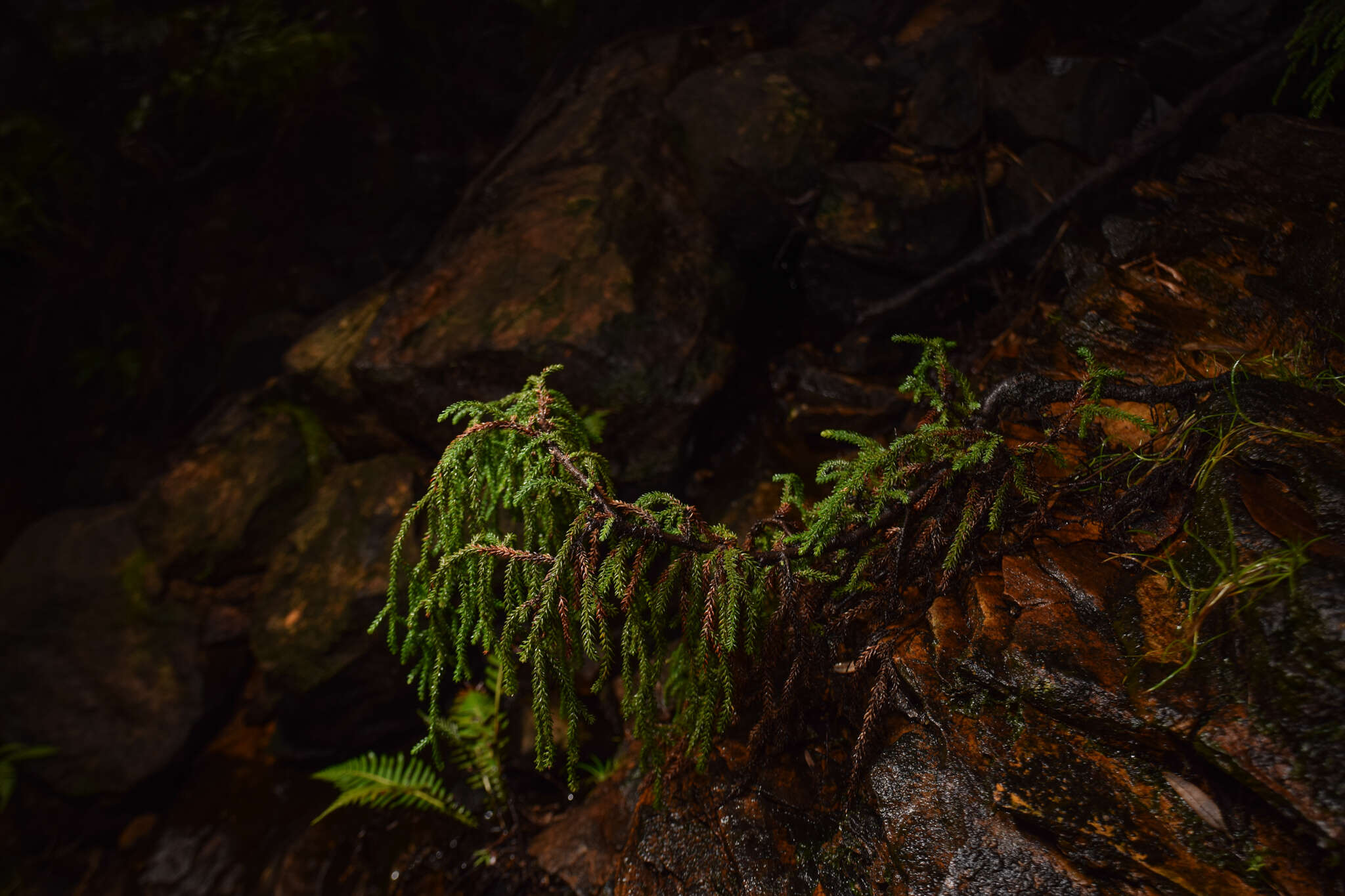
Pherosphaera
Pherosphaera is a genus of conifers belonging to the family Podocarpaceae.
Sundacarpus
Sundacarpus is a genus of conifers containing a single species Sundacarpus amarus, belonging to the family Podocarpaceae. Sundacarpus was designated a genus by Christopher Nigel Page in 1989; formerly it had been classified variously as a species of Podocarpus or of Prumnopitys. In Australia it is treated as Prumnopitys amara (Blume) de Laub.

Parasitaxus
Parasitaxus usta, also known in French as cèdre rabougri, is a rare species of conifer of the family Podocarpaceae, and the sole species of the genus Parasitaxus.