Category
page 1Poems in Persian

Shahnameh
thumb|Plate with a hunting scene from the tale of Bahram V|Bahram Gur and Azadeh. The imagery on this plate represents the earliest known depiction of a well-known episode from the story of Bahram Gur, which seems to have been popular for centuries, but was only recorded in the Shahnameh, centuries after this plate was created. Iran, [[Metropolitan Museum of Art]]
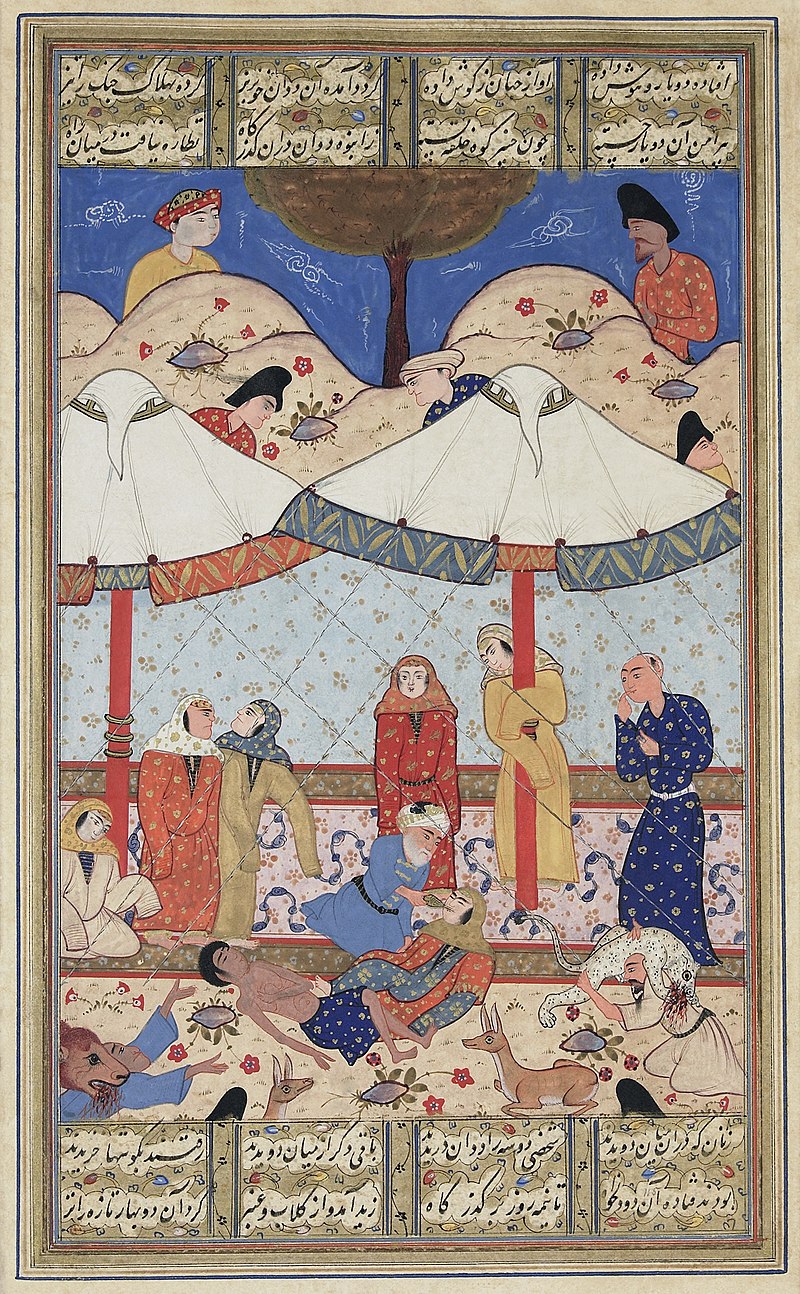
Layla and Majnun
story of Arab origin, about the 7th-century Arabic poet Qays ibn al-Mulawwah and his lover Layla bint Mahdi

Rubáiyát of Omar Khayyám
Persian poetry. Omar Khayyam’s robāʿiyyāt (“quatrains”). Also Persian-English quatrains translations by Edward Fitzgerald.

Masnavi
thumb|250px|
The Masnavi is an extensive Persian masnavi (a poetic form) written by Rumi, and one of the most influential works in the history of Sufism. It is a series of six books of poetry that together amount to around 25,000 verses or 50,000 lines.
Khosrow and Shirin
Persian tragic romance by Nizami Ganjavi
Yusuf and Zulaikha
romantic story
The Conference of the Birds
Persian poem by Sufi poet Attar
Vis and Rāmin
poem

The Seven Beauties
literary work by Nezami Ganjavi
The Divān of Hafez
collection of Classical Persian Poems written by Hafez
The Storehouse of Mysteries
epic poem by Nezami Ganjavi
Layla and Majnun
poem written by Nezami Ganjavi

Haft Awrang
15th century Persian literary work
Metiochus and Parthenope
ancient Greek novel
The Secrets of the Self
book by Mohammed Iqbal
Bijan and Manijeh
Love story in Shahnameh epic poem
Gift from Hijaz
poetry book of Allama Iqbal
Persian Psalms
1927 poetry book by Muhammad Iqbal
Message from the East
book by Mohammed Iqbal
Kush Nama
Persian epic
Javid Nama
book by Mohammed Iqbal
Bahman Nama
thumb|right|"Azar Barzin killing a dragon", folio from the Bahman-nameh, presumably interpolated into a Shahnameh manuscript. Created in [[Qazvin, Safavid Iran, dated ]]
The Bahman-nameh () is a Persian epic poem of around 9500 lines, which describes the exploits of Kay Bahman, the son of Esfandiyar of the royal Kayanid dynasty. The earliest attestation of this work is in the book Mojmal al-tawarikh, which gives the author as Iranshan ibn Abi'-Khayr (Iranshah).
Drakht-i Asurig
parthian epic poem
What should then be done O people of the East
book by Mohammed Iqbal
Bani Adam
poem by Persian poet Saadi Shirazi
Rumi ghazal 163
13th-century poem by Rumi