Category
page 1Polarization (waves)
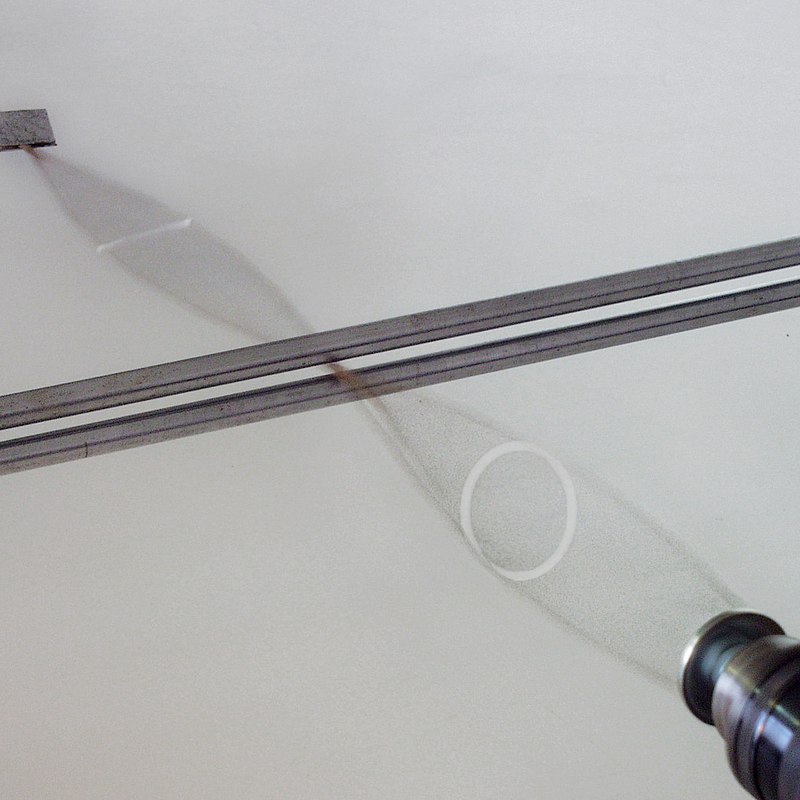
polarization
property of waves that can oscillate with more than one orientation
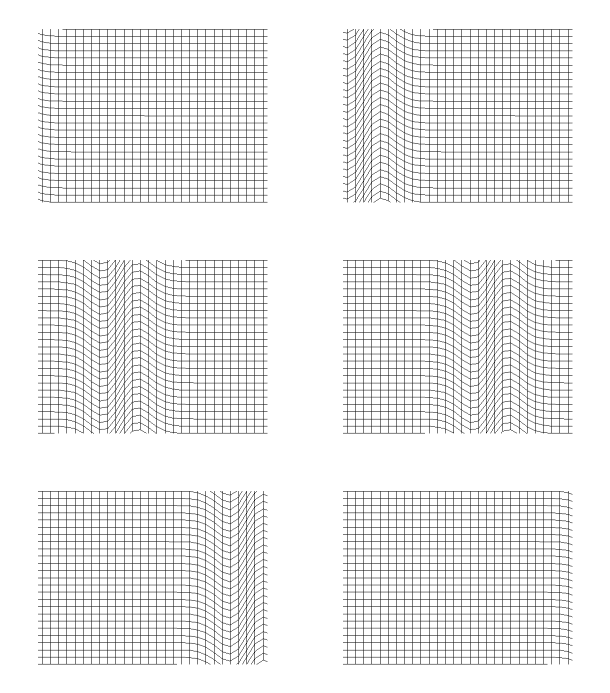
transverse wave
moving wave that consists of oscillations occurring perpendicular (right angled) to the direction of energy transfer (or the propagation of the wave)

birefringence
right|thumb|A calcite crystal laid upon a graph paper with blue lines showing the double refraction
right|thumb|In this example, optic axis along the surface is shown perpendicular to plane of incidence. Incoming light in the polarization (which means perpendicular to plane of incidence – and so in this example becomes "parallel polarisation" to optic axis, thus is called extraordinary ray) sees a greater refractive index than light in the polarization (which becomes ordinary ray because "perpendicular polarisation" to optic axis) and so polarization ray is undergoing greater refraction on ent
chirality
geometric property of some molecules and ions
Faraday effect
physical law
Brewster's angle
angle of incidence for which all reflected light will be polarized

polarizer
thumb|right|A polarizing filter cuts down the reflections (top) and makes it possible to see a photographer through the glass at roughly Brewster's angle although reflections off the back window of the car are not cut because they are less-strongly polarized, according to the [[Fresnel equations.]]
Nicol prism
optical polarizer made of two birefrengent calcite crystals
optical rotation
rotation of the plane of linearly polarized light as it travels through a chiral material
Kerr effect
change in refractive index of a material in response to an applied electric field
.svg)
polarimeter
upright=1.5|thumb|Operating principle of an optical polarimeter.
1. Light source
2. Unpolarized light
3. Linear polarizer
4. [[Linearly polarized light
5. Sample tube containing chiral molecules under study
6. Optical rotation due to molecules
7. Rotatable linear analyzer
8. Detector]]
Fresnel equations
equations of light transmission and reflection

polarizability
Polarizability usually refers to the tendency of matter, when subjected to an electric field, to acquire an electric dipole moment in proportion to that applied field. It is a property of particles with an electric charge. When subject to an electric field, the negatively charged electrons and positively charged atomic nuclei are subject to opposite forces and undergo charge separation. Polarizability is responsible for a material's dielectric constant and, at high (optical) frequencies, its refractive index.
Iceland spar
transparent variety of calcite

polarimetry
thumb|right|upright|Synthetic aperture radar image of [[Death Valley colored using polarimetry.]]

Waveplate
[[Image:Waveplate.png|thumb|300px|
circular dichroism
dichroism involving circularly polarized light.
Pockels effect
appearance or change of birefringence in an optical medium by an applied electric field

dichroism
thumb|right|lampworking|Lampworked [[dichroic glass bead]]
In optics, a dichroic material refers to:
a material which causes visible light to be split up into two distinct beams of different wavelengths (colours), one of which is reflected and one of which is transmitted (not to be confused with dispersion), or
a material in which light rays having different polarization directions are absorbed differently.
Wollaston prism
type of polarizer
Haidinger's brush
visible effect of polarised light
optic axis of a crystal
birefringence-free direction of light transmission
circular polarization
polarization state
sunstone
ancient navigational aid
Jones calculus
system for describing optical polarization
Stokes parameters
linear polarization
confinement of the electric field vector or magnetic field vector to a given plane along the direction of propagation
polarizing filter
optical filter
Glan–Thompson prism
type of polarizing prism
Glan–Taylor prism
improved air-spaced calcite polarizer design
Mueller calculus
system for describing optical polarization

elliptical polarization
polarization of electromagnetic radiation

Glan–Foucault prism
type of polarizer
Cotton effect
characteristic change in optical rotatory dispersion and/or circular dichroism in the vicinity of an absorption band of a substance
Voigt effect
Physical phenomenon
optical mineralogy
The optical properties of rocks and minerals
Sénarmont prism
type of polarizer
spin polarization
term
Polaroid
optically active material
Nomarski prism
type of polarizer
Sokolov–Ternov effect
Physical phenomenon of spin-polarization
optical rotatory dispersion
method of measuring the dispersion of an optically active molecule to determine the relative magnitude of right- or left-handed components, and some structural features of the molecule
Fresnel rhomb
Optical prism
index ellipsoid
aspect of crystal optics
Polarization mode dispersion
form of modal dispersion
Polarized light pollution
property of light waves that describes the orientation of their oscillations
Fresnel–Arago laws
Rochon prism
type of polarizer
herapathite
Herapathite, or iodoquinine sulfate, is a chemical compound whose crystals are dichroic and thus can be used for polarizing light.
Polarization in astronomy