Category
page 1Political spectrum

right-wing
political alignment favoring social hierarchy

left-wing
political ideologies supporting social equality and egalitarianism

chauvinism
Chauvinism ( ) is the unreasonable belief in the superiority or dominance of one's own group or people, who are seen as strong and virtuous, while others are considered weak, unworthy, or inferior. The Encyclopaedia Britannica describes it as a form of "excessive and unreasonable" patriotism and nationalism, a fervent faith in national excellence and glory.
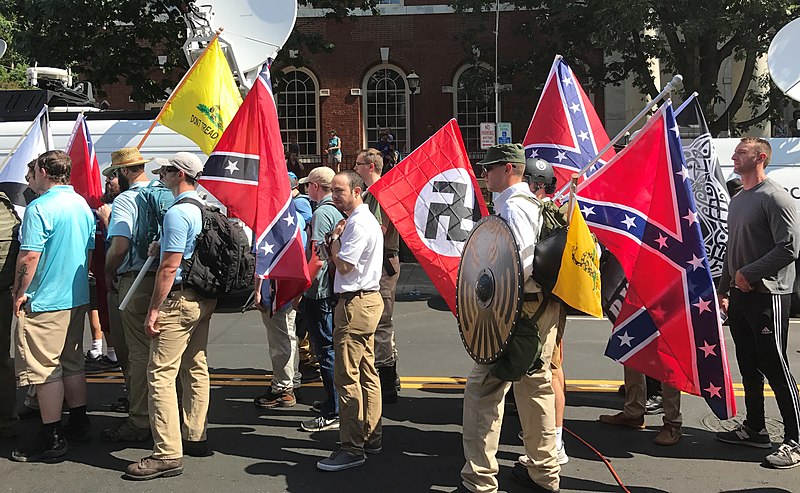
far-right politics
political alignment on the extreme end of right-wing politics
.jpg)
centrism
Centrism is the range of political ideologies that exist between left-wing politics and right-wing politics on the left–right political spectrum. It is associated with moderate politics, including people who strongly support moderate policies and people who are not strongly aligned with left-wing or right-wing policies. Centrism is commonly associated with liberalism, radical centrism, and agrarianism. Those who identify as centrist support gradual political change, often through a welfare state with moderate redistributive policies. Though its placement is widely accepted in political science
extremism
Extremism is "the quality or state of being extreme" or "the advocacy of extreme measures or views". The term is primarily used in a political or religious sense to refer to an ideology that is considered (by the speaker or by some implied shared social consensus) to be far outside the mainstream attitudes of society. It can also be used in an economic context. The term may be used pejoratively by opposing groups, but is also used in academic and journalistic circles in a purely descriptive and non-condemning sense.

far-left politics
political alignment on the extreme end of left-wing politics

political spectrum
graphical system to visually classify different political positions

centre-left
position within the political spectrum

centre-right
position within the political spectrum

Overton window
range of ideas tolerated in public discourse
right-wing populism
political ideology and movement that combines right-wing political positions with populist rhetoric, emphasizing opposition to elites, nationalism, and the defense of national identity, culture, or sovereignty
left–right politics
system of classifying political positions, ideologies and parties
horseshoe theory
political theory that states the far-left and far-right have similarities
left-wing populism
political ideology and movement that combines left-wing political positions with populist rhetoric emphasizing opposition to elites and advocacy for social and economic equality

apoliticism
Apoliticism is apathy or antipathy towards all political affiliations. A person may be described as apolitical if they are uninterested or uninvolved in politics. Being apolitical can also refer to situations in which people take an unbiased position in regard to political matters. The Collins English Dictionary defines apolitical as "politically neutral; without political attitudes, content, or bias."
radical centrism
political ideology
Nolan Chart
political spectrum diagram
.jpg)
ultraconservatism
Ultraconservatism refers to extreme conservative views in politics or religious practice. In modern politics, ultraconservative usually refers to conservatives of the far-right on the political spectrum, comprising groups or individuals who are located to the right of those who hold mainstream conservative views, and continuing further right to include fringe parties.

ultra-leftism
In Marxism, ultra-leftism encompasses a broad spectrum of revolutionary Marxist currents. Ultra-leftism distinguishes itself from other left-wing currents through its rejection of electoralism, trade unionism, and national liberation. The term is sometimes used as a synonym of Italian left communism. "Ultra-left" is also commonly used as a pejorative by Marxist–Leninists and Trotskyists to refer to extreme or uncompromising Marxist sects.

The Fourth Political Theory
book by Alexander Dugin
The Political Compass
website used to rate political ideology in a political spectrum
radical politics
intent to transform or replace the fundamental principles of society
Pournelle chart
two-dimensional coordinate system which can be used to distinguish political ideologies
hardline stance
In politics, hardline or hard-line is an adjective describing a stance on an issue that is inflexible and not subject to compromise. A hardliner is a person holding such views. The stance is usually far from the centrist view. People, policies, and laws can be considered hardline. A hardliner may be either a reactionary or a revolutionary. Synonyms for hardliner include diehard, hawk, extremist, radical, fanatic, or zealot. The term is almost always relative to the Overton window of a given time and place.