Category
page 2Polydesmida
Polydesmus skinneri
species of myriapod

Eutrichodesmus
Eutrichodesmus is a genus of millipedes in the family Haplodesmidae. Containing 54 species, this genus is among the genera with the greatest number of species not only in the family Haplodesmidae but also in the order Polydesmida. This genus includes the species E. peculiaris, notable for featuring sexual dimorphism in segment number: The adult females have 20 segments (counting the collum as the first segment and the telson as the last), but the adult males have only 19 segments. Millipedes in this genus are found in southern Japan, Taiwan, southern China, mainland Southeast Asia, Indonesia,
Antichiropus
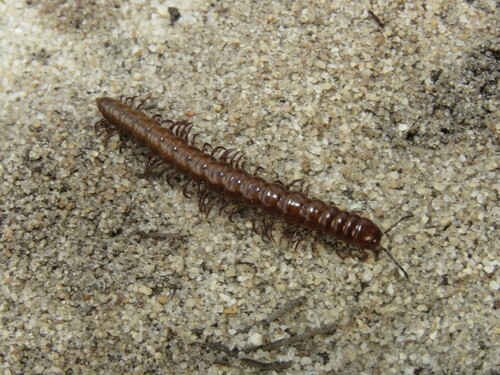
Antichiropus is a genus of millipede in the family Paradoxosomatidae. The genus is very distinctive in the form of the gonopod, which is typically coiled through at least a full circle. It is probably endemic to Australia. Some species have small ranges of less than 10000 km2, classifying them as short-range endemic invertebrates.
Anbarrhacus
Anbarrhacus is an extinct genus of millipede in the family Platyrhacidae known from a fossil found in North America. There is one described species in the genus, Anbarrhacus adamantis, which is one of three millipedes described from Mexican amber.
Plicatodesmus
Plicatodesmus is a genus of millipedes in the family Chelodesmidae.
Pseudopolydesmus canadensis
species of myriapod

Pseudopolydesmus serratus
species of myriapod
Pleuroloma cala
species of myriapod
Brachydesmus
Brachydesmus is a genus of millipedes belonging to the family Polydesmidae. The Czech zoologist Camill Heller first described this genus to contain the type species B. subterraneus. This genus now includes about 75 described species.
Aulodesmus
Aulodesmus is a genus of millipedes belonging to the family Gomphodesmidae.
Prosopodesmus
Prosopodesmus is a genus of flat-backed millipedes in the family Haplodesmidae. These millipedes are found primarily in Australia and southern Japan. This genus includes the species P. panporus, which is notable for exhibiting sexual dimorphism in segment number: Whereas adult females of this species feature the usual 20 segments (counting the collum as the first segment and the telson as the last) usually observed in the order Polydesmida, the adult males of this species feature only 19 segments.

Boraria infesta
species of myriapod
Auturus evides
species of myriapod
Euryurus
Euryurus is a genus of flat-backed millipedes in the family Euryuridae. There are about 14 described species in Euryurus.

Boraria deturkiana
species of myriapod

Pseudopolydesmus erasus
species of myriapod
Tonkinosoma tiani
species of myriapod
Nannaria swiftae
Millipede species
Agathodesmus
Inodesmus is a genus of millipedes in the family Haplodesmidae, first described by Orator F. Cook in 1896. The type species is I. jamaicensis. This genus exhibits a disjunct distribution, with species found in Colombia, Jamaica, New Caledonia, and the Australian states of Queensland, New South Wales, Victoria, and South Australia.

Nannaria ohionis
species of myriapod
Aulodesmus mossambicus
species of myriapod
Semionellus
Semionellus is a genus of flat-backed millipedes in the family Xystodesmidae. There are at least three described species in Semionellus.

Brachoria dentata
species of myriapod
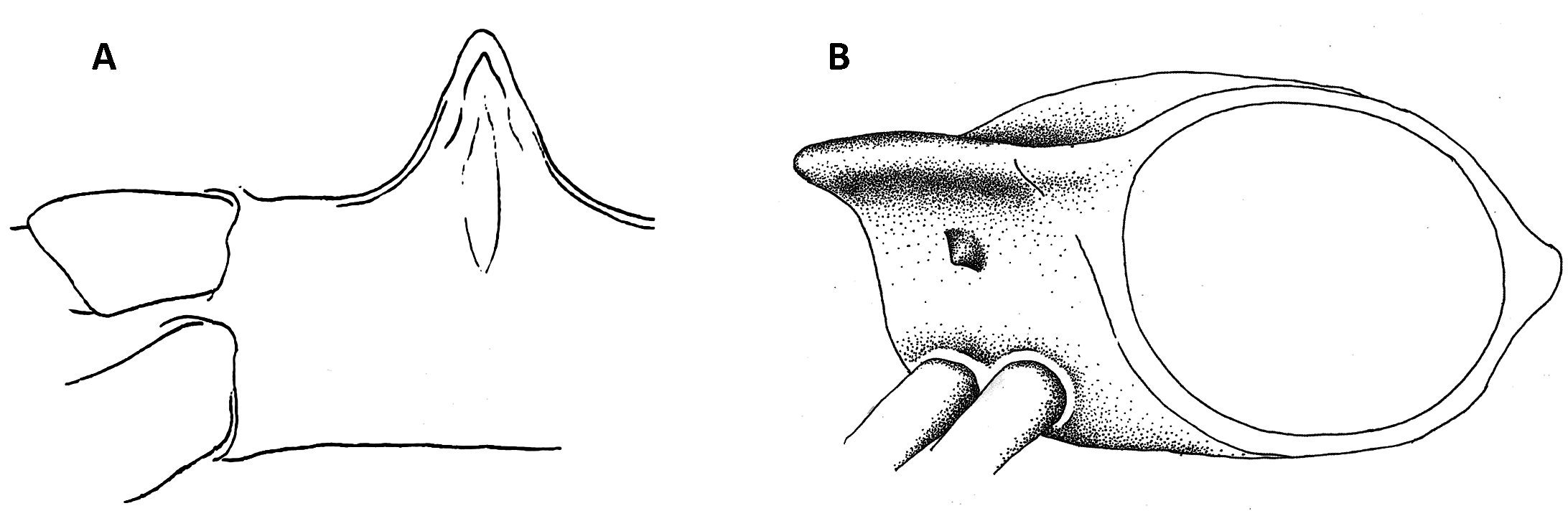
Gomphodesmidae
Gomphodesmidae is a family of millipedes in the order Polydesmida, containing around 55 genera and 150 species.
The family is native to Africa, and occurs primarily in savanna habitat (open-canopy grasslands) from South Africa north to Senegal and Ethiopia.

Parafontaria
Parafontaria is a genus of "flat-backed" millipedes (order Polydesmida) consisting of 14 species native to Japan and Korea. Parafontaria laminata armigera, formerly called train millipedes, has been synonymized with P. laminata. This is because some populations exhibit periodical swarming behavior during which large numbers congregate and can impact train passage when this congregation occurs on tracks. Documentation of this event goes back to 1920. Individuals vary from around as adults, and feed on leaf litter as well as soil, making them comparable to earthworms in facilitating decompositio

Sigmoria australis
species of myriapod