Category
page 1Polyphonic form
melody
thumb|A bar from Johann Sebastian Bach|J. S. Bach's [[Fugue No. 17 in A-flat, BWV 862, from The Well-Tempered Clavier (Part I), an example of counterpoint. The two voices (melodies) on each staff can be distinguished by the direction of the stems and beams.thumbthumb|Voice 1thumb|Voice 2thumb|Voice 3thumb|Voice 4]]

fugue
thumb|The six-part fugue in the "Ricercar a 6" from [[The Musical Offering, in the hand of Johann Sebastian Bach]]
In classical music, a fugue (, from Latin , meaning 'flight' or 'escape') is a contrapuntal, polyphonic compositional technique in two or more voices, built on a subject (a musical theme) that is introduced at the beginning in imitation (repetition at different pitches), which recurs frequently throughout the course of the composition. It is not to be confused with a fuguing tune, which is a style of song popularized by and mostly limited to early American (i.e. shape note or "Sac

polyphony
Polyphony ( ) is a type of musical texture consisting of two or more simultaneous lines of independent melody, as opposed to a musical texture with just one voice (monophony) or a texture with one dominant melodic voice accompanied by chords (homophony).
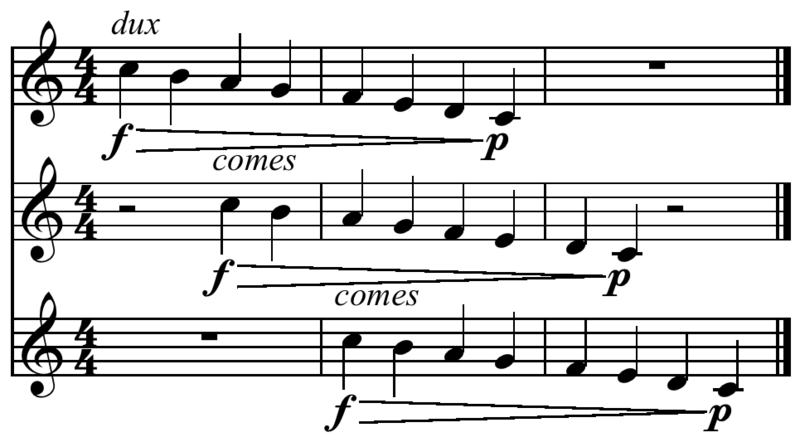
canon
contrapuntal form of music involving a self-harmonizing theme with imitations offset in time

antiphon
The Liber responsorialis, showing on the right-hand page the antiphons for the first Matins|night office of Christmas. The associated [[psalm tones are indicated by number and ending pitch, and the pitches for the ending of the doxology are indicated by the mnemonic Euouae.|thumb]]
theme
musical melody on which a composition is based
organum
Organum () is, in general, a plainchant melody with at least one added voice to enhance the harmony, developed in the Middle Ages. Depending on the mode and form of the chant, a supporting bass line (or bourdon) may be sung on the same text, the melody may be followed in parallel motion (parallel ), or a combination of both of these techniques may be employed. As no real independent second voice exists, this is a form of heterophony. In its earliest stages, organum involved two musical voices: a Gregorian chant melody, and the same melody transposed by a consonant interval, usually a perfect f
invention
short musical composition with two-part counterpoint
part
section of a musical composition
imitation
in polyphonic music, the repetition (exact or modified) of a melody in a different voice
Musica enchiriadis
anonymous 9th century treatise on music

stretto
The Italian term stretto (plural: stretti) has two distinct meanings in music:
crab canon
an arrangement of two musical lines that are complementary and backward

catch
type of round or canon at the unison