Category
page 1Pompeii (ancient city)
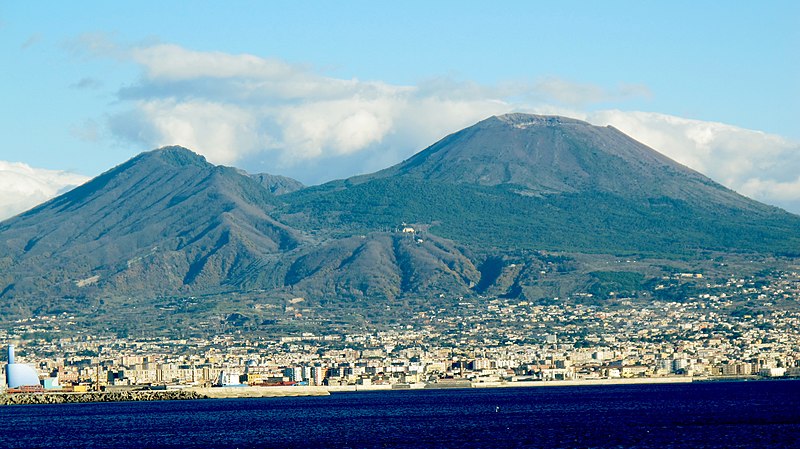
Mount Vesuvius
active stratovolcano in the Gulf of Naples, Italy

Pompeii
Pompeii (; ) was a city in what is now the municipality of Pompei, near Naples, in the Campania region of Italy. Along with Herculaneum, Stabiae, and many surrounding villas, it was buried under of volcanic ash and pumice in the eruption of Mount Vesuvius in 79 AD.
Naples National Archaeological Museum
Italian archeological museum known for Roman materials
Sator Square
word square containing a five-word Latin palindrome
eruption of Mount Vesuvius in 79
major eruption of stratovolcano in southern Italy

Stabiae
350px|right|thumb|Stabiae and other cities affected by the eruption of Mount Vesuvius. The black cloud represents the general distribution of ash and cinder. Modern coast lines are shown.
Alexander Mosaic
Roman mosaic of Pompeii
speculum
medical device for investigating orifices
Pompeian Styles
artistic styles of Roman murals

Lupanar
thumb|right|280px|The Lupanar at VII, 12, 18–20. Vico del Lupanare is on the right. Vico del Balcone is to the left.
Pompeii Lakshmi
Ivory statuette from Pompeii resembling an Indian fertility goddess
Amphitheatre of Pompeii
Roman amphitheatre in Pompeii, Italy
62 Pompeii earthquake
earthquake in Italy in 62 AD
Aqua Augusta
aqueduct
Portrait of Terentius Neo
portrait fresco, Pompeii

Macellum of Pompeii
mall at the forum of Pompeii
Erotic art in Pompeii and Herculaneum
aspect of art in ancient Rome
museum Pompejanum
The Pompejanum (or Pompeiianum) is an idealised replica of a Roman villa, located on the high banks of the river Main in Aschaffenburg, Bavaria, Germany. It was commissioned by King Ludwig I and built in the 1840s. The villa is a replica of a domus in Pompeii, the so-called House of Castor and Pollux (Casa dei Dioscuri).
Plato's Academy mosaic (from Pompeii)
Roman mosaic in Pompeii, Italy
Stabian Baths
public baths at Pompeii located at the intersection of the Via Stabiana and the Via dell'Abbondanza.
Achilles and Briseis
ancient erotic picture, Pompeii
Pompeian red
color
Suburban Baths
buildings in Pompeii
venereum
thumb|A venereum in the House of Sallust
Venereum (after goddess Venus) was an element of ancient Roman private apartments found particularly in Pompeii. It was originally interpreted as a specialized apartment or room dedicated to sexual activities. One venereum was found in the House of Julia Felix and another one in the House of Sallust, both in Pompeii. In the latter house, the venereum was a garden with several separate rooms.
CIL 4.5296
graffiti poem found at Pompeii
Woman with wax tablets and stylus (so-called "Sappho")
fresco