Category
page 1Pottery shapes
.jpg)
cup
thumb|Rococo cup with saucer, circa 1753, [[soft-paste porcelain with overglaze enamelling, Vincennes porcelain]]

vase
thumb|Neoclassicism|Neoclassical vase; circa 1790; jasper; height: 25.4 cm, width: 18.7 cm; [[Victoria and Albert Museum (London)]]
thumb|The David Vases; 1351 (the [[Yuan Dynasty); porcelain, cobalt blue decor under glaze; height: 63.8 cm; British Museum (London)]]
A vase (, , or ) is an open container. It can be made from a number of materials, such as ceramics, glass, or non-rusting metals, such as aluminium, brass, bronze, or stainless steel. Even wood has been used to make vases, either by using tree species that naturally resist rot, such as teak, or by applying a protective coating to c
.jpg)
jug
thumb|French ceramic jug
250px|thumb|Covered cream jug, 1735, silver, Cleveland Museum of Art (US)
A jug is a type of container commonly used to hold and serve liquids, but not normally to drink from directly. It has an opening, sometimes narrow, from which to pour or drink, and has a handle, and usually a pouring lip. Jugs throughout history have been made of metal, ceramic, or glass, and plastic is now common.

teapot
thumb|A Brown Betty (teapot)|Brown Betty teapot
A teapot is a vessel used for steeping tea leaves or a herbal mix in boiling or near-boiling water and serving the resulting infusion called tea; usually put in a teacup. It is one of the core components of teaware.
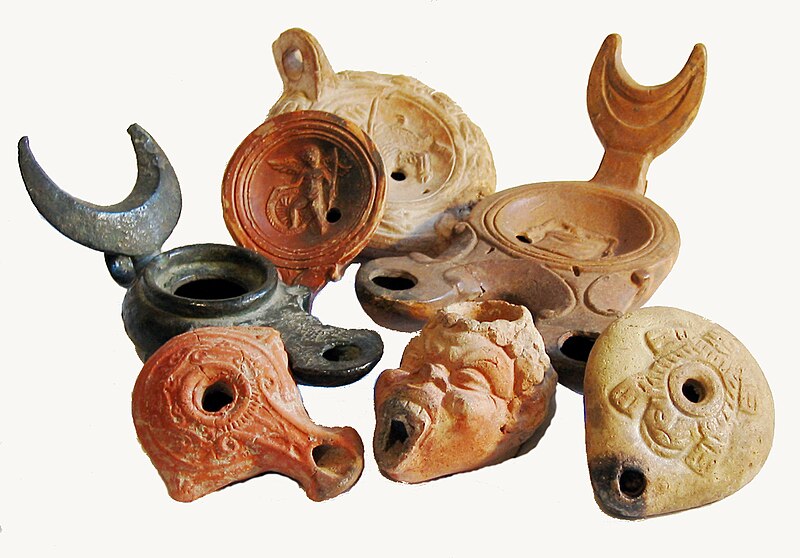
oil lamp
object used to produce light continuously for a period of time using an oil-based fuel source

flowerpot
thumb|Meilland International SA|Meillandine [[rose in a terracotta flowerpot]]
thumb|Traditional flowerpots in unglazed terracotta in [[Charles Darwin's laboratory at Down House]]
thumb|right|Terracotta flowerpot in Italy, decorated with festoons

pitcher
container with a spout used for storing and pouring liquids

piñata
thumb|right|A nine-pointed star piñata
thumb|right|A woman strikes a piñata at a celebration.

Qvevri
thumb|upright|250px|A large kvevri held at the Georgian National Museum of Tbilisi
Kvevri or qvevri ( ) - also known as '''ch'uri''' ( ) in Western Georgia - are large earthenware vessels used for the fermentation, storage and aging of traditional Georgian wine. Resembling large, egg-shaped amphorae without handles, they are either buried below ground or set into the floors of large wine cellars. Kvevris vary in size: volumes range from , with being typical.
==History==
%2C%200-50%20dc%20ca..JPG)
urn
thumb|Ancient Roman urn made of [[alabaster]]
.jpg)
Kalash
thumb|The Pūrṇa-Kalaśa or Pūrṇa-Ghaṭa with "Padmotpalakumudvat" - overflowing pot with Nelumbo|Padma (lotus), Utpala (blue water-lily) and Kumuda (white water-lily), 1st century BCE depiction.
gaiwan
A ' (; ) or ' () is a Chinese lidded bowl without a handle, used for the infusion of tea leaves and the consumption of tea. It was invented during the Ming dynasty. It consists of a bowl, a lid, and a saucer.

jebena
thumb|right|Traditional jebena from central Ethiopia, distinguished from Sudanese , northern Ethiopian and southern Eritrean pots by its spout
Jebena (, ) is a traditional Ethiopian and Eritrean flask made of pottery and used to brew
coffee. It is also popular in some parts of Egypt.
crock
container used to cook food in ovens or direct fire

chawan
A chawan (; literally "tea bowl") is a bowl used for preparing and drinking tea. Many types of chawan are used in East Asian tea ceremonies.
cong
ancient Chinese vessel
%20(cropped).jpg)
cachepot
thumb|Lilac, white and green jasperware cachepot with saucer, 1785–1790, by William Adams & Sons.
thumb|Pair of 19th-century cachepots in Meissen porcelain.

albarello
thumb|Blue and white albarello adorned with the traditional colors of Chinese Porcelain and decorated with designs derived from Kufic script, a style of Arabic script. Manufactured in Tuscany, Italy in the second half of the 15th century.
An albarello (a name of Italian descent, plural: albarelli) is also known as a "maiolica drug jar" because of the type of tin glaze used, known as Maiolica (also known as majolica). This cylindrical storage unit is used for a plethora of purposes, most commonly for drug storage in pharmacies as a medicinal jar. The jar was also used for other purposes such as
Acoustic jar
ceramic vessels to improve acoustics
Bartmann jug
stoneware jug with bearded man on the neck of it
jardinière
thumb|English Victorian majolica jardinière
Jardinière is a French word, from the feminine form of "gardener". In English it means a decorative flower box or "planter", a receptacle (usually a ceramic pot or urn) or a stand upon which, or into which, plants (often in pots) may be placed, usually indoors. The French themselves mostly refer to tabletop "planter" versions of such receptacles as cachepots ("hide-pots"). The French tend to use jardinière for larger outdoor containers for plants, and for raised beds in gardens in some sort of isolated frame, such as a stone wall, especially growing
Meiping
A meiping () is a type of vase in Chinese ceramics. It is traditionally used to display branches of plum blossoms. The meiping was first made of stoneware during the Tang dynasty (618–907). It was originally used as a wine vessel, but since the Song dynasty (960–1279) it also became popular as a plum vase and got its name "meiping". It is tall, with a narrow base spreading gracefully into a wide body, followed by a sharply-rounded shoulder, a short and narrow neck, and a small opening.
matki
earthen clay pot
slop bowl
bowl for accepting used tea leaves for European tea sets
drug jar
glass or ceramic jar for storing drugs or medicines
hollowware
thumb|right|upright=1.4|Creamer and sugar bowl from Atchison, Topeka and Santa Fe Railway service, made by for dining car service
olla
An olla is a ceramic jar, often unglazed, used for cooking stews or soups, for the storage of water or dry foods, or for other purposes like the irrigation of olive trees. Ollas have short wide necks and wider bellies, resembling beanpots or South Asian matki.
puzzle jug
trick drinking vessel