Category
page 1Prehistoric canines

dire wolf
extinct species of canids (Canidae)

Amphicyon
Amphicyon is an extinct genus of large carnivorans belonging to the family Amphicyonidae (known colloquially as "bear-dogs"), subfamily Amphicyoninae, from the Miocene epoch. Members of this family received their vernacular name for possessing bear-like and dog-like features. They ranged over North America, Eurasia, and Africa.

Borophagus
Borophagus ("gluttonous eater") is an extinct genus of the subfamily Borophaginae, a group of canids endemic to North America from the Middle Miocene to the early Pleistocene (12—2Mya).

Epicyon
Epicyon ("more than a dog") is a large, extinct, canid genus of the subfamily Borophaginae ("bone-crushing dogs"), native to North America. Epicyon existed for about from the early Clarendonian age of the Late Miocene to the late Hemphillian age of the Early Pliocene.'' E. haydeni'' is the largest known canid of all time, with the type species reaching 2.4 m (7.9 ft) in length, 90 cm (35 in) in shoulder height and approximately 100–125 kg (220–276 lb) in body mass. The largest known humerus specimen belonged to an individual weighing up to .

Hesperocyon
Hesperocyon is an extinct genus of canids belonging to the subfamily Hesperocyoninae of the canid family that was endemic to North America, ranging from southern Canada to Colorado. It appeared during the Uintan age, –Bridgerian age (NALMA) of the Mid-Eocene– 42.5 Ma to 31.0 Ma. (AEO). Hesperocyon existed for approximately .
%20skull%20compared%20to%20Leptocyon%20vafer%20skull%20cast%20(bottom)%20(cropped).jpg)
Leptocyon
The genus Leptocyon (Greek: leptos slender + cyon dog) includes 11 species and is the oldest known canine. They were small and weighed around . They first appeared in North America around 34 million years ago in the Oligocene, at the same time as the Borophaginae, with whom they share features, indicating that these were two sister groups. Borophaginae skull and dentition were designed for a powerful killing bite compared with the Leptocyon which were designed for snatching small, fast-moving prey. The species L. delicatus is the smallest canid to have existed. At the close of their genus 9 mi
%20-%20E.%20odessanus.png)
Eucyon
Eucyon (Greek: : good, true; : dog) is an extinct genus of medium-sized omnivorous coyote-like canid that first appeared in the Western United States during the late Middle Miocene 10 million years ago. It was the size of a jackal and weighed around 15 kg. It was one of the few North American mammals which invaded Eurasia about 6 million years ago, followed by the genus going extinct 3 million years ago. This genus is proposed to have given rise to genus Canis 6 million years ago.
Canis lepophagus
species of mammal
%2C%20Aelurodon%20taxoides%20(middle)%2C%20Tomarctus%20brevirostris%20(bottom)%20(cropped).jpg)
Aelurodon
Aelurodon is an extinct canid genus of the subfamily Borophaginae which lived from the Barstovian land mammal age () of the middle Miocene to the late Miocene epoch (). Aelurodon existed for approximately .

Archaeocyon
Archaeocyon ("ancient dog") is an extinct genus of the Borophaginae subfamily of canids native to North America. It lived during the Oligocene epoch 32-24 Ma., existing for approximately . Species of Archaeocyon are among the earliest known borophagines, although a species of Otarocyon has a slightly earlier first appearance. Fossils have been found across the northern Great Plains and along the west coast of North America.
Speothos pacivorus
species of mammal
Lycaon sekowei
species of mammal

Tomarctus
Tomarctus is a genus of borophagine canid which inhabited most of North America during the late Early Miocene to the Early Barstovian age of the Middle Miocene (23—16 million years ago).
== Description ==
Protocyon
Protocyon (from Greek for "first dog") is an extinct genus of large canid endemic to South and Central America from the Late Pliocene to the Late Pleistocene.
%20Fig.%201.png)
Xenocyon
Xenocyon ("strange dog") is an extinct group of canids, either considered a distinct genus or a subgenus of Canis. The group includes Canis (Xenocyon) africanus, Canis (Xenocyon) antonii and Canis (Xenocyon) falconeri that gave rise to Canis (Xenocyon) lycanoides. The hypercarnivorous Xenocyon is thought to be closely related and possibly ancestral to modern dhole and the African wild dog, as well as the insular Sardinian dhole.
Canis edwardii
species of mammal (fossil)
Canis etruscus
species of mammal
evolution of the wolf
overview about the evolution of the wolf
Beringian wolf
extinct type of wolf
Armbruster's wolf
species of mammal (fossil)
Vulpes riffautae
species of mammal
Canis mosbachensis
species of mammal
Vulpes qiuzhudingi
species of mammal
Cerdocyon avius
Ferrucyon is an extinct genus of omnivorous mammal of the family Canidae, which inhabited North America during the Pliocene, Blancan in the NALMA classification, from about 4.9 to approximately 2.6 Ma. The type species, F. avius, was originally interpreted as a relative of the modern crab-eating fox, and described as a species belonging to the genus Cerdocyon. Ruiz-Ramoni et al. (2020) reinterpreted it as a vulpine canid related to North American species Metalopex macconnelli, and to the Eurasian genus Nyctereutes. This reinterpretation necessitated removal of "Cerdocyon" avius from the genus
Theriodictis
Theriodictis is an extinct monotypic genus of cerdocyonine canid endemic to South America during the Middle Pleistocene.
Megafaunal wolf
extinct species of carnivore
European dhole
subspecies of mammal
Bonn–Oberkassel dog
late Paleolithic dog specimen
Nyctereutes abdeslami
species of mammal (fossil)
Vulpes skinneri
species of mammal
Cave wolf
extinct subspecies of wolves (Canis lupus)
Canis arnensis
species of mammal (fossil)
Cynarctus
Cynarctus is an extinct genus of the Borophaginae subfamily of canids native to North America. The genus was first founded by W. D. Matthew in 1901, based from a pair of lower jaws, Cynarctus saxitilis, found in the Pawnee Creek Beds of Colorado. It lived during the Middle to Late Miocene 16.0—10.3 mya, existing for approximately . Fossils have been uncovered in Colorado, California, Maryland, western Nebraska, and Texas. It was likely an omnivore, and lacked the bone-cracking adaptations found in some later borophagines. Newer findings have proved the genus to be described as a large dog-like
Protepicyon raki
thumb | right | alt=Remains of a jaw, brownish in color, with dark brown teeth | Jaw of Protepicyon raki
Protepicyon is an extinct monospecific genus of the Borophaginae subfamily of canids native to North America. It lived during the Barstovian stage of the Middle Miocene 16.0—13.6 mya. One of the top predators of its time, it was the probable ancestor of the better known Epicyon, and is known from remains in California and New Mexico.
Canis ferox
species of mammal (fossil)
Canis latrans orcutti
subspecies of mammal
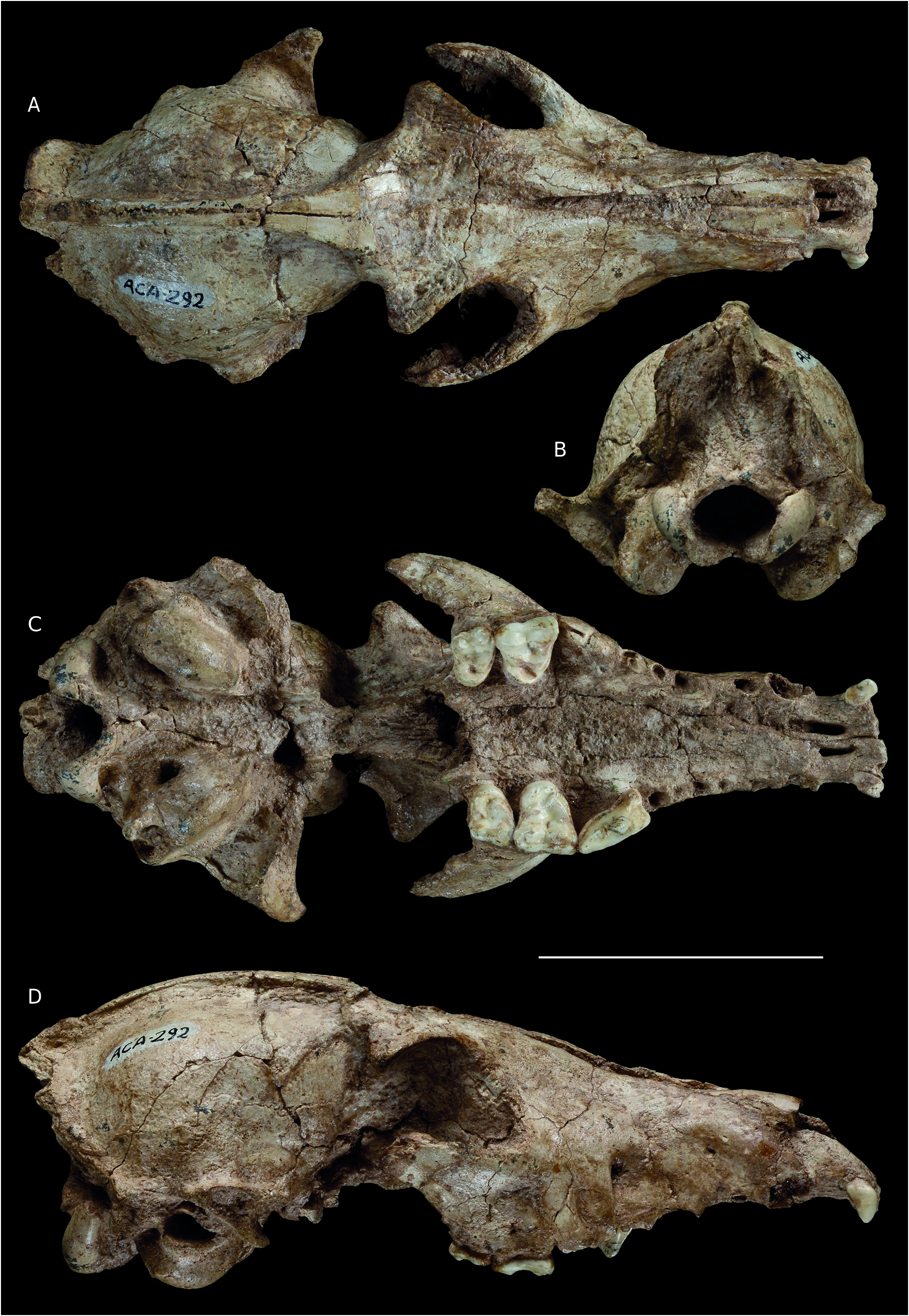
Nyctereutes donnezani
species of mammal
Enhydrocyon
Enhydrocyon is an extinct genus of bone crushing canid which inhabited North America during the Oligocene and Early Miocene, 30.8—20.4 Ma, existing for approximately .
Nurocyon
Nurocyon is an extinct member of the dog family (Canidae) from the Pliocene of Mongolia. Nurocyon chonokhariensis is the only species in the genus. The teeth of Nurocyon show adaptations to an omnivorous diet, comparable to the living raccoon dog (Nyctereutes procyonoides). The overall structure of the skull is similar to the more primitive Eucyon.