Category
page 1Prehistoric plant orders
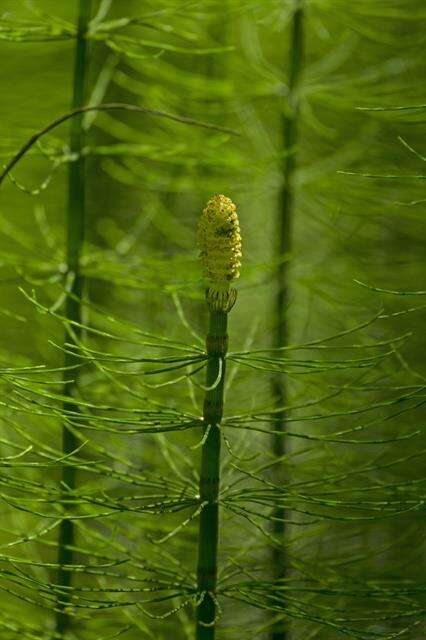
Equisetales
Equisetales is an order of subclass Equisetidae with only one living family, Equisetaceae, containing the genus Equisetum (horsetails), as well as a variety of extinct groups, including the tree-like Calamitaceae.

Bennettitales
Bennettitales (also known as cycadeoids) is an extinct order of seed plants that first appeared in the Permian period and became extinct in most areas toward the end of the Cretaceous. Bennettitales were amongst the most common seed plants of the Mesozoic, and had morphologies including shrub and cycad-like forms. The foliage of bennettitaleans is superficially nearly indistinguishable from that of cycads, but they are distinguished from cycads by their more complex flower-like reproductive organs, at least some of which were likely pollinated by insects.

Cordaitales
Cordaitales are an extinct order of gymnosperms, known from the early Carboniferous to the late Permian. Many Cordaitales had elongated strap-like leaves, resembling some modern-day conifers of the Araucariaceae and Podocarpaceae. They had cone-like reproductive structures reminiscent of those of modern conifers. Some Cordaitales formed large trees that seem to have been particularly abundant on drier ground, in tropical environments. Also, some tall trees but also shrubby and mangrove-like species of Cordaitales seem to have grown in the Carboniferous coal swamps. Cordaitales were also abunda

Lepidodendrales
Lepidodendrales (from the Greek for "scale tree") or arborescent lycophytes are an extinct order of primitive, vascular, heterosporous, arborescent (tree-like) plants belonging to Lycopodiopsida. Members of Lepidodendrales are the best understood of the fossil lycopsids due to the vast diversity of Lepidodendrales specimens and the diversity in which they were preserved; the extensive distribution of Lepidodendrales specimens as well as their well-preservedness lends paleobotanists exceptionally detailed knowledge of the coal-swamp giants’ reproductive biology, vegetative development, and role
Glossopteridales
Glossopteridales is an extinct order of seed plants, known from the Permian of Gondwana. They arose at the beginning of the Permian, and the majority or all members of the group became extinct during the Permian–Triassic extinction event, 251.9 mya. Possible Triassic records of the group have been recorded. The best known genus is Glossopteris, a leaf form genus. Other examples are Gangamopteris, Glossotheca, and Vertebraria.
Sphenophyllales
Sphenophyllales is an extinct order of articulate land plants and a sister group to the present-day Equisetales (horsetails). They are fossils dating from the Devonian to the Triassic. They were common during the Late Pennsylvanian to Early Permian, with most of the fossils coming from the Carboniferous period.
Voltziales
Voltziales is an extinct order of conifers. The group contains the ancestral lineages from which modern conifer groups emerged. Voltzialean conifers are divided into two informal groups, the primitive "walchian conifers" like Walchia, where the ovuliferous cone is composed of radial shoots and the more advanced "voltzian voltziales", also known as "transitional conifers" where the cone is composed of fertile scales with sessile seeds, like those of modern conifers. Walchian conifers generally grew as small trees. The earliest walchian conifers are known from the Middle Pennsylvanian (Moscovian
Pleuromeiales
REDIRECT Pleuromeiaceae
Drepanophycales
Drepanophycales is an order of extinct lycophyte plants of Late Silurian to Late Devonian age (around ), found in North America, China, Russia, Europe, and Australia. Sometimes known as the Asteroxylales or Baragwanathiales.
Zygopteridales
Zygopteridales is an extinct order of ferns or fern-like plants which grew primarily during the Carboniferous. It comprises two families: Zygopteridaceae, which contains at least a dozen named genera, and Teledeaceae, which comprises two genera (Teledea and Senftenbergia). A few other genera are of uncertain placement and are not assigned to any family yet.
Peltaspermales
The Peltaspermales are an extinct order of seed plants, often considered "seed ferns". They span from the Late Carboniferous to the Early Jurassic or the Jurassic-Cretaceous Boundary. It includes at least one valid family, Peltaspermaceae, which spans from the Permian to Early Jurassic, which is typified by a group of plants with Lepidopteris leaves, Antevsia pollen-organs, and Peltaspermum ovulate organs, though the family now also includes other genera like Peltaspermopsis, Meyenopteris and Scytophyllum. Along with these, two informal groups (the "Supaioids" and the "Comioids") of uncertain
Caytoniales
The Caytoniales are an extinct order of seed plants known from fossils spanning from the Middle Triassic (Anisian) to the Late Cretaceous (Campanian). They are regarded as "seed ferns" because they are seed-bearing plants with fern-like leaves. Although at one time considered angiosperms because of their berry-like cupules, that hypothesis was later disproven. Nevertheless, many authorities consider them likely ancestors or close relatives of angiosperms. The origin of angiosperms remains unclear, and they cannot be linked with any known seed plants groups with certainty.
Sawdoniales
The Sawdoniales are an order or plesion of extinct zosterophylls. The zosterophylls were among the first vascular plants in the fossil record, and share an ancestor with the living lycophytes. The group has been divided up in various ways. In their major cladistic study of early land plants, Kenrick and Crane placed most of the zosterophylls in the Sawdoniales (which they treated as a plesion).
Lyginopteridales
The Lyginopteridales are an extinct group of seed plants known from the Paleozoic. They were the first plant fossils to be described as pteridosperms (a polyphyletic group sometimes referred to as "seed ferns") and, thus, the group on which the concept of pteridosperms was first developed; they are the stratigraphically oldest-known pteridosperms, occurring first in late Devonian strata; and they have the most primitive features, most notably in the structure of their ovules. During early and most of middle Pennsylvanian times the Medullosales took over as the more important of the larger pter
Protolepidodendrales
The Protolepidodendrales are an extinct order of lycopsids that flourished from the Devonian to the lower Carboniferous (Mississippian) periods.
Medullosales
The Medullosales is an extinct order of pteridospermous seed plants characterised by large ovules with circular cross-section and a vascularised nucellus, complex pollen-organs, stems and rachides with a dissected stele, and frond-like leaves. Their nearest still-living relatives are the cycads.
Pseudosporochnales
Pseudosporochnales is an order of the extinct cladoxylopsids. It contains the Hyeniales.
Callistophytales
Callistophytales is an extinct order of spermatophytes (seed plants) which lived from the Pennsylvanian (Late Carboniferous) to Permian periods. They were mainly scrambling and lianescent (vine-like) plants found in the wetland "coal swamps" of Euramerica and Cathaysia. Like many other early spermatophytes, they could be described as "seed ferns", combining ovule-based reproduction with pinnate leaves superficially similar to modern ferns.
Protosphagnales
REDIRECT Protosphagnum
Archaeopteridales
The Archaeopteridales are an extinct order of plants belonging to Progymnospermae, and dominant forest trees of the Late Devonian. They reproduced with spores rather than seeds. They were the evolutionary precursors of the conifers of gymnosperms which also include cycads and ginkgo.
Pseudoborniales
REDIRECT Pseudobornia
Gigantopterid
Gigantopterids (Gigantopteridales) is an extinct, possibly polyphyletic group of seed plants known from the Permian period. Gigantopterids were among the most advanced land plants of the Paleozoic Era and disappeared around the Permian–Triassic extinction event around 252 million years ago. Though some lineages of these plants managed to persist initially, they either disappeared entirely or adapted radically, evolving into undetermined descendants, as surviving life prospered again in much-altered ecosystems. One hypothesis proposes that at least some "gigantopterids" became the ancestors of
Iridopteridales
Iridopteridales is an order of the extinct cladoxylopsids. It contains the genus Ibyka which is a possible ancestor of the horsetails.
Calamopityales
REDIRECT Calamopityaceae