Category
page 1Prehistoric ray-finned fish genera

Leedsichthys
Leedsichthys is an extinct genus of pachycormid fish that lived in the oceans of the Middle to Late Jurassic. It was the largest ray-finned fish, and amongst the largest fish known to have ever existed.

Xiphactinus
Xiphactinus (from Latin and Greek for "sword-ray") is an extinct genus of large predatory marine ray-finned fish that lived during the late Albian to the late Maastrichtian. The genus grew up to in length, and superficially resembled a gargantuan, fanged tarpon. It is a member of the extinct order Ichthyodectiformes, which represent close relatives of modern teleosts.

Lepidotes
Lepidotes (from , 'covered with scales') (previously known as Lepidotus) is an extinct genus of Mesozoic ray-finned fish. It has long been considered a wastebasket taxon, characterised by "general features, such as thick rhomboid scales and, for most of the species, by semi-tritorial or strongly with dozens of species assigned to it. Fossils attributed to Lepidotes have been found in Jurassic and Cretaceous rocks worldwide. It has been argued that Lepidotes should be restricted to species closely related to the type species L. gigas, which are only known from the Early Jurassic of Western and
Zenopsis
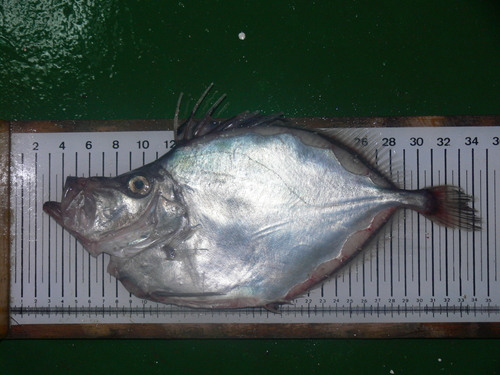
Zenopsis is a genus of dories, a group of marine fish. There are five extant species, but the genus is also known from fossils dating back to the Oligocene epoch. They largely resemble the better-known John Dory, and are typically found in relatively deep water, below normal scuba diving depth.

Cheirolepis
Cheirolepis (from , 'hand' and 'scale') is an extinct genus of marine and freshwater ray-finned fish that lived in the Devonian period of Europe and North America. It is the only genus yet known within the family Cheirolepididae and the order Cheirolepidiformes. It was among the most basal of the Devonian actinopterygians and is considered the first to possess the "standard" dermal cranial bones seen in later actinopterygians.

Protosphyraena
Protosphyraena is a fossil genus of swordfish-like marine fish, that thrived worldwide during the Cretaceous period (Albian-Maastrichtian). Fossil remains of this taxon are mainly discovered in North America and Europe, and potential specimens are also known from Asia, Africa and Australia. Its fossils are best known from the Smoky Hill Member of the Niobrara Formation of Kansas (Late Coniacian-Early Campanian).

Aspidorhynchus
Aspidorhynchus (from Ancient Greek ἀσπίς (aspís), meaning "shield", and ῥύγχος (rhúnkos), meaning "snout") is an extinct genus of predatory ray-finned fish from the Middle Jurassic to the earliest Cretaceous. Fossils have been found in Europe, Antarctica and the Caribbean.

Enchodus
Enchodus (from , 'spear' and 'tooth') is an extinct genus of aulopiform ray-finned fish related to lancetfish and lizardfish. Species of Enchodus flourished during the Late Cretaceous, where they were a widespread component of marine ecosystems worldwide, and there is some evidence that they may have survived to the Paleocene or Eocene; however, this may just represent reworked Cretaceous material.
Pachycormus
genus of fishes (fossil)

Leptolepis
Leptolepis (from , 'slight' and 'scale') is an extinct genus of stem-teleost fish that lived in what is now Europe (Germany, Luxembourg, France, England, Italy and maybe Greece) and North of Africa (Algeria, Tunisia and Morocco) during the Jurassic period (Pliensbachian–Callovian ages).

Megapiranha
Megapiranha is an extinct serrasalmid characin fish from the Late Miocene (8–10 million years ago) Ituzaingó Formation of Argentina, described in 2009. The type species is M. paranensis. It is thought to have been about in length and in weight. The holotype consists only of premaxillae and a zigzag tooth row; the rest of its body is unknown. This dentition is reminiscent of both the double-row seen in pacus, and the single row seen in the teeth of modern piranhas, suggesting that M. paranensis is a transitional form. Its bite force is estimated between .

Scheenstia
Scheenstia is an extinct genus of neopterygian ray-finned fish from the Late Jurassic–Early Cretaceous of Europe. Fossils have been found in both marine and freshwater environments.
thumb|left|Life restoration of S. maxima
Most species of the genus were previously referred to the related genus Lepidotes, but most Late Jurassic–Early Cretaceous species of that genus have since been re-classified as Scheenstia following detailed phylogenetic analysis. It is a member of Lepisosteiformes meaning that its closest living relatives are gars. The teeth of Scheenstia are low and rounded, and were likel
Plectrypops
Plectrypops is a genus of soldierfish containing two extant species, with one species in the Indo-Pacific, and another in the western Atlantic and the Caribbean. They are red and reach a length of approximately 15 cm (6 in). Some members of this genus are also known from fossil remains.

Cimolichthys
Cimolichthys (Greek for "chalk fish") is an extinct genus of large predatory marine aulopiform ray-finned fish known worldwide from the Late Cretaceous. It is the only member of the family Cimolichthyidae.

Ichthyodectes
Ichthyodectes is an extinct genus of ichthyodectid ray-finned fish which lived during the Late Cretaceous. Fossils of the species included have been found from Canada to Texas.

Diplomystus
Diplomystus is an extinct genus of freshwater and marine clupeomorph fish distantly related to modern-day extant herrings, anchovies, and sardines. It is known from the United States, Canada, China, Uzbekistan and Lebanon from the Late Cretaceous to the middle Eocene. Many other clupeomorph species from around the world were also formerly placed in the genus, due to it being a former wastebasket taxon. It was among the last surviving members of the formerly-diverse order Ellimmichthyiformes, with only its close relative Guiclupea living for longer.

Saurichthys
thumb|left|Saurichthys curionii fossil from the Middle Triassic of [[Monte San Giorgio, Switzerland]]
thumb|left|Early Triassic and [[Middle Triassic marine predators: 3. Saurichthys]]

Dapedium
Dapedium (from , 'pavement') is an genus of deep-bodied ray-finned fish belonging to the extinct family Dapediidae. Dapedium lived in the Late Triassic to the Middle Jurassic period, from the late Norian to the early Aalenian, being one of the most abundant fossil fish found in Early Jurassic deposits in Europe.

Gillicus
Gillicus was a relatively small (about long) marine ichthyodectiform ray-finned fish that lived in central North America (Western Interior Seaway), Europe and East Asia, from the late Albian to the early Maastrichtian.
Bananogmius
Bananogmius is an extinct genus of marine ray-finned fish that was found in what is now North America and Europe during the Late Cretaceous, from the Cenomanian to the Santonian. It lived in the Western Interior Seaway, which split North America in two during the Late Cretaceous, as well as the proto-North Sea of Europe.
Semionotus
Semionotus (from , 'mark' and , 'back') is an extinct genus of ray-finned fish found throughout Northern Pangaea (North America and Europe) during the late Triassic, becoming extinct in the Early Jurassic.
thumb|left|Fossil slab of S. kapffi mass mortality
thumb|left|Reconstruction of a generalized individual
Hypsocormus
Hypsocormus (from , 'height' and 'timber log') is an extinct genus of pachycormid fish from the Middle to Late Jurassic of Europe. Fossils have been found in Germany, France and the UK.
Palaeoniscum
Palaeoniscum (from , 'ancient' and 'cod-fish' or 'woodlouse') is an extinct genus of ray-finned fish from the Middle to Late Permian period (Guadalupian-Lopingian) of England, Germany, Turkey, North America and Greenland, and possibly other regions. The genus was named Palaeoniscum in 1818 by Henri Marie Ducrotay de Blainville, but was later misspelled as Palaeoniscus by Blainville and other authors (notably Louis Agassiz). Palaeoniscum belongs to the family Palaeoniscidae.
Knightia
Knightia is an extinct genus of clupeid bony fish that lived in the freshwater lakes and rivers of North America and Asia during the Eocene epoch. The genus was erected by David Starr Jordan in 1907, in honor of the late University of Wyoming professor Wilbur Clinton Knight, "an indefatigable student of the paleontology of the Rocky Mountains." It is the official state fossil of Wyoming, and the most commonly excavated fossil fish in the world.
Stratodus
Stratodus ("layer tooth") is a genus of giant prehistoric aulopiform fish found in Cretaceous-aged marine strata of Kansas, Alabama, Morocco, Israel, Niger, South Dakota, and Jordan. It has also been found in the Tamaguélelt Formation of Mali, dating to the Lower Eocene, indicating that Stratodus survived the Cretaceous-Paleogene extinction event. This sleek fish has an upper jaw filled with multiple rows of tiny teeth and was the largest aulopiform, reaching in length.
Pholidophorus
Pholidophorus (from , 'horny scale' and , 'to bear') is an extinct genus of stem-teleost fish. Numerous species were assigned to this genus in the past, but only the type species Pholidophorus latiusculus, from the Late Triassic of Europe, is considered to be a valid member of the genus today.
Armigatus
Armigatus is an extinct genus of marine clupeomorph fishes belonging to the order Ellimmichthyiformes. These fishes lived in the Cretaceous (Albian to Campanian, about 103-72 million years ago); their fossil remains have been found in Mexico, Europe, the Middle East and North Africa, suggesting the genus ranged across the Tethys Sea.
Caturus
Caturus (from , 'down' and 'tail') is an extinct genus of predatory marine fishes in the family Caturidae in the order Amiiformes, related to modern bowfin. It has been suggested that the genus is non-monophyletic with respect to other caturid genera.
Thrissops
Thrissops (from , 'hair' and 'look') is an extinct genus of stem-teleost fish from the Jurassic period (Kimmeridgian to Tithonian). Its fossils are known from the Solnhofen Limestone, as well as the Kimmeridge Clay.
Sinamia
Sinamia is an extinct genus of freshwater amiiform fish which existed in China, Japan, South Korea and North Korea during the Early Cretaceous period. Like the related bowfin, it has an elongated low-running dorsal fin, though this was likely convergently evolved.
Gwawinapterus
Gwawinapterus beardi is a species of saurodontid ray-finned fish from the Late Cretaceous period of British Columbia, Canada. While initially described as a very late-surviving member of the pterosaur family Istiodactylidae, further examination has cast doubt on the identification of the specimen as a pterosaur, and research published in 2012 identified the remains as having come from a saurodontid fish.
Birgeria
Birgeria is a genus of carnivorous marine ray-finned fish from the Triassic period. Birgeria had a global distribution, with fossil known from Madagascar, Spitsbergen, Germany, Switzerland, Italy, Slovenia, China, Russia, Canada and Nevada, United States. The oldest fossils are from Griesbachian aged beds of the Wordie Creek Formation of East Greenland. Birgeria existed throughout the entire Triassic period, from the very beginning just after the Permian-Triassic mass extinction, up to the very end with its extinction during the Triassic-Jurassic mass extinction.
Callipurbeckia
Callipurbeckia is an extinct genus of marine semionotiform ray-finned fish from the Late Jurassic and Early Cretaceous periods. Fossils have been found in Germany, Tanzania, and England.
Aidachar
Aidachar (named for Aydahar, a mythical Kazakh dragon) is an extinct genus of freshwater ichthyodectiform ray-finned fish from the Late Cretaceous (Cenomanian-Turonian) of Central Asia and North Africa.
Lycoptera
Lycoptera is an extinct genus of fish that lived from Lower Cretaceous, Barremian to Aptian in present-day China, North Korea, Mongolia and Siberia. Although there is record from Jurassic Formation in Siberia, its age remains questionable. It is known from abundant fossils representing sixteen species, which serve as important index fossil used to date geologic formations in China. Along with the genus Peipiaosteus, Lycoptera has been considered a defining member of the Jehol Biota, a prehistoric ecosystem famous for its feathered dinosaurs, which flourished for 20 million years during the Ear
Rhacolepis
Rhacolepis is an extinct genus of ray-finned fish from the Cretaceous Romualdo Formation of Brazil. Complete fossilised hearts from this species have been recovered.thumb|R. buccalis skull|leftleft|thumb|Inside the stomach of a Notelops|Notelops brama.
left|thumb|R. buccalis with several hundred small shrimp in stomach.
thumb|Fossil in Vienna
Dastilbe
Dastilbe is an extinct genus of prehistoric marine & freshwater ray-finned fish from the Early Cretaceous of Brazil. It was a relative of modern milkfish.
Phareodus
Phareodus is a genus of freshwater fish from the Paleocene to Eocene of North America.
Amblypterus
Amblypterus (from , 'blunt' and 'wing' or 'fin') is an extinct genus of freshwater ray-finned fish that lived during the Gzhelian (upper Carboniferous) and Cisuralian (lower Permian) epoch in what is now Europe (Czech Republic, France, Germany, Switzerland) and possibly India and Argentina. Potential indeterminate records stretch as far back as the early Carboniferous.
Amiopsis
Amiopsis is an extinct genus of freshwater and marine ray-finned fish belonging to the family Amiidae, making it closely related to the modern bowfin. Fossils are known from the Late Jurassic Solnhofen Limestone, Germany (A. lepidota), the Early Cretaceous Purbeck Group, England (A. damoni), La Pedrera de Rúbies Formation, Spain (A. woodwardi) and Bernnissant Iguanodon locality, Belgium (A. dolloi) and the Late Cretaceous (Cenomanian) of the Balkans (A. prisca type species). The monophyly of the genus is questionable, due to it being based on a single character, "the presence of three or more
Belonostomus
Belonostomus (from , 'dart' and 'mouth') is a genus of prehistoric ray-finned fish that was described by Louis Agassiz in 1844. It is a member of the order Aspidorhynchiformes, a group of fish known for their distinctive elongated rostrums.
Pleuropholis
Pleuropholis is an extinct genus of prehistoric ray-finned fish.
Pachyrhizodus
Pachyrhizodus is an extinct genus of ray-finned fish that lived during the Cretaceous to Paleocene in what is now Europe, North America, South America, and Oceania. Many species are known, primarily from the Cretaceous of England and the midwestern United States.
Cooyoo australis
Cooyoo ("fish" in the Yirandhali language) is an extinct genus of ichthyodectid ray-finned fish known from the Lower Cretaceous. It contains a single species, C. australis, known from the Albian-aged Toolebuc and Allaru Formations of Queensland, Australia. C. australis was originally named by Arthur Smith Woodward as a species of Portheus (now a probable synonym of Xiphactinus) in 1894, which was later amended to Xiphactinus.
Uarbryichthys
Uarbryichthys is a genus of primitive ginglymodian ray-finned fish from fossil beds near the Talbragar River Bed. The various species were lake-dwelling fish that lived during the Upper Jurassic of Australia, and are closely related to the macrosemiids. The living animal would have had a superficial resemblance to a very small porgie, scup, or sea bream, but with a heterocercal tail fin.
Mimipiscis
Mimipiscis is a fossil genus of very primitive ray-finned fishes from the Upper Devonian Gneuda and Gogo formations of Western Australia.
Chondrosteus
Chondrosteus ("cartilage bone" in Greek) is a genus of extinct marine actinopterygian (ray-finned fish) belonging to the family Chondrosteidae. It lived during the Hettangian and Sinemurian (early Early Jurassic) in what is now England. Chondrosteus is related to sturgeons and paddlefishes as part of the clade Acipenseriformes, and is one of the earliest known definitive members of the group. Similar to sturgeons, the jaws of Chondrosteus were free from the rest of the skull (projectile jaw system). Its scale cover was reduced to the upper lobe of the caudal fin like in paddlefish. It is repre
Berycopsis
Berycopsis is an extinct genus of marine ray-finned fish from the Late Cretaceous period. Fossils are known from England, Germany, and Lebanon. A potential specimen is known from the Czech Republic.
Caproberyx
Caproberyx is an extinct genus of marine acanthomorph ray-finned fish, possibly a holocentrid, from the Late Cretaceous.
Heterolepidotus
Heterolepidotus is an extinct genus of prehistoric ray-finned fish.
Araripichthys
Araripichthys is an extinct genus of marine ray-finned fish that lived from the Aptian to Coniacian stages of the Cretaceous period. The genus is named after the Araripe Basin, where it was found in the Crato and Santana Formations. Other fossils of the genus have been found at Goulmima in Morocco, the Tlayua Formation of Mexico and the Apón Formation of Venezuela.
Coccolepis
Coccolepis is an extinct genus of prehistoric marine ray-finned fish in the family Coccolepididae. Originally including most species within the family, it is now restricted to two species from the Late Jurassic Solnhofen Limestone of Germany. The holotype of C. bucklandi, designated and described by Louis Agassiz, was thought to be lost but was later rediscovered in Neuchâtel.
Peipiaosteus
thumb|left|Peipiaosteus pani fossil
thumb|left|Peipiaosteus pani fossil
thumb|left|Fossil of the Peipiaosteidae|peipiaosteid Yanosteus longidorsalis (at [[MHNT), a close relative of Peipiaosteus]]
Ophiopsis
Ophiopsis is an extinct genus of prehistoric ray-finned fish belonging to the family Ophiopsidae. Specimens are known from the Tithonian-age Solnhofen Formation of Bavaria, Germany.
Potanichthys xingyiensis
Potanichthys is a fossil genus of thoracopterid fish found in deposits from China dating to the Ladinian age of the Middle Triassic epoch. The type species is P. xingyiensis, though P. wushaensis is considered as the alternative species name. It is known to have been the first vertebrate ever to have glided over water, and thus the first fish ever that had over-water gliding strategy. The genus name Potanichthys is a portmanteau of the Ancient Greek ποτάνος (potanos, winged/flying) and ιχθύς (ichthys, fish). The species epithet refers to Xingyi city which is near the site where Potanichthys wa
Cladocyclus
Cladocyclus (derived from the Greek κλάδος/kládos ("branch") and κύκλος/kýklos ("circle")) is an extinct genus of marine ichthyodectiform ray-finned fish from the middle Cretaceous. It was a predator of about in length.
Platysomus
thumb|left|Platysomus gibbosus
thumb|left|Fossil of Platysomus circularis in the Field Museum of Natural History, Chicago
Gyrolepis
Gyrolepis is an extinct genus of prehistoric ray-finned fish from the Middle-Late Triassic epochs in what is now Europe. It is known both from complete specimens and isolated skeletal elements, such as scales or teeth.
thumb|left|Isolated teeth and scales ascribed to Gyrolepis
Kyphosichthys
Kyphosichthys is an extinct genus of basal actinopterygian bony fish known from the lower Middle Triassic (Anisian) marine deposits (Guanling Formation) in Luoping, eastern Yunnan Province, southwestern China. The species is the first known fossil record of highly deep-bodied ginglymodians.
Histionotus
Histionotus is an extinct genus of prehistoric ray-finned fish.