Category
page 1Presidency of Lyndon B. Johnson

Cold War
1947–1991 tension between the Soviet Union and the United States and their respective allies

Vietnam War
The Vietnam War was an armed conflict in Vietnam, Laos, and Cambodia fought between North Vietnam and South Vietnam and their allies. North Vietnam was supported by the Soviet Union and China, while South Vietnam was supported by the United States and other anti-communist nations. The conflict was the second of the Indochina wars and a proxy war of the Cold War between the Soviet Union and US. The Vietnam War was one of the postcolonial wars of national liberation, a theater in the Cold War, and a civil war, with civil warfare a defining feature from the outset. Direct US military involvement escalated from 1965 until US forces were withdrawn in 1973. The fighting spilled into the Laotian and Cambodian civil wars, which ended with all three countries becoming communist in 1975.

space race
competition to explore space between USA and USSR

Assassination of John F. Kennedy
John F. Kennedy, the 35th president of the United States, was assassinated while riding in a presidential motorcade through Dealey Plaza in Dallas, Texas, on Friday, November 22, 1963. Kennedy was in the vehicle with his wife Jacqueline, Texas governor John Connally, and Connally's wife Nellie, when he was fatally shot from the nearby Texas School Book Depository by Lee Harvey Oswald, a former U.S. Marine. The motorcade rushed to Parkland Memorial Hospital, where Kennedy was pronounced dead about 30 minutes after the shooting; Connally was also wounded in the attack but recovered. Vice President Lyndon B. Johnson was hastily sworn in as president two hours and eight minutes later aboard Air Force One at Dallas Love Field.
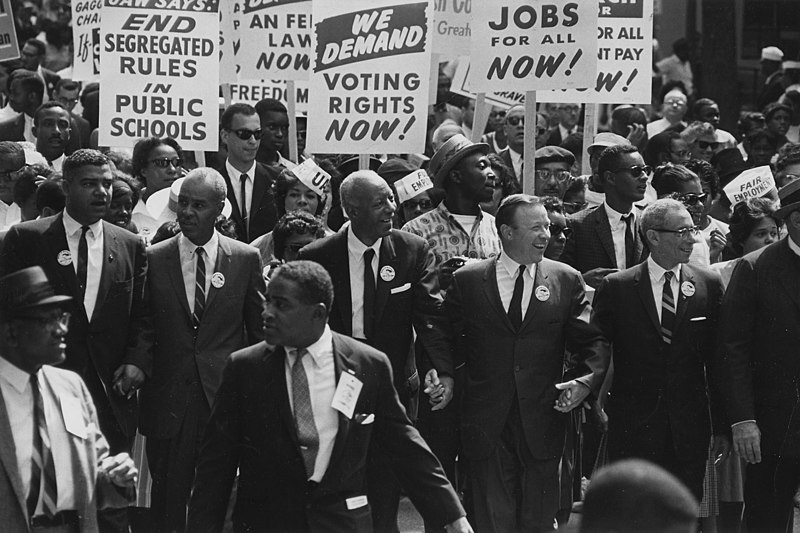
civil rights movement
1954–1968 U.S. nonviolent social movement

Civil Rights Act of 1964
landmark U.S. civil rights and labor law
Medicare
US federal health insurance
assassination of Robert F. Kennedy
1968 murder in Los Angeles, California, US
1964 United States presidential election
45th quadrennial U.S. presidential election
Voting Rights Act of 1965
piece of federal legislation in the United States that prohibits racial discrimination in voting
Warren Commission
U.S. presidential commission on the Assassination of J. F. Kennedy
Great Society
political program launched by Democratic President Lyndon B. Johnson in 1964–65
assassination of Martin Luther King Jr.
1968 murder in Memphis, Tennessee, U.S

Medicaid
Medicaid is a government program in the United States that provides health insurance for adults and children with limited income and resources. The program is partially funded and primarily managed by state governments, which also have wide latitude in determining eligibility and benefits, but the federal government sets baseline standards for state Medicaid programs and provides a significant portion of their funding. States are not required to participate in the program, although all have since 1982.
Twenty-fourth Amendment to the United States Constitution
1964 amendment prohibiting poll taxes
Freedom of Information Act
1967 US statute regarding access to information produced by the US government; gave individuals, including non-US citizens, rights to apply for looking into government files including those - with restrictions - of the US intelligence agencies
Johnson Doctrine
foreign policy doctrine of the Johnson administration
Dominican Civil War
1965 civil war in the Dominican Republic
Clean Air Act
United States federal law designed to control air pollution on a national level
Chicken tax
US tariff on light trucks, instituted in response to European tariffs on US chicken
first inauguration of Lyndon B. Johnson
8th United States intra-term presidential inauguration
University of Texas Tower Shooting
mass shooting
Immigration and Nationality Act of 1965
American immigration law
second inauguration of Lyndon B. Johnson
45th United States presidential inauguration
War on Poverty
unofficial name for legislation first introduced by U.S. president Lyndon B. Johnson during his State of the Union address on January 8, 1964
presidency of Lyndon B. Johnson
U.S. presidential administration from 1963 to 1969
1964 T-39 shootdown incident
a Cold War incident involving an unarmed American T-39 being shot down by a Soviet MiG
Cecil W. Stoughton
American photographer (1920–2008)
Cold War (1962–1979)
phase of the Cold War between 1962–1979
Let Us Continue
President Lyndon B. Johnson's speech after the assassination of John F. Kennedy
Project MINARET
National Security Agency surveillance operation
David Ludwig Bloch
German-born American lithographer and painter (1910–2002)
Social Security Amendments of 1965
act of Congress in the United States
withdrawal of Lyndon B. Johnson from the 1968 United States presidential election
Lyndon B. Johnson's decision to stop his 1968 re-election campaign