Category
page 1Printing

newspaper
thumb|Front page of the newspaper The New York Times on [[Armistice Day, 1918]]

printing
upright=1.5|thumb|From top to bottom, left to right: cylinder seal of a scene, block used for [[woodblock printing, movable type, printing press, lithograph press, offset press used for modern lithographic printing, linotype machine for hot metal typesetting, digital printer, 3D printer in action.]]

starch
thumb|Structure of the amylose molecule
thumb|Structure of the amylopectin molecule
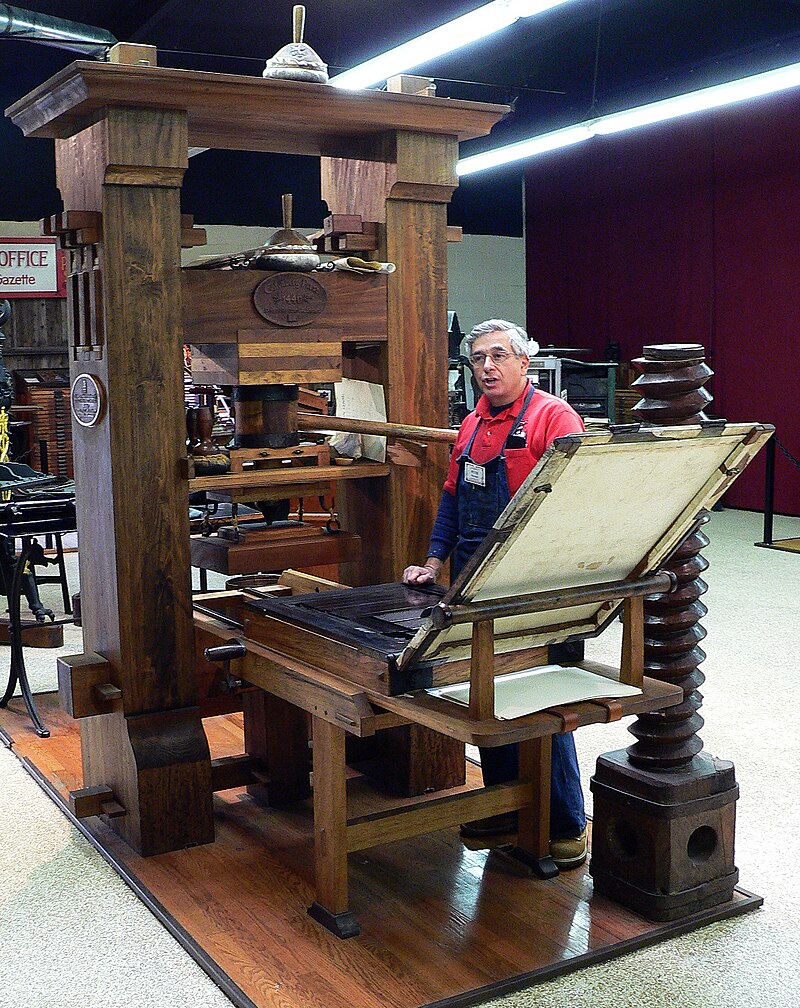
printing press
device for evenly printing ink onto a print medium

CMYK color model
subtractive color model, used in color printing

sheet music
handwritten or printed form of musical notation that uses musical symbols to indicate the pitches, rhythms, or chords of a song or instrumental musical piece

stencil
thumb|320px|right|Parts of a stencil
thumb|320px|Stenciled warning sign in Singapore
thumb|Stencilled Gaelic type
thumb|320px|Japanese Ise-katagami stencil for printing textiles
Stencilling produces an image or pattern on a surface by applying pigment to a surface through an intermediate object, with designed holes in the intermediate object. The holes allow the pigment to reach only some parts of the surface creating the design. The stencil is both the resulting image or pattern and the intermediate object; the context in which stencil is used makes clear which meaning is intended. In practic

mezzotint technique
thumb|Saint Agnes, mezzotint by John Smith (engraver)|John Smith after [[Godfrey Kneller, usually thought to be a portrait of Kneller's daughter, Catherine Voss]]

tabloid
type of newspaper format
printing company
company for printed products
moiré pattern
interference pattern

Pantone
Pantone LLC (stylized as PANTONE) is an American limited liability company headquartered in Carlstadt, New Jersey, and best known for its Pantone Matching System (PMS), a proprietary color naming system used in a variety of industries, notably graphic design, fashion design, product design, textile industry, printing, as well as manufacturing and supporting the management of color from design to production, in physical and digital formats, across coated paper and uncoated paper stocks, as well as cotton, polyester, nylon and plastics.

coating
thumb|Lacquer being sprayed onto a cabinet
A coating is a covering that is applied to the surface of an object, or substrate. The purpose of applying the coating may be decorative, functional, or both. Coatings may be applied as liquids, gases or solids e.g. powder coatings.
linotype machine
printing machine used in hot type

printmaking
thumb|alt=Hokusai, The Underwave off Kanagawa, depicting various waves. A ship can be seen upon the waters.|300px|Katsushika Hokusai The Underwave off Kanagawa, 1829/1833, color [[woodcut, Rijksmuseum Collection]]
thumb|300px|Rembrandt, [[Self-portrait, etching, ]]
thumb|300px|Francisco Goya, There is No One To Help Them, [[Disasters of War series, aquatint ]]
version, edition or translation
specific version of a work, resulting from its edition, adaptation, or translation; set of substantially similar copies of a work (use with P31 ["instance of"])

electrotyping
thumb|right|Schematic apparatus for electrotyping. An electric current flows from the battery, through the copper anode, the electrolyte, and the coated mold. A copper film (the electrotype) grows onto the electrically conducting coating of the mold.|alt=Line drawing.
monotype
typesetting system
3D printer
machine that uses additive manufacturing to create tridimensional objects
stereotype
solid plate resulting from the application of a stereotyping technique
lenticular printing
technology for creating optical illusions
recto and verso
"front" and "back" sides of a leaf of paper

Photochrom
thumb|280px|1890s photochrom print of Neuschwanstein Castle, [[Bavaria, Germany]]
Photochrom, Fotochrom, Photochrome or the Aäc process is a process of colorizing from a single black-and-white negative with subsequent photographic transfer onto lithographic printing plates. The process is a photographic variant of chromolithography (color lithography). Because no color information was preserved in the photographic process, the photographer would make detailed notes on the colors within the scene and use the notes to transfer the image through colored gels onto the printing plates.
peel
tool
printer's mark
symbol used as a trademark by printers
typefounding matrix
copper block acting as a mould for making movable characters or raised letters on a hard support
page number
number itself, which may appear in various places on the page

mordant
thumb|200 px|Mordant red 19 is a typical mordant dye. Like many mordant dyes, it features the [[azo group (RN=NR) and various sites for chelating to metal cations.]]
thumb|A French Indienne, a printed or painted textile in the manner of Indian productions, which used mordants to fix the dyes
Michler's ketone
chemical compound
type metal
metal alloys used in traditional typefounding and hot metal typesetting
sandwich panel
structural panel made of three layers
type case
compartmentalized wooden box used to store movable type used in letterpress printing
grammage
Grammage and basis weight, in the pulp and paper industry, are measures of the area density of a paper product, that is, its mass per unit of area. Two common ways of expressing the area density of a paper product are used:
Expressed in grams (g) per square metre (g/m2), regardless of its thickness (caliper) (known as grammage). This is the measure used in most parts of the world. It is often notated as gsm on paper product labels and spec sheets.
Expressed in terms of the mass per number of sheets of a specific paper size (known as basis weight). The convention used in the United States and
letter
paper size
edible ink printing
Images printed with edible food coloring

woodburytype
thumb|Boston and Maine Corporation|Boston & Maine locomotive at the [[Baldwin Locomotive Works by John Carbutt, 1871]]
Urbatagirk
Urbatagirk (), or "The Book of Friday", was the first printed book in the Armenian language. It was printed in Venice (Italy) in 1512 by Hakob Meghapart. Its content was partly religious, partly secular, consisting of cures and prayers for the sick, ancient writings, myths, long quotations from Grigor Narekatsi's Book of Lamentations, the Prayer of Cyprianos of Antioch, the story of the Virgin and Justinian, etc.
book format
size of a book, manuscript, or sheet of paper resulting from folding standard sheets into multiple pages
form
element os printing techniques
Lines per inch
measurement of printing resolution
color printing
reproductive printing with color
Zebra
programming language
quad
metal spacer used in typography
platen
thumb|300px|Section of a platen printing press in use. The platen is the sturdy plate which applies the pressure to the paper and type.
A platen (or platten) is a platform with a variety of roles in printing or manufacturing. It can be a flat metal (or earlier, wooden) plate pressed against a medium (such as paper) to cause an impression in letterpress printing. Platen may also refer to a typewriter roller which friction-feeds paper into position below the typebars or print head. It can refer to the glass surface of a copier, and the rotating disk used to polish semiconductor wafers.
Worshipful Company of Stationers and Newspaper Makers
London livery company
graphic charter
Project document
linen tester
magnifying device used to check fabrics quality
private press
publishing and printing operation operated as an artistic or craft-based endeavor
National Printing Bureau
Japanese government agency, produces banknotes
popular print
15th–18th century Western low-quality printed image

old master print
paper illustration by woodcut, engraving or etching
wall decal
decorative item
combination plate
type of tableware
paper density
mass per unit volume
diatype
printing machine
superimposition
thumb|Superimposition of hand stencils at Cueva de las Manos
Superimposition is the placement of one thing over another, typically so that both are still evident. Superimpositions are often related to the mathematical procedure of superposition.
thermal copier
photocopier based using heat to produce images
substrate
(in a converting process such as printing or coating) base material onto which, e.g. images, will be printed
reverse-contrast typeface
type of typeface or custom lettering
St. Andrew's cross
saltire cross, crossed X design, sometimes on sheets of stamps