Category
page 1Production economics

capitalism
Capitalism is an economic system based on the private ownership of the means of production and its use for the purpose of obtaining profit. This socioeconomic system has developed historically in several stages, and is defined by a number of constituent elements: private property, profit motive, capital accumulation, competitive markets, commodification, wage labor, and an emphasis on innovation and economic growth. Capitalist economies may experience business cycles of economic expansion followed by recessions.

economic production
planned economic activity of creating or transforming goods or services
means of production
reference to physical, non-human inputs used in production to produce wealth
synergy
Synergy is the concept that a combined effect of two or more entities is greater than the sum of their individual effects. The term synergy comes from the Attic Greek word συνεργία ' from ', , meaning "working together". Synergy is similar in concept to emergence.

fixed cost
business expenses that are not dependent on the level of goods or services produced by the business
%20-%20Hartsook%20photo%20LCCN94506959%20Trim.jpg)
Fordism
thumb|Henry Ford, after whom Fordism is named
Fordism is an industrial engineering and manufacturing system that serves as the basis of modern social and labor-economic systems that support industrialized, standardized mass production and mass consumption. The concept is named after Henry Ford. It is used in social, economic, and management theory about production, working conditions, consumption, and related phenomena, especially regarding the 20th century. It describes an ideology of advanced capitalism centered around the American socioeconomic systems in place in the post-war economic boom
economies of scale
the cost advantages that enterprises obtain due to size, throughput, or scale of operation, with cost per unit of output generally decreasing with increasing scale as fixed costs are spread out over more units of output

production–possibility frontier
graphical representation of all efficient combinations of goods quantities
variable cost
costs that change in proportion to the good or service that a business produces
diminishing returns
additional factor of production resulting in smaller increase in output
mode of production
Marxist term for way of producing goods
intermediate good
good used as input by a process of production
production function
physical output of a production process to physical inputs or factors of production
transaction cost
cost incurred in making an economic exchange
weighted average cost of capital
rate that a company is expected to pay on average to all its security holders to finance its assets; firm’s cost of capital
Cobb–Douglas production function
macroeconomic formula that describes productivity
decentralized autonomous organization
computer network organization model
returns to scale
what happens as the scale of production increases in the long run, when all input levels (e.g. physical capital usage) are variable (chosen by the firm)
operations management
area of management concerned with designing and controlling the process of production and redesigning business operations
material requirements planning
production planning, scheduling, and inventory control system

isoquant
An isoquant (derived from quantity and the Greek word ', , meaning "equal"), also known as iso-product curve or equal product curve''' in microeconomics, is a contour line drawn through the set of points at which the same quantity of output is produced while changing the quantities of two or more inputs. The x and y axis on an isoquant represent two relevant inputs, which are usually a factor of production such as labour, capital, land, or organisation.
land
(in economics) comprises all naturally occurring resources whose supply is inherently fixed
limiting factor
bottleneck variable limiting the evolution of a system
Baumol effect
rise of salaries in jobs that have seen little rise of productivity
margin
set of constraints conceptualised as a border
marginal product
change in output resulting from employing one more unit of a particular input, keeping other input quantities constant
economy of scope
efficiencies formed by variety of products or services offered
theory of the firm
approach of price maximisation
diseconomies of scale
mechanisms that cause larger firms and governments to produce goods and services at increased per-unit costs
productive capacity
Robinson Crusoe economy
economy with one consumer, one producer and two goods
materials management
material management supply chain
indirect costs
costs that are not directly accountable to a cost object
total factor productivity
macroeconomic quantity; the ratio of aggregate output to aggregate inputs
Constant elasticity of substitution
concept in economics
returns
benefit distributed to the owner of a factor of production
data envelopment analysis
nonparametric method in operations research and econometrics

sexual division of labour
delegation of different tasks between males and females
experience curve effects
finding that costs decrease in fixed proportion to production quantity and experience
capacity utilization
economic term
Leontief production function
Function in economics
peer production system
production of goods and services that relies on self-organizing communities of individuals
rationalization
attempt to change a pre-existing ad hoc workflow into one based on a published rules set
long run and short run
concept in economics
capitalist mode of production
Marxist theory
marginal rate of technical substitution
slope of the isoquant; amount by which the quantity of one input has to be reduced when one extra unit of another input is used, so that output remains constant
productive efficiency
situation in which an economy cannot produce more of one good without sacrificing the production of another
envelope theorem
theorem in mathematics and economics
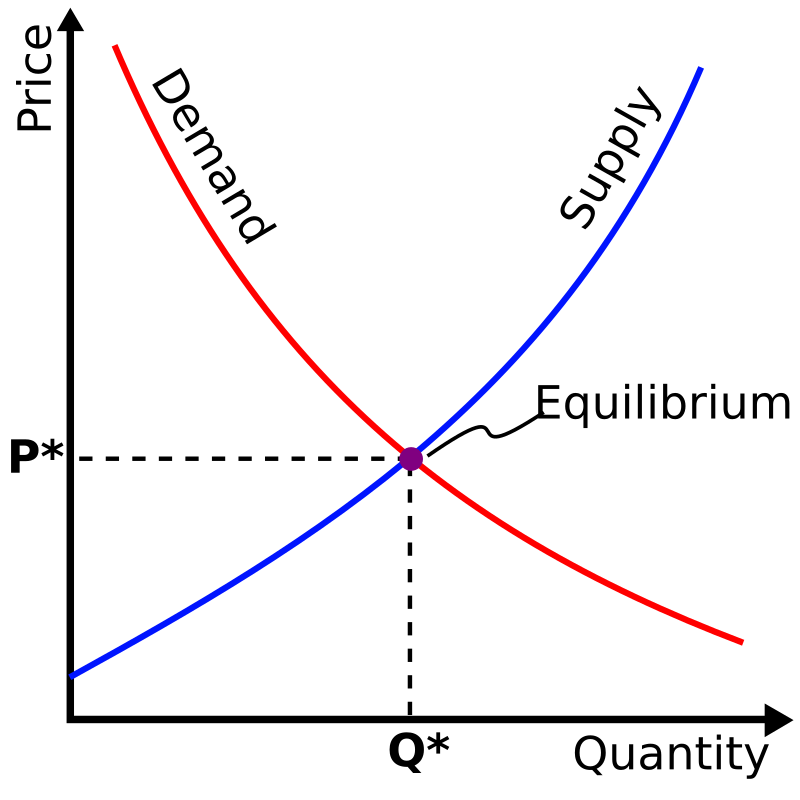
excess supply
situation in which the quantity of a good or service supplied is more than the quantity demanded
sales and operations planning
integrated business management process
Cost driver
Major share in Cost of a Product
Inclusive capitalism
theoretical concept and policy movement
Industrial production index
list of countries by industrial production growth rate
Wikimedia list article
learning by doing
learning through practice, self-perfection and minor innovations
production set
location modified to allow easy production of motion pictures
scheduling
the process of arranging, controlling and optimizing work and workloads in a production process or manufacturing process; is used to allocate plant and machinery resources, plan human resources, plan production processes and purchase materials

Value and Capital
book
marginal profit
method of profit maximization

Foundations of Economic Analysis
non-fiction work by Paul A. Samuelson