Category
page 1Projectors
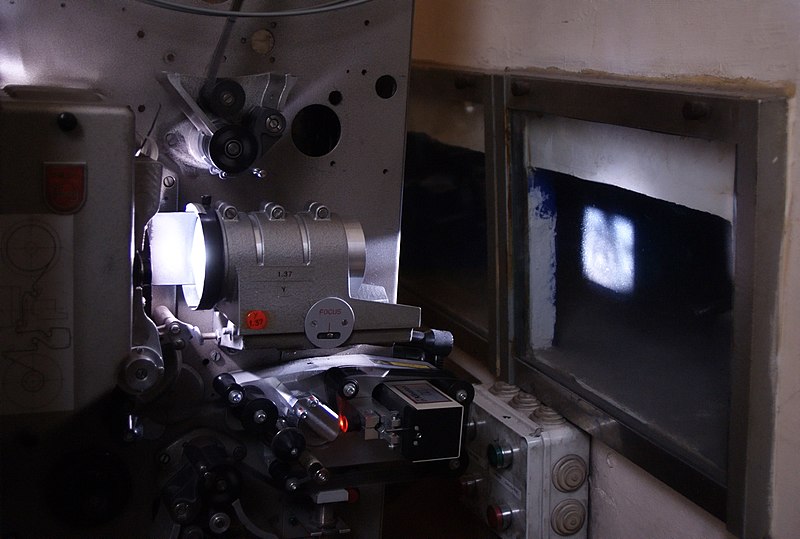
film projector
opto-mechanical device for displaying motion picture film by projecting it onto a screen
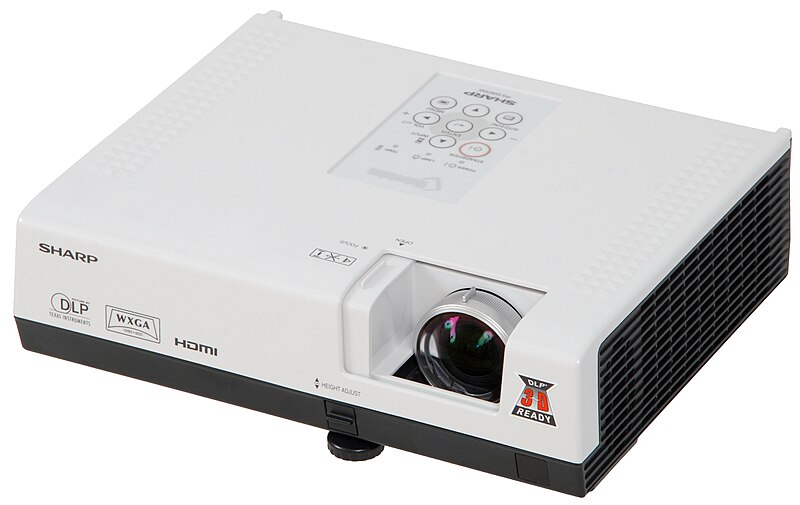
video projector
image projector that receives a video signal and projects the corresponding image on a projection screen using a lens system
magic lantern
early type of image projector
overhead projector
device that projects a transparent image

projector
thumb|right|Acer inc.|Acer projector, 2012
thumb|Digital Light Processing|DLP type home theatre projector in use
A projector or image projector is an optical device that projects an image (or moving images) onto a surface, commonly a projection screen. Most projectors create an image by shining a light through a small transparent lens, but some newer types of projectors can project the image directly, by using lasers. A virtual retinal display, or retinal projector, is a projector that projects an image directly on the retina instead of using an external projection screen.
opaque projector
Optical device
digital light processing
display technology uses micromirrors to create a picture
liquid crystal on silicon
type of display technology that uses liquid crystal on a silicon backplane

Bioscop
thumb|Bioskop|200px
The Bioscop is a movie projector developed in 1895 by German inventors and filmmakers Max Skladanowsky and his brother Emil Skladanowsky (1866–1945).

Vitascope
thumb|1896 poster advertising the Vitascope|upright=1.4
Vitascope was an early film projector first demonstrated in 1895 by Charles Francis Jenkins and Thomas Armat. They had made modifications to Jenkins' patented Phantoscope, which cast images via film and electric light onto a wall or screen. The Vitascope is a large electrically-powered projector that uses light to cast images. The images being cast are originally taken by a kinetoscope mechanism onto gelatin film. Using an intermittent mechanism, the film negatives produced up to fifty frames per second. The shutter opens and closes to re
LCD projector
type of video projector
handheld projector
image projector in a handheld device
CRT projector
video projector using cathode ray tube
Eidophor
thumb|120px|Eidophor
thumb|120px|Eidophor front view
thumb|120px|Eidophor back view
Theatrograph
350px|thumb|Animatograph in Rossio, [[Lisbon]]
The Theatrograph is the first commercially produced 35mm film projector in Britain. It was first demonstrated by R.W. Paul at Finsbury Technical College on February 20, 1896. The use of Paul's Theatrograph in music halls up and down the country popularised early cinema in Britain. It was first revealed to the public at the Egyptian Hall in Piccadilly, London.
3LCD
thumb|180px|The 3LCD Logo
3LCD is the name and brand of a major LCD projection color image generation technology used in modern digital projectors. 3LCD technology was developed and refined by Japanese imaging company Epson in the 1980s and was first licensed for use in projectors in 1988. In January 1989, Epson launched its first 3LCD projector, the VPJ-700.
Keystone effect
image distortion caused by projection
Cinemeccanica
thumb|Victoria 5 projector
thumb|The sound of the projector running, without the light (Xenon lamp). The projector used in the Nova Cinema (Brussels)|Nova is an Italian Cinemeccanica projector, Victoria 9 model, one of the last models produced by this firm.
Phantoscope
right|thumb|Image of the Phantoscope from Scientific American 1896
The Phantoscope was a film projection machine, a creation of Charles Francis Jenkins and Thomas Armat. In the early 1890s, Jenkins began creating the projector. He later met Thomas Armat, who provided financial backing and assisted with necessary modifications.