Category
page 1Prose texts in Latin

Philosophiæ Naturalis Principia Mathematica
1687 work by Isaac Newton describing his laws of motion and gravitation

Salic law
major body of Frankish law governing all the Franks of Frankia under the rule of its kings during the Old Frankish Period
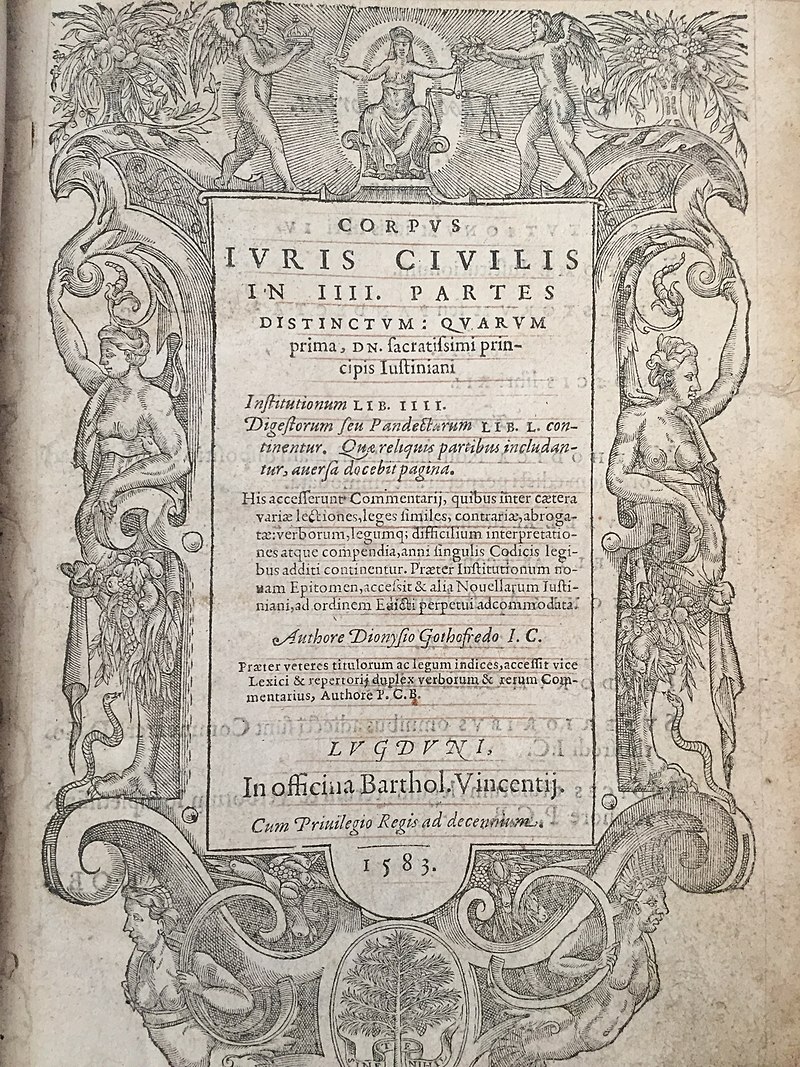
Corpus Juris Civilis
collection of fundamental works in jurisprudence as codified by Justinian

Natural History
Encyclopedia published circa AD 77–79 by Pliny the Elder

The City of God
book by Augustine of Hippo

Augustan History
late Roman collection of biographies, written in Latin, of the Roman Emperors, their junior colleagues, designated heirs and usurpers of the period 117–284; much of its content is regarded as fictional

Confessions
autobiographical work by Saint Augustine
Codex Theodosianus
Compilation of laws of Roman Empire (438)
Liber Pontificalis
book of biographies of popes

Notitia Dignitatum
document detailing the administrative organisation of the Eastern and Western Roman Empires
Treaty of Nerchinsk
the first border treaty between Russia and Siberian-Manchu ruled China (1689)
Digest
Roman law digest

The Consolation of Philosophy
philosophical work by Boethius

De architectura
treatise on architecture by Vitruvius

De re coquinaria
thumb|right|The Apicius manuscript (ca. 900 AD) of the Fulda monastery|monastery of Fulda in Germany, which was acquired in 1929 by the [[New York Academy of Medicine]]

Cupid and Psyche
story from the Metamorphoses of Apuleius
Code of Justinian
part of the 6th century codification of Roman law
Antonine Itinerary
Imperial Roman register of roads and stations
Disquisitiones Arithmeticae
book written by Carl Friedrich Gauss

De Agri Cultura
book by Cato the Elder
Distichs of Cato
Latin collection of proverbial wisdom and morality

Itinerarium Burdigalense
4th-century account of a pilgrimage from Bordeaux to the Holy Land
Novellae Constitutiones
one of the four components of the “Corpus juris civilis” drafted under the Byzantine emperor Justinian

De doctrina Christiana
theological text written by Saint Augustine of Hippo (4 books)
Institutes of Justinian
sixth century codification of Roman law

Apocolocyntosis
thumb|300px|Apocolocyntosis, from a 9th-century manuscript of the Abbey library of Saint Gall.
The Apocolocyntosis (divi) Claudii, literally Pumpkinification/Gourdification of (the Divine) Claudius, is a satire on the Roman emperor Claudius (), which, according to Cassius Dio, was written by Seneca the Younger. A partly extant Menippean satire, an anonymous work called Ludus de morte Divi Claudii ("Play on the Death of the Divine Claudius") in its surviving manuscripts, may or may not be identical to the text mentioned by Cassius Dio. "Apocolocyntosis" is a word play on "apotheosis", the proce

Rhetorica ad Herennium
ancient Latin book on rhetoric
Proslogion
The Proslogion () is a prayer (or meditation) written by the medieval cleric Saint Anselm of Canterbury between 1077 and 1078. In each chapter, Anselm juxtaposes contrasting attributes of God to resolve apparent contradictions in Christian theology. This meditation is considered the first-known philosophical formulation that sets out an ontological argument for the existence of God.

Apologeticus
thumb|A manuscript of Tertullian's Apologeticus from the 1440s.
Apologeticus ( or Apologeticus) is a text attributed to Tertullian according to Christian tradition, consisting of apologetic and polemic. In this work Tertullian defends Christianity, demanding legal toleration and that Christians be treated like all other sects of the Roman Empire. It is in this treatise that one finds the sentence "Plures efficimur, quotiens metimur a vobis: semen est sanguis Christianorum," which has been liberally and apocryphally translated as "the blood of the martyrs is the seed of the Church" (Apologeticu

Dialogus de oratoribus
book by Publius Cornelius Tacitus
Panegyrici Latini
collection of twelve ancient Roman panegyric orations
Raffelstetten customs regulations
Latin-language medieval document about trade between Germans and Slavs

Naturales quaestiones
Latin work of natural philosophy by Seneca

De Christiana expeditione apud Sinas
Book by Nicolas Trigault

De re rustica
work on agriculture by Marcus Terentius Varro
Edictum Theodorici
statute
China Illustrata
book on China compiled by Athanasius Kircher from various Jesuit reports
Littera Florentina
Epistulae by Pliny the Younger
series of personal missives by Pliny the Younger directed to his friends
Notitia Urbis Constantinopolitanae
Groans of the Britons
Briton missive to Rome, 5th century
De miseria condicionis humane
12th century Latin text by Innocent III
Historia Caroli Magni
book

De ludo scachorum
manuscript on the game of chess

Commentariolum Petitionis
essay supposedly written by Quintus Tullius Cicero
Itinerarium Regis Ricardi
literary work
commentarii
Commentarii (Latin, Greek: hupomnemata) are notes to assist the memory, or memoranda. This original idea of the word gave rise to a variety of meanings: notes and abstracts of speeches for the assistance of orators; family memorials, the origin of many of the legends introduced into early Roman history from a desire to glorify a particular family; and diaries of events occurring in their own circle kept by private individuals. An example of this is the day-book drawn up for Trimalchio in Petronius's Satyricon (Satyricon, 53) by his actuarius, a slave to whom the duty was specially assigned. Ot