Category
page 1Protein biosynthesis

ribosome
A ribosome () is a ribonucleoprotein particle found in all cells, both prokaryotic and eukaryotic, responsible for the synthesis of proteins. A ribosome functions as a molecular machine in the translation of strands of messenger RNA (mRNA) and production of a protein. A ribosome links amino acids together in the order specified by the codons of mRNA molecules to form polypeptide chains. A ribosome is made up of a large and a small subunit, each consisting of one or more ribosomal RNA molecules and many ribosomal proteins. The ribosomes and associated molecules are also known as the translation

standard genetic code
rules by which information encoded within genetic material is translated into proteins

messenger RNA
large family of RNA molecules that convey genetic information from DNA to the ribosome, where they specify the amino acid sequence of the protein products of gene expression

protein biosynthesis
cellular metabolic process in which a protein is formed, using the sequence of a mature mRNA or circRNA molecule to specify the sequence of amino acids in a polypeptide chain

translation
in biology, the creation of proteins using information from nucleic acids
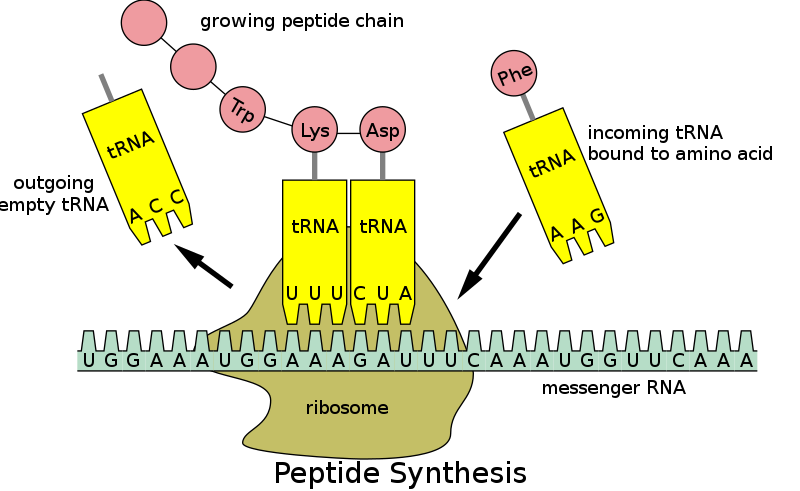
transfer RNA
adaptor molecule composed of RNA, typically 76–90 nucleotides, that carries amino acids to the ribosome as directed by codons in mRNA

ribosomal RNA
RNA component of the ribosome, essential for protein synthesis in all living organisms
molecular chaperone
proteins assisting in protein folding
post-translational protein modification
covalent and generally enzymatic modification of proteins during or after protein biosynthesis
stop codon
a codon that marks the end of a sequence
Shine–Dalgarno sequence
ribosomal binding site in prokaryotic messenger RNA

polysome
thumb|Several ribosomes synthesizing a polypeptide on the same mRNA strand
A polysome (or polyribosome or ergosome) is a group of ribosomes bound to an mRNA molecule like "beads" on a "thread". It consists of a complex of an mRNA molecule and two or more ribosomes that act to translate mRNA instructions into polypeptides. Originally coined "ergosomes" in 1963, they were further characterized by Jonathan Warner, Paul M. Knopf, and Alex Rich.
aminoacyl tRNA synthetase
class of enzymes
reading frame
which divides a sequence of nucleotides into a set of consecutive, non-overlapping triplets
transfer-messenger RNA
bifunctional RNA that has properties of a tRNA and an mRNA
Kozak consensus sequence
in molecular biology
translation elongation factor
class of proteins
wobble base pair
RNA base pair that does not follow Watson-Crick base pair rules; guanine–uracil (G-U), hypoxanthine–uracil (I-U), hypoxanthine–adenine (I-A), or hypoxanthine–cytosine (I-C)
translation initiation factor
protein which binds to a ribosome to initiate translation
protein synthesis inhibitor
compound which inhibits the synthesis of proteins

translation release factor
class of proteins / complexes
Synonymous substitution
form of Mutation
internal ribosome entry site
sequence in the 5′ UTR of some mRNAs where a ribosome can bind
.jpg)
translation elongation factor EFG/EF2
EF-G (elongation factor G, historically known as translocase) is a prokaryotic elongation factor involved in mRNA translation. As a GTPase, EF-G catalyzes the movement (translocation) of transfer RNA (tRNA) and messenger RNA (mRNA) through the ribosome.

Aminoacyl-tRNA
thumb|An aminoacyl-tRNA, with the tRNA above the arrow and a generic amino acid below the arrow. Most of the tRNA structure is shown as a simplified, colorful ball-and-stick model; the terminal adenosine and the amino acid are shown as [[structural formulas. The arrow indicates the ester linkage between the amino acid and tRNA.]]
inteins
REDIRECT Protein splicing#Intein
artificial gene synthesis
fully artificial DNA production method based on solid-phase DNA synthesis
30S
smaller subunit of the 70S ribosome found in prokaryote cells
Bacterial translation
protein synthesis process in bacteria
50S
Protein critical for bacterial RNA translation
Ribonuclease III
class of enzymes
translation elongation factor EF1A, eukaryotic/archaeal
EF-Tu (elongation factor thermo unstable) is a prokaryotic elongation factor responsible for catalyzing the binding of an aminoacyl-tRNA (aa-tRNA) to the ribosome. It is a G-protein, and facilitates the selection and binding of an aa-tRNA to the A-site of the ribosome. As a reflection of its crucial role in translation, EF-Tu is one of the most abundant and highly conserved proteins in prokaryotes. It is found in eukaryotic mitochondria as TUFM.
protein splicing
post-translational removal of peptide sequences from a protein sequence
ribosomal binding site
sequence of nucleotides
eukaryotic translation initiation factor
proteins
DNA codon table
list of standard rules to translate DNA encoded information into proteins
eukaryotic initiation factor 2
Eukaryotic Initiation Factor 2 (eIF2) is a eukaryotic initiation factor. It is required for most forms of eukaryotic translation initiation. eIF2 mediates the binding of tRNAiMet to the ribosome in a GTP-dependent manner. eIF2 is a heterotrimer consisting of an alpha (also called subunit 1, EIF2S1), a beta (subunit 2, EIF2S2), and a gamma (subunit 3, EIF2S3) subunit.
enhancer RNAs
type of RNA
N-end rule
cell-free protein synthesis
molecular biology technique
mature messenger RNA
a eukaryotic RNA transcript
protein dynamics
kinesin walking on a microtubule