Category
page 1Protein structure

X-ray crystallography
technique used for determining the atomic or molecular structure of a crystal, in which the ordered atoms cause a beam of incident X-rays to diffract into specific directions

peptide bond
covalent chemical bond linking two consecutive amino acid monomers along a peptide or protein chain

denaturation
chemical process by which proteins lose their three-dimensional structure

ubiquitin
Ubiquitin is a small () regulatory protein found in most tissues of eukaryotic organisms, i.e., it is found ubiquitously. It was discovered in 1975 by Gideon Goldstein and further characterized throughout the late 1970s and 1980s. Four genes in the human genome code for ubiquitin: UBB, UBC, UBA52 and RPS27A.

Protein Data Bank
international open access database of protein and nucleic acid structures
protein folding
the process of assisting in the covalent and noncovalent assembly of single chain polypeptides or multisubunit complexes into the correct tertiary structure
structural biology
study of molecular structures in biology
protein primary structure
the full linear sequence of amino acids of a peptide or protein

Folding@home
Folding@home (FAH or F@h) is a distributed computing project aimed to help scientists develop new therapeutics for a variety of diseases by the means of simulating protein dynamics. This includes the process of protein folding and the movements of proteins, and is reliant on simulations run on volunteers' personal computers. Folding@home is currently based at the University of Pennsylvania and led by Greg Bowman, a former student of Vijay Pande.
protein structure
three-dimensional arrangement of atoms in an amino acid-chain molecule
globular protein
spherical ("globe-like") protein; one of the common protein types (the others being fibrous, disordered and membrane proteins); somewhat water-soluble (forming colloids in water), unlike the fibrous or membrane proteins
dihedral angle
angle between two planes in space
protein secondary structure
general three-dimensional form of local segments of proteins
protein tertiary structure
3D shape of protein molecule

N-terminus
thumb|350px|A tetrapeptide (example: Val-Gly-Ser-Ala) with green highlighted N-terminal α-amino acid (example: L-[[valine) and blue marked C-terminal α-amino acid (example: L-alanine). This tetrapeptide could be encoded by the mRNA sequence 5'-GUU GGU AGU GCU-3'.]]
The N-terminus (also known as the amino-terminus, NH2-terminus, N-terminal end or amine-terminus) is the start of a protein or polypeptide, referring to the free amine group (-NH2) located at the end of a polypeptide. Within a peptide, the amine group is bonded to the carboxylic group of another amino acid, making it a chain. That l
post-translational protein modification
covalent and generally enzymatic modification of proteins during or after protein biosynthesis
protein domain
conserved part of a protein

C-terminus
thumb|500px|A tetrapeptide (example: Valine|Val-Gly-Ser-Ala) with green highlighted N-terminal α-amino acid (example: L-[[valine) and blue marked C-terminal α-amino acid (example: L-alanine).]]
The C-terminus (also known as the carboxyl-terminus, carboxy-terminus, C-terminal tail, carboxy tail, C-terminal end, or COOH-terminus) is the end of an amino acid chain (protein or polypeptide), terminated by a free carboxyl group (-COOH). When the protein is translated from messenger RNA, it is created from N-terminus to C-terminus. The convention for writing peptide sequences is to put the C-terminal
protein quaternary structure
number and arrangement of multiple folded protein subunits in a multi-subunit complex
integral membrane protein
type of membrane protein that is permanently attached to the biological membrane
side chain
oligomeric or polymeric chemical group that is attached to a core part of the molecule called "main chain" or backbone

Rosetta@home
Rosetta@home is a volunteer computing project researching protein structure prediction on the Berkeley Open Infrastructure for Network Computing (BOINC) platform, run by the Baker lab. Rosetta@home aims to predict protein–protein docking and design new proteins with the help of about fifty-five thousand active volunteered computers processing at over 487,946 gigaFLOPS on average as of September 19, 2020. Foldit, a Rosetta@home videogame, aims to reach these goals with a crowdsourcing approach. Though much of the project is oriented toward basic research to improve the accuracy and robustness o
cryogenic electron microscopy
form of transmission electron microscopy (TEM) where the sample is studied at cryogenic temperatures
molecular docking
attempt to predict the structure of the intermolecular complex formed between two or more molecules
Edman degradation
degradation
protein structure prediction
constructing an atomic-resolution model of a protein from its amino acid sequence
circular dichroism
dichroism involving circularly polarized light.
desmosine
Desmosine is an amino acid found uniquely in elastin, a protein found in connective tissue such as skin, lungs, and elastic arteries.
beta barrel
protein domain

racemization
In chemistry, racemization is a conversion, by heat or by chemical reaction, of an optically active compound into a racemic (optically inactive) form. This creates a 1:1 molar ratio of enantiomers and is referred to as a racemic mixture (i.e. contain equal amount of (+) and (−) forms). Plus and minus forms are called dextrorotation and levorotation. The D and L enantiomers are present in equal quantities, the resulting sample is described as a racemic mixture or a racemate. Racemization can proceed through a number of different mechanisms, and it has particular significance in pharmacology in
Levinthal's paradox
paradox that the number of possible protein-folding configurations is too large, so that it is impossible that the lowest-energy configuration will be found purely thermodynamically
binding site
region on a protein or piece of DNA or RNA to which ligands may form a chemical interaction
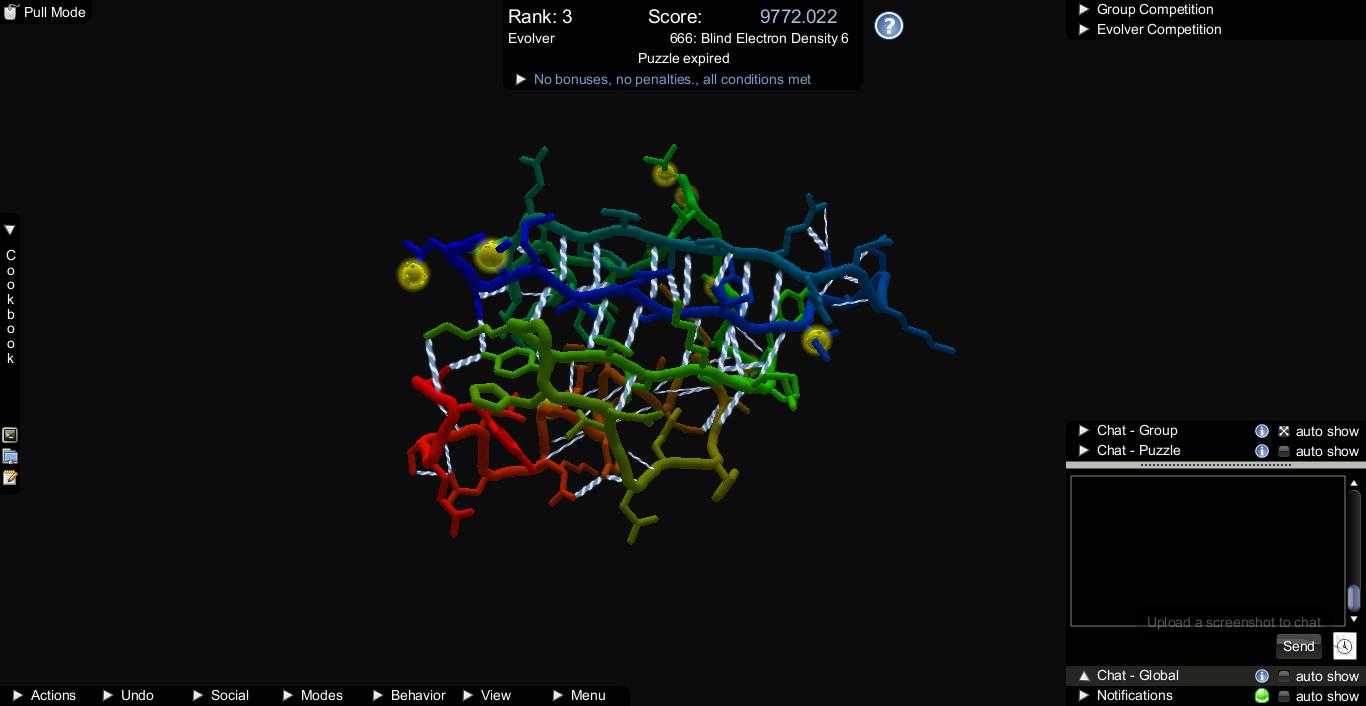
Foldit
Foldit is an online puzzle video game about protein folding. It is part of an experimental research project developed by the University of Washington, Center for Game Science, in collaboration with the UW Department of Biochemistry. The objective of Foldit is to fold the structures of selected proteins as perfectly as possible, using tools provided in the game. The highest scoring solutions are analyzed by researchers, who determine whether or not there is a native structural configuration (native state) that can be applied to relevant proteins in the real world. Scientists can then use these
isoform
a member of a set of highly similar proteins that originate from a single gene and are the result of genetic differences
structural motif
(in a chain-like biological molecule, such as a protein or nucleic acid) supersecondary structure, which also appears in a variety of other molecules
guanidinium chloride
chemical compound
conserved sequence
similar DNA, RNA or protein sequences within genomes or among species
Template:Protein primary structure
Wikimedia template
intrinsically unstructured proteins
protein type
Structural Classification Of Proteins
database that hierarchical categories protein structures based on structural and evolutionary relationships
oxanion hole
pocket in the active site of an enzyme
thermostability
thumb|Crystal structure of β-[[glucosidase from Thermotoga neapolitana (PDB: 5IDI). Thermostable protein, active at 80°C and with unfolding temperature of 101°C.]]
protein design
design of new protein molecules to design novel activity, behavior, or purpose, and to advance basic understanding of protein function
iron-sulfur protein
class of proteins in which iron is coordinated with cysteine sulfur and also with inorganic sulfur
protein dimer
macromolecular complex formed by two, usually non-covalently bound, macromolecules
conjugated protein
protein that contains a non-peptide component

Cyclol
thumb|350px|right|Figure 1: In the classic cyclol reaction, two peptide groups are linked by a N-C' bond, converting the carbonyl oxygen into a hydroxyl group. Although this reaction occurs in a few cyclic peptides, it is disfavored by Thermodynamic free energy|free energy, mainly because it eliminates the [[resonance stabilization of the peptide bond. This reaction was the basis of Dorothy Wrinch's cyclol model of proteins.]]

Polyhistidine-tag
thumb|right|200px|A simple gravity flow column for Ni2+-affinity chromatography. The sample and subsequent buffers are manually poured into the column and collected at the bottom end after flowing through the resin bed (in light blue at the base of the column).

citrullination
thumb|upright=1.3|The chemical conversion of arginine to citrulline, known as citrullination or deimination.
Citrullination or deimination is the conversion of the amino acid arginine in a protein into the amino acid citrulline. Citrulline is not one of the 20 standard amino acids encoded by DNA in the genetic code. Instead, it is the result of a post-translational modification. Citrullination is distinct from the formation of the free amino acid citrulline as part of the urea cycle or as a byproduct of enzymes of the nitric oxide synthase family.
ribbon diagram
3D schematic representation of protein structure
native state
proper form of a protein or nucleic acid
Protein trimer
complex of three proteins
Nuclear magnetic resonance spectroscopy of proteins
field of structural biology
Anfinsen's dogma
Molecular biology hypothesis
Chemical affinity
In biochemistry, avidity refers to the accumulated strength of multiple affinities of individual non-covalent binding interactions, such as between a protein receptor and its ligand, and is commonly referred to as functional affinity. Avidity differs from affinity, which describes the strength of a single interaction. However, because individual binding events increase the likelihood of occurrence of other interactions (i.e., increase the local concentration of each binding partner in proximity to the binding site), avidity should not be thought of as the mere sum of its constituent affinities
homology modeling
method of protein structure prediction
hydrolyzed protein
solution derived from the hydrolysis of a protein into its component amino acids and peptides
molten globule
various types of partially folded protein states found in mildly denaturing conditions (e.g. low pH, mild denaturant, or high temperature), collapsed with some native-like secondary structure and a dynamic tertiary structure
Fluorescence anisotropy
term
electron crystallography