Category
page 1Proto-writing

pictogram
thumb|upright=1.35|Sampling of US National Park Service pictograms
quipu
thumb|259x259px|Quipu in the Cleveland Museum of Art in Cleveland, Ohio.
Quipu ( ), also spelled khipu (, ; , ), are record-keeping devices fashioned from knotted cords. They were historically used by various cultures in the central Andes of South America, most prominently by the Inca Empire.
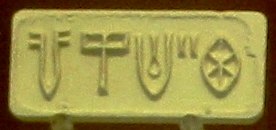
Indus script
script, short strings of symbols associated with the Indus Valley Civilization
Aztec script
mixed ideographic/phonetic writing system for Nahuatl

Wampum
thumb|300px|right|Quahog (left) and whelk (right) wampum
thumb|right|A representation of the original Two Row Wampum Treaty|Two Row Wampum treaty belt
thumb|Modern examples and interpretations of wampum
thumb|right|Haudenosaunee wampum belt
Vinča symbols
set of symbols found upon Neolithic era (6th to 5th millennia BC) artifacts from the Vinča culture of Central Europe and Southeastern Europe

proto-writing
thumb|right|The Kish tablet, bearing pictographic symbols. Some of the symbols are written in a “…seemingly archaic form…” according to the CDLI entry.
Tărtăria tablets
archaeological artifact
Dispilio Tablet
wooden tablet bearing inscribed markings, discovered in Dispilio, Greece
Jiahu symbols
ancient carvings on artifacts in China

Nsibidi
Nsibidi (also known as Nsibiri, Nchibiddi or Nchibiddy) is a system of symbols or proto-writing developed by the Ejagham in the southeastern part of Nigeria and South Western part of Cameroon.
They are classified as pictograms, though there have been suggestions that some are logograms or syllabograms.
Naxi Dongba
pictographic writing system
Mesoamerican writing systems
one of 3 cradles of civilization thought to have developed writing independently
veve
A veve (also spelled vèvè or vevè) is a religious symbol commonly used in different branches of Vodun throughout the African diaspora, such as Haitian Vodou and Louisiana Voodoo. The veve acts as a "beacon" for the lwa, and will serve as a lwas representation during rituals.
Pre-Christian Slavic writing
hypothesized writing system
Gradeshnitsa tablets
Bulgarian Neolithic artefacts with incised marks
Neolithic symbols in China
marks inscribed on Chinese Neolithic pottery
warazan
thumb|right|250px|Example of warazan at the Museum of Science, Tokyo University of Science
thumb|right|250px|Instruction to use warazan to record the level of tax assessed, in the Yaeyama-jima Kuramoto Kujichō (1873 copy of the 1857 original); the fourth to sixth characters in the fifth line from the right read「わら算」(University of the Ryukyus Library)
was a system of record-keeping using knotted straw at the time of the Ryūkyū Kingdom. In the Southern Ryukyuan languages of the Sakishima Islands it was known as barazan and on Okinawa Island as warazani or warazai. Formerly used in particular in
Olmec hieroglyph
signs found on the Cascajal Block, which may represent Olmec writing
siglas poveiras
proto-writing system
semasiography
Semasiography ('writing with signs', from Greek 'signification' + 'writing') is the use of symbols, called semasiographs, to "communicate information without the necessary intercession of forms of speech". This non-phonetic based technique is studied in semasiology within the field of linguistics.