Category
page 1Pseudocereals

Quercus
An oak is a hardwood tree or shrub in the genus Quercus of the beech family. They have spirally arranged leaves, often with lobed edges, and a nut called an acorn, borne within a cup. The genus is widely distributed in the Northern Hemisphere, with some 500 species, both deciduous and evergreen. Fossil oaks date back to the Middle Eocene. Molecular phylogeny shows that the genus is divided into Old World and New World clades, but many oak species hybridise freely, making the genus's history difficult to resolve.

Fagopyrum esculentum
Buckwheat (Fagopyrum esculentum) or common buckwheat is a flowering plant in the knotweed family Polygonaceae cultivated for its grain-like seeds and as a cover crop. Buckwheat cultivation originated around the 6th millennium BC in the region of what is now Yunnan Province in southwestern China. The name "buckwheat" is used for several other species, such as Fagopyrum tataricum, a domesticated food plant raised in Asia.

Amaranthus
Amaranthus is a genus of plants commonly known as amaranths. Some species are known by variants of the common name "pigweed". Some members are annual and others are perennial. The plant can grow from tall with a succulent, hollow stem. Parts of the plant vary from green to reddish. Catkin-like cymes of densely packed flowers grow in the summer or fall.

acorn
thumb|English oak acorn
thumb|Acorns of the willow oak in South Carolina (from small to large, counterclockwise from center): Q. phellos (willow oak), Q. falcata (southern red oak; top right), Q. alba (white oak), and Q. coccinea (scarlet oak). Scale bar at upper right is 1 cm.

Chenopodium quinoa
Quinoa (Chenopodium quinoa; , from Quechua ' or ') is a flowering plant in the amaranth family. It is an herbaceous annual plant grown as a crop primarily for its edible seeds; the seeds are high in protein, dietary fiber, B vitamins and dietary minerals especially potassium and magnesium in amounts greater than in many grains. Quinoa is not a grass but rather a pseudocereal botanically related to spinach and amaranth (Amaranthus spp.), and originated in the Andean region of northwestern South America. It was first used to feed livestock 5,2007,000 years ago, and for human consumption 3,0004,0

Atriplex
Atriplex () is a plant genus of about 250 species, known by the common names of saltbush and orache (; also spelled orach). It belongs to the subfamily Chenopodioideae of the family Amaranthaceae s.l..
The genus is quite variable and widely distributed. It includes many desert and seashore plants and halophytes, as well as plants of moist environments.
The generic name originated in Latin and was applied by Pliny the Elder to the edible oraches. The name saltbush derives from the fact that the plants retain salt in their leaves; they are able to grow in areas affected by soil salination.

Salvia hispanica
species of plant

Amaranthus caudatus
species of plant
%201200.jpg)
Celosia
Celosia ( ) is a small genus of edible and ornamental plants in the amaranth family, Amaranthaceae. Its species are commonly known as woolflowers, or, if the flower heads are crested by fasciation, cockscombs. The plants are well known in East Africa's highlands and are used under their Swahili name, .

Fagopyrum tataricum
species of plant

Amaranthus cruentus
species of plant

pseudocereal
thumb|Quinoa, a common pseudocereal
thumb|Buckwheat is the most widely consumed pseudocereal. This image shows (left to right) buckwheat seeds, [[crispbread and buckwheat flakes.]]
A pseudocereal or pseudograin is one of any non-grasses that are used in much the same way as cereals (true cereals are grasses). Pseudocereal can be further distinguished from other non-cereal staple crops (such as potatoes) by their being processed like a cereal: their seed can be ground into flour and otherwise used as a cereal. Prominent examples of Pseudocereals include amaranth (love-lies-bleeding, red amarant

Chenopodium pallidicaule
species of plant

Chenopodium berlandieri
species of plant

Boscia senegalensis
species of plant

Kitniyot
thumb|Kitniyot in the market
Kitniyot (, ) is a Hebrew word meaning legumes. During the Passover holiday, however, the word kitniyot (or kitniyos in Ashkenazi dialects) takes on a broader meaning to include grains and seeds such as rice, corn, sunflower seeds, and sesame seeds, in addition to legumes such as beans, peas, and lentils.

Amaranthus acanthochiton
species of plant
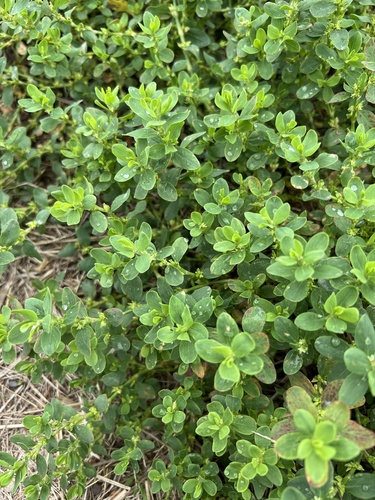
Polygonum erectum
species of plant
Iva annua
species of plant
amaranth grain
edible grain of the Amaranth genus

Eriogonum fasciculatum
species of plant