Category
page 1Pseudoscorpion families
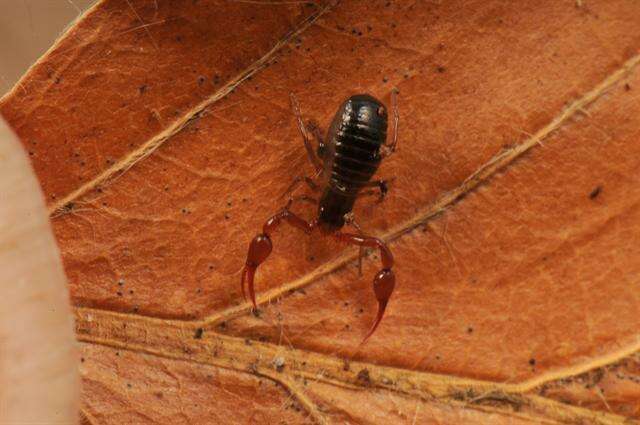
Neobisiidae
Neobisiidae is a family of pseudoscorpions distributed throughout Africa, the Americas and Eurasia and consist of 748 species in 34 genera. Some species live in caves while some are surface-dwelling.

Chthoniidae
Chthoniidae is a family of pseudoscorpions within the superfamily Chthonioidea. The family contains more than 600 species in about 30 genera. Fossil species are known from Baltic, Dominican, and Burmese amber. Chthoniidae now includes the former families Tridenchthoniidae, and Lechytiidae which has been demoted to subfamilies.

Cheliferidae
Cheliferidae is a family of pseudoscorpions in the order Pseudoscorpiones, first described by Antoine Risso in 1827.

Chernetidae
Chernetidae is a family of pseudoscorpions, first described by Anton Menge in 1855.
Ideoroncidae
Ideoroncidae is a family of pseudoscorpions belonging to the order Pseudoscorpiones. Members of the family are known from Asia, Africa, western North America and South America.
Garypidae
Garypidae is a family of pseudoscorpions, first described by Eugène Simon in 1879.
Pseudogarypidae
The Pseudogarypidae are a small family of pseudoscorpions. Most recent species are found in North America, while one species is endemic to Tasmania.
Syarinidae
Syarinidae is a family of pseudoscorpions in the order Pseudoscorpiones. There are at least 20 genera and 110 described species in Syarinidae.
Geogarypidae
Geogarypidae is a family of pseudoscorpions, which was described in 1930 by American arachnologist Joseph Conrad Chamberlin.

Olpiidae
Olpiidae is a family of pseudoscorpions in the superfamily Garypoidea. It contains the following genera:
Hyidae
Hyidae is a family of pseudoscorpions. It was described in 1930 by American arachnologist Joseph Conrad Chamberlin. Habitats include plant litter and caves. They are found in South and Southeast Asia, Madagascar, and Australia.
Bochicidae
Bochicidae is a family of pseudoscorpions distributed throughout the Americas from Texas and Mexico to South America, from the Antilles to Venezuela, Guyana and Brazil, as well as in Europe (Iberian Peninsula). Members of the family can be diagnosed mainly by features of the claws, notably the presence of exactly 12 trichobothria on each claw (members of other similar families possess many more) and a long, as opposed to short, venom duct. Some species live in caves while some are surface-dwelling.
Menthidae
Menthidae is a family of pseudoscorpions, first described by Joseph Conrad Chamberlin in 1930.
Sternophoridae
The Sternophoridae are a family of pseudoscorpions with about 20 described species in three genera. While Afrosternophorus is an Old World genus, found mainly in Australasia (with, despite its name, only one African species), the other two genera are found in the New World, from El Salvador to the southern USA and in the Dominican Republic.

Withiidae
Withiidae is a family of pseudoscorpions, first described by Joseph Conrad Chamberlin in 1931.
Gymnobisiidae
Gymnobisiidae is a family of pseudoscorpions found throughout South America and southern Africa. South Africa hosts eight distinct species including the troglobitic Gymnobisium inukshuk.

Garypinidae
Garypinidae is a family of pseudoscorpions, first described by Eugen von Daday in 1889.
Cheiridiidae
Cheiridiidae is a family of pseudoscorpions belonging to the order Pseudoscorpiones. It was described in 1894 by Danish zoologist Hans Jacob Hansen.
Atemnidae
Atemnidae is a family of pseudoscorpions, first described by Kyukichi Kishida in 1929.
Pseudochiridiidae
Pseudochiridiidae is a family of pseudoscorpions. It was described in 1923 by American arachnologist Joseph Conrad Chamberlin. Pseudochiridiids are relatively small pseudoscorpions. They are found in plant litter or beneath tree bark. The family was sometimes treated as a subfamily of the Cheiridiidae, but has since been reinstated.
Larcidae
REDIRECTLarca
Feaellidae
Feaellidae is a family of pseudoscorpions, first described by Edvard Ellingsen in 1906.
Pseudotyrannochthoniidae
Pseudotyrannochthoniidae is a family of pseudoscorpions, belonging to the superfamily Chthonioidea. It is one of the most primitive living groups of pseudoscorpions and contains fewer than 100 species in 6 genera. Living members of the group have a strongly disjunct distribution, likely reflecting ancient vicariance, occurring in Australia, Asia, Southern Africa and Madagascar, Western North America and southern South America. Fossils species are known from the Eocene Baltic and Bitterfeld amber, which represent members of extant Asian genera.