Category
page 1Quantum field theory

elementary particle
quantum particle having no known substructure; quark, electron, photon, etc.

Higgs boson
elementary particle transmitting the Higgs field giving particles mass

boson
thumb|upright=1.6|The class of Bosons is one of the two fundamental classes of subatomic particle, the other being [[fermions. All subatomic particles must be one or the other. A composite particle (hadron) may fall into either class depending on its composition.]]

antimatter
thumb|A cloud chamber photograph of the first observed [[positron, 2 August 1932]]
fermion
thumb|upright=1.6|Fermions form one of the two fundamental classes of subatomic particle, the other being [[bosons. All subatomic particles must be one or the other. A composite particle (hadron) may fall into either class depending on its composition.]]
In particle physics, a fermion is a subatomic particle that follows Fermi–Dirac statistics. Fermions have a half-integer spin (spin , spin , etc.) and obey the Pauli exclusion principle. These particles include all quarks and leptons and all composite particles made of an odd number of these, such as all baryons and many atoms and nuclei. Ferm

spin
intrinsic form of angular momentum as a property of quantum particles

antiparticle
thumb|alt=Diagram illustrating the particles and antiparticles of electron, neutron and proton, as well as their "size" (not to scale). It is easier to identify them by looking at the total mass of both the antiparticle and particle. On the left, from top to bottom, is shown an electron (small red dot), a proton (big blue dot), and a neutron (big dot, black in the middle, gradually fading to white near the edges). On the right, from top to bottom, are shown the anti electron (small blue dot), anti proton (big red dot) and anti neutron (big dot, white in the middle, fading to black near the edg

quantum field theory
theoretical framework combining classical field theory, special relativity, and quantum mechanics
quantum electrodynamics
Abelian gauge theory describing quantum interactions of the electromagnetic field with matter
quantum chromodynamics
theory of strong interactions, a fundamental force describing the interactions between quarks and gluons, which make up hadrons such as the proton, neutron and pion

Hawking radiation
radiation with a blackbody spectrum radiated from an event horizon

supersymmetry
Supersymmetry is a theoretical framework in physics that suggests the existence of a symmetry between particles with integer spin (bosons) and particles with half-integer spin (fermions). It proposes that for every known particle, there exists a partner particle with different spin properties. There have been multiple experiments on supersymmetry that have failed to provide evidence that it exists in nature. If evidence is found, supersymmetry could help explain certain phenomena, such as the nature of dark matter and the hierarchy problem in particle physics.
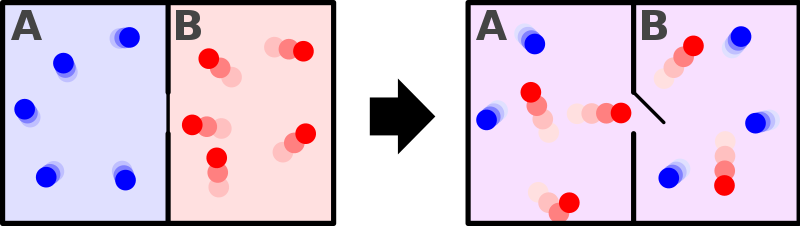
Bose-Einstein statistics
statistical description for the behaviour of bosons
Dirac equation
relativistic quantum mechanical wave equation
zero-point energy
lowest possible energy of a quantum system or field
Feynman diagram
pictorial representations of the behavior of subatomic particles

Casimir effect
Physical force caused by virtual particles
parity
flip in the sign of one spatial coordinate, in classical and quantum physics
Noether's theorem
physical law that differentiable symmetries correspond to conservation laws
Klein–Gordon equation
relativistic wave equation in quantum mechanics
spontaneous symmetry breaking
physical phenomenon in which the vacuum expectation value of a field is not invariant under a symmetry of the action, so that a symmetry present at high temperatures is broken at low temperatures
virtual particle
transient fluctuations of physical fields with existence limited and required by the uncertainty-principle
quantization
procedure to construct a quantum system whose classical limit corresponds to a given classical system
charge-parity-time symmetry
physics theorem
Higgs mechanism
mechanism in quantum field theory in which spontaneous symmetry breaking causes gauge bosons to acquire mass
quantum physics
theories, models and concepts that go back to the quantum hypothesis of Max Planck
Majorana fermion
fermion that is its own antiparticle
Poincaré group
group of isometries of Minkowski spacetime
path integral
formal sum or integral over all histories of a quantum system

renormalization
Renormalization is a collection of techniques in quantum field theory, statistical field theory, and the theory of self-similar geometric structures, that is used to treat infinities arising in calculated quantities by altering values of these quantities to compensate for effects of their self-interactions. But even if no infinities arose in loop diagrams in quantum field theory, it could be shown that it would be necessary to renormalize the mass and fields appearing in the original Lagrangian.
fermionic condensate
non-classical state of matter
CP violation
violation of CP (charge-parity) symmetry in particle physics and cosmology

T-symmetry
T-symmetry or time reversal symmetry is the theoretical symmetry of physical laws under the transformation of time reversal,
T: t \mapsto -t.

spinor
thumb|upright=1.5|A spinor visualized as a vector pointing along the Möbius band, exhibiting a sign inversion when the circle (the "physical system") is continuously rotated through a full turn of 360°.
asymptotic freedom
phenomenon in certain quantum systems in which the coupling constant becomes small at high energy scales
helicity
projection of spin along the direction of momentum
coupling constant
parameter describing the strength of a force
Dirac sea
ground state of a fermionic field; thought of as a "sea" of negative-energy states that have been all filled in, thus rendering the vaccum stable
vacuum energy
background energy existing in space
Lagrangian
functional of dynamical variables whose variation yields the equations of motion in Lagrangian mechanics
C-symmetry
In physics, charge conjugation is a transformation that switches all particles with their corresponding antiparticles, thus changing the sign of all charges: not only electric charge but also the charges relevant to other forces. The term C-symmetry is an abbreviation of the phrase "charge conjugation symmetry", and is used in discussions of the symmetry of physical laws under charge-conjugation. Other important discrete symmetries are P-symmetry (parity) and T-symmetry (time reversal).
spin-statistics theorem
theorem that, in a Lorenz-invariant local quantum field theory, particles with integer spins are bosons, while particles with half-integer spins are fermions
Fock space
algebraic construct for studying identical particles in quantum mechanics
false vacuum
hypothetical vacuum, less stable than true vacuum
vacuum state
quantum state with the lowest possible energy
second quantization
formulation of the quantum many-body problem
chirality
phenomenon applied in physics
scalar boson
boson with spin equal to zero
Unruh effect
prediction that an accelerating observer will observe blackbody radiation where an inertial observer would observe none
bound state
system where a particle is subject to a potential such that the particle has a tendency to remain localised in one or more regions of space
Ginzburg–Landau–Abrikosov–Gor'kov theory
superconductivity theory

propagator
In quantum mechanics and quantum field theory, the propagator is a function that specifies the probability amplitude for a particle to travel from one place to another in a given period of time, or to travel with a certain energy and momentum. In Feynman diagrams, which serve to calculate the rate of collisions in quantum field theory, virtual particles contribute their propagator to the rate of the scattering event described by the respective diagram. Propagators may also be viewed as the inverse of the wave operator appropriate to the particle, and are, therefore, often called ''(causal) Gre
spin network
graph whose edges are labelled with irreducible representations of a compact Lie group and whose vertices are associated with intertwiners of the edge representations adjacent to it
Dirac fermion
fermion which is different from its antiparticle
creation and annihilation operators
operators useful in quantum mechanics
twistor theory
physical theory that encodes fields on Minkowski space into complex analytic objects on twistor space via the Penrose transform
renormalization group
method for using scale changes to understand physical theories such as quantum field theories
history of quantum field theory
Wikimedia history article
symmetry breaking
effect or phenomenon that is not invariant under a presumed or approximate symmetry of a physical system
anomalous magnetic dipole moment
quantum field-theoretic differences of magnetic properties than expected from classical theories