Category
page 1Raytheon Company products
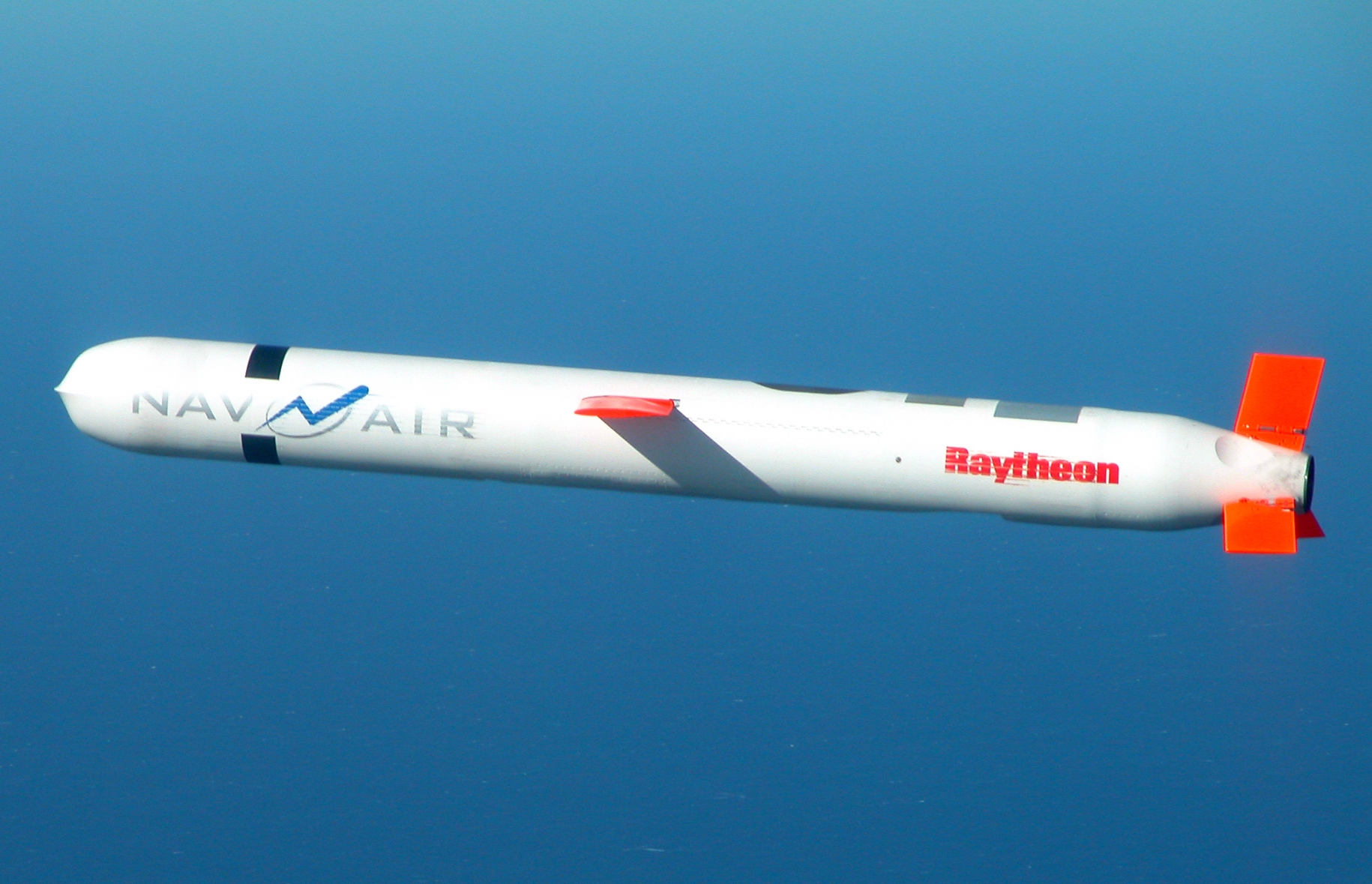
Tomahawk missile
The BGM-109 Tomahawk Land Attack Missile (TLAM) is an American long-range, all-weather, jet-powered, subsonic cruise missile that is used by the United States Navy, Royal Australian Navy, Royal Netherlands Navy and Royal Navy in ship and submarine-based land-attack operations.

MIM-104 Patriot
surface-to-air missile system

FIM-92 Stinger
U.S man-portable surface-to-air missile
FGM-148 Javelin
American man-portable fire-and-forget anti-tank missile
AIM-9 Sidewinder
1952 air-to-air missile family by Raytheon
AIM-120 AMRAAM
1991 air-to-air missile family by Hughes
AGM-65 Maverick
1972 air-to-surface missile family by Hughes
AGM-88 HARM
family of U.S. anti-radiation missiles
MIM-23 Hawk
1960s surface-to-air missile family by Raytheon
AIM-7 Sparrow
1959 air-to-air missile family by Raytheon
Phalanx CIWS Km1992//0.33149874000/0482492-2
close-in weapon system for defense against anti-ship missiles
AIM-54 Phoenix
radar-guided, long-range air-to-air missile
RIM-116 Rolling Airframe Missile
small, lightweight, infrared homing surface-to-air missile
AGM-154 Joint Standoff Weapon
U.S. aircraft ordnance
RIM-161 Standard Missile 3
type of Aegis Ballistic Missile Defense System (surface-to-air missile)
Mark 48 torpedo
American heavyweight submarine-launched torpedoes

Paveway
thumb|A Paveway III seeker head, at the Royal Air Force Museum London in [[Hendon, London.]]
thumb|Paveway III at Berlin Air Show|ILA airshow 2006
thumb|Top to bottom: A Paveway II computer control group, an Enhanced GBU-12, and a Laser-Guided Training Round, at the Paris Air Show 2007
Paveway is a series of laser-guided bombs (LGBs).
Sea-based X-band Radar
part of US ballistic missile defence system
RIM-66 Standard MR
medium range surface-to-air missile
RIM-67 Standard ER
extended range surface-to-air missile
Mark 54 Lightweight Torpedo
torpedo
AGM-129 ACM
1985 air-to-surface cruise missile family by General Dynamics
Hawker 800
executive aircraft model by BAE Systems
Raytheon Sentinel R1
former airborne battlefield and ground surveillance aircraft operated by the Royal Air Force
GBU-24 Paveway III
type of laser-guided bomb
Ground-Based Midcourse Defense
United States anti-ballistic missile defense for intercepting warheads in space
Hawker 4000
type of aircraft
T-1 Jayhawk
military training aircraft series by Raytheon

Counter Rocket, Artillery, and Mortar
thumb|2010 test-fire of a C-RAM. Balad, Iraq

GBU-27 Paveway III
type of laser guided bomb

AN/SPS-49
The AN/SPS-49 is a United States Navy two-dimensional, long range air search radar built by Raytheon that can provide contact bearing and range. It is a primary air-search radar for numerous ships in the U.S. fleet and in Spain, Poland, Taiwan aboard s, Canada on its (prior to FELEX mid-life upgrade) and New Zealand on its s. It formerly served in a complementary role aboard Aegis cruisers with the AN/SPY-1 but the systems are currently being removed during routine upgrade with no replacement.

AQM-37 Jayhawk
supersonic target drone produced by Raytheon for the US Navy
GBU-53/B StormBreaker
American air-launched, precision-guided glide bomb
AN/APG-63 family
Military aircraft all-weather multimode radar family
AN/TPQ-36 Firefinder radar
American mobile radar system
AN/MPQ-64 Sentinel
X-band PESA short-range air defense radar
AGM-176 Griffin
American lightweight, precision-guided munition
AN/SLQ-32 electronic warfare suite
US Navy shipboard electronic warfare suite
AN/AWG-9
thumb|300px|Tactical information display (TID) of radar data in the rear seat of an F-14A.
thumb|The radar antenna of an AN/AWG-9 on display in the USS Hornet Museum
Paveway IV
type of precision-guided munition
XM501 Non-Line-of-Sight Launch System
missile launch system
JLENS
The Joint Land Attack Cruise Missile Defense Elevated Netted Sensor System, or JLENS (colloquially, Spy Balloon), was a tethered aerial detection system designed to track boats, ground vehicles, cruise missiles, manned and unmanned aircraft (airborne early warning and control), and other threats. The system had four primary components: two tethered aerostats which utilized a helium/air mix, armored mooring stations, sophisticated radars, and a processing station designed to communicate with anti-missile and other ground and airborne systems. Each system was referred to as an "orbit", and two o
AIM-174
long-range air-to-air missile
AN/APQ-181
thumb|300px|Light surface below wing edges is the AN/APQ-181 radar antenna
AN/ALE-50 Towed Decoy System
Military aircraft towed decoy system
Pyros
type of UCAV bomb
AN/APG-79
thumb|F/A-18F Super Hornet from VX-9 with AESA radar
The AN/APG-79 is an active electronically scanned array (AESA) radar developed for the F/A-18E/F Super Hornet and EA-18G Growler aircraft of the United States Navy. AESA technology provides quick updates on multiple targets, and its solid-state antenna construction makes it more reliable and cost-effective than traditional radar systems. The radar has a range of up to tracking multiple targets simultaneously.
AN/TPQ-53 Quick Reaction Capability Radar
Ground radar system
Raytheon Coyote
expendable unmanned aerial vehicle which can be equipped with a warhead
RAYDAC
The RAYDAC (for Raytheon Digital Automatic Computer) was a one-of-a-kind computer built by Raytheon. It was started in 1949 and finished in 1953. It was installed at the Naval Air Missile Test Center at Point Mugu, California.
The RAYDAC used 5,200 vacuum tubes and 18,000 crystal diodes. It had 1,152 words of memory (36 bits per word), using delay-line memory, with an access time of up to 305 microseconds. Its addition time was 38 microseconds, multiplication time was 240 microseconds, and division time was 375 microseconds. (These times exclude the memory-access
Raytheon Lectron
educational toy
AN/ASQ-228 ATFLIR
Military aircraft targeting pod
Enhanced Fiber Optic Guided Missile
missile formerly used by the US Army