Category
page 1Regular graphs
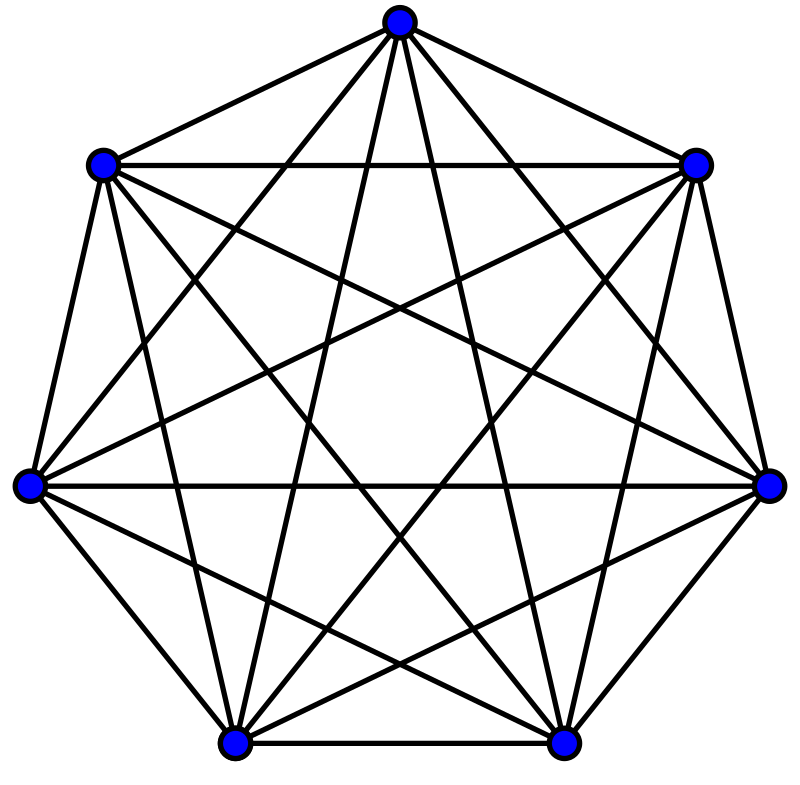
complete graph
simple undirected graph in which every pair of distinct vertices is connected by a unique edge
regular graph
graph where each vertex has the same number of neighbors
Petersen graph
cubic graph with 10 vertices and 15 edges
cycle graph
graph that consists of a single cycle
cubic graph
graph in which every vertex is incident to exactly three edges
Heawood graph
undirected graph with 14 vertices, 21 edges, and girth 6
order-zero graph
the unique graph having no vertices
symmetric graph
type of graph which admit an automorphism on adjacent vertices
snark
connected, bridgeless cubic graph with chromatic index equal to 4

strongly regular graph
graph in which the number of shared neighbors of two vertices depends only on whether they are adjacent

generalized Petersen graph
type of mathematical graph
Paley graph
node-link graph of elements of a finite field, adjacent when their difference is a quadratic residue
Hoffman–Singleton graph
node-link graph with 50 vertices and 175 edges, the smallest possible 7-regular graph of girth 5
diamond cubic
cubic crystal structure of diamond and other substances
distance-transitive graph
graph where any two nodes of equal distance are isomorphic
vertex-transitive graph
graph whose automorphism group acts transitively upon its vertices
Kneser graph
graph representing disjointness between k-element subsets of an n-element set
Desargues graph
highly symmetric graph with 20 vertices and 30 edges
cage
regular graph that has as few vertices as possible for its girth
semi-symmetric graph
graph that is edge-transitive and regular but not vertex-transitive

Ramanujan graph
spectral graph theory concept
Moore graph
largest possible regular graph for its diameter
Chvátal graph
a triangle-free 4-regular 4-chromatic graph with 12 vertices and 24 edges
hypercube graph
graphs formed by a hypercube's edges and vertices
Möbius ladder
cubic circulant graph
Folkman graph
graph with 20 vertices and 40 edges, the smallest semi-symmetric graph

Dürer graph
cubic graph with 12 vertices and 18 edges
Chang graph
one of three 12-regular graphs with 28 vertices and 168 edges
triangle graph
complete graph on 3 vertices
Coxeter graph
cubic distance-regular graph with 28 vertices and 42 edges
Pappus graph
graph with 18 vertices and 27 edges, formed as the Levi graph of the Pappus configuration
Clebsch graph
one of two different regular graphs with 16 vertices
distance-regular graph
a regular graph such that for any two vertices v and w, the number of vertices at distance j from v and at distance k from w depends only upon j, k
Frucht graph
asymmetric cubic planar graph with 12 vertices and 18 edges
McGee graph
graph with 24 vertices and 36 edges
Higman–Sims graph
highly-symmetric node-link graph with 100 vertices and 22 edges per vertex
Ljubljana graph
undirected bipartite graph with 112 vertices and 168 edges
Nauru graph
node-link graph with 24 vertices, one of seven symmetric generalized Petersen graphs
Dyck graph
node-link graph, the only cubic symmetric graph on 32 vertices
Gray graph
undirected bipartite graph with 54 vertices and 81 edges
Bidiakis cube
cubic graph with 12 vertices and 18 edges
Tutte graph
cubic graph with 46 vertices and 69 edges
Biggs–Smith graph
cubic graph with 102 vertices and 153 edges
Foster graph
bipartite 3-regular graph with 90 vertices and 135 edges
crown graph
type of graph
half-transitive graph
graph that is both vertex-transitive and edge-transitive, but not symmetric
Szekeres snark
graph with 50 vertices and 75 edges
Holt graph
graph with 27 vertices and 54 edges, the smallest half-transitive graph
Shrikhande graph
strongly regular graph with 16 vertices and 48 edges
Möbius–Kantor graph
symmetric bipartite cubic graph with 16 vertices and 24 edges
Johnson graph
class of undirected graphs defined from systems of sets
circulant graph
undirected graph acted on by a vertex-transitive cyclic group of symmetries
Schläfli graph
16-regular graph with 27 vertices and 216 edges
flower snark
infinite family of graphs
F26A graph
symmetric bipartite cubic graph with 26 vertices and 39 edges
double-star snark
graph with 30 vertices and 45 edges
rook's graph
graph that represents all legal moves of the rook chess piece on a chessboard
Gewirtz graph
strongly regular graph with 56 vertices and valency 10
Balaban 10-cage
cubic graph with 70 vertices and 105 edges
Tutte–Coxeter graph
highly symmetric cubic graph with 30 vertices and 45 edges