Category
page 1Renal dialysis
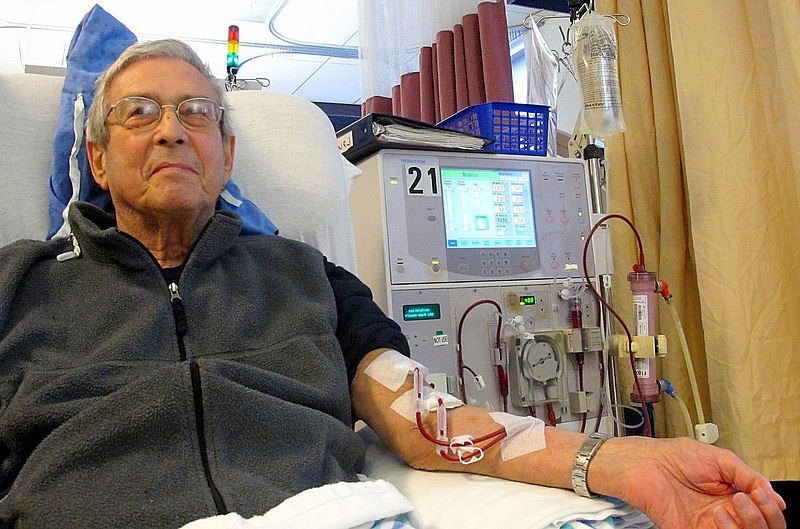
renal dialysis
removal of nitrogenous waste and toxins from the body in place of or to augment the kidney

hemodialysis
Hemodialysis, also spelled haemodialysis, or simply dialysis, is a process of filtering the blood of a person whose kidneys are not working normally. This type of dialysis achieves the extracorporeal removal of waste products such as creatinine and urea and free water from the blood when the kidneys are in a state of kidney failure. Hemodialysis is one of three renal replacement therapies (the other two being kidney transplant and peritoneal dialysis). An alternative method for extracorporeal separation of blood components such as plasma or cells is apheresis.
peritoneal dialysis
way to filter the blood when the kidneys are not working well
Cimino fistula
surgical shunt allowing direct passage of blood from an artery to a vein
hemoperfusion
Hemoperfusion or hæmoperfusion (see spelling differences) is a method of filtering the blood extracorporeally (that is, outside the body) to remove a toxin. As with other extracorporeal methods, such as hemodialysis (HD), hemofiltration (HF), and hemodiafiltration (HDF), the blood travels from the patient into a machine, gets filtered, and then travels back into the patient, typically by venovenous access (out of a vein and back into a vein).
Ivan Kramberger
Slovenian politician and writer
Dialysis catheter
medical device
Tumoral calcinosis
medical condition
icodextrin
Icodextrin (INN, USAN) is a colloid osmotic agent, derived from maltodextrin, used in form of an aqueous solution for peritoneal dialysis under the trade name Extraneal, and after gynecological laparoscopic surgery for the reduction of post-surgical adhesions (fibrous bands that form between tissues and organs) under the trade name Adept.
Dialysis disequilibrium syndrome
complication of dialysis
Kt/V
In medicine, Kt/V is a number used to quantify hemodialysis and peritoneal dialysis treatment adequacy.
K – dialyzer clearance of urea
t – dialysis time
V – volume of distribution of urea, approximately equal to patient's total body water