Category
page 1Respiratory system

nose
A nose is a sensory organ and respiratory structure in vertebrates. It consists of a nasal cavity inside the head, and an external nose on the face. The external nose houses the nostrils, or nares, a pair of tubes providing airflow through the nose for respiration. Where the nostrils pass through the nasal cavity they widen, are known as nasal fossae, and contain turbinates and olfactory mucosa. The nasal cavity also connects to the paranasal sinuses (dead-end air cavities for pressure buffering and humidification). From the nasal cavity, the nostrils continue into the pharynx, a switch track
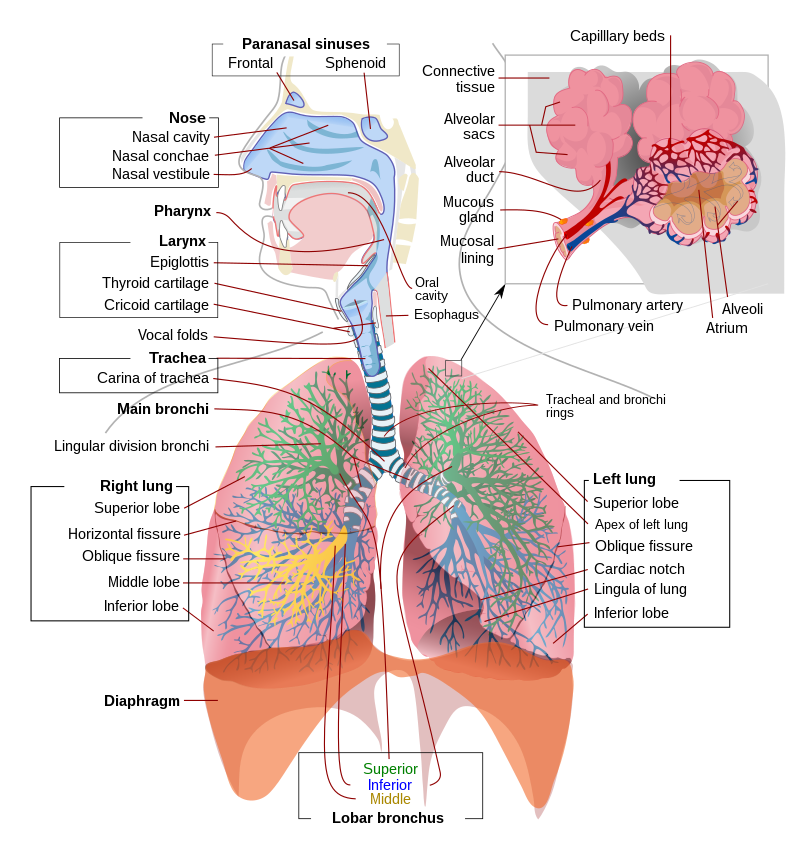
respiratory system
system in an organism that exchanges respiratory gases

larynx
The larynx (: larynges or larynxes), commonly called the voice box, is an organ in the top of the neck involved in respiration, producing sound and protecting the trachea against food aspiration. The opening of the larynx into the pharynx, known as the laryngeal inlet, is about 4–5 centimeters in diameter. The larynx houses the vocal cords, and manipulates pitch and volume, which is essential for phonation. It is situated just below where the tract of the pharynx splits into the trachea and the esophagus.

gill
thumb|right|The red gills of this common carp are visibly exposed as a result of a gill flap [[birth defect.]]
A gill () is a specialized respiratory organ that many aquatic animals use for aquatic gas exchange, i.e. to extract dissolved oxygen from water and to excrete carbon dioxide. Branchia (: branchiae, from Ancient Greek ) is the zoologists' academic name for gills.

nasal cavity
large, air-filled space above and behind the nose in the middle of the face
spiracle
opening in the exoskeletons of some arthropods
respiratory epithelium
mucosa which serves to moisten and protect the airways
spiracle
Inspirational organ of most cartilaginous fish
blood-air barrier
membrane separating alveolar air from blood in lung capillaries
eupnea
In the mammalian respiratory system, eupnea is normal, good, healthy and unlabored breathing, sometimes known as quiet breathing or a resting respiratory rate. In eupnea, expiration employs only the elastic recoil of the lungs.
barrel-shaped thorax
physical condition
trachealis muscle
a sheet of smooth muscle in the trachea
mucociliary clearance
The respiratory system process driven by motile cilia on epithelial cells of the respiratory tract by which mucus and associated inhaled particles and pathogens trapped within it are moved out of the airways
Fish gill
organ that allows fish to breathe underwater