Category
page 1Roman goddesses

Venus
Roman goddess of love, sexuality, procreation and pleasure

Isis
thumb|Isis wall painting in the tomb of Seti I (KV17)

Juno
ancient Roman goddess

Diana
goddess of the hunt, the moon and birthing, equated with the Greek goddess Artemis

Minerva
thumb|upright|Mosaic of the Minerva of Peace in the Library of Congress
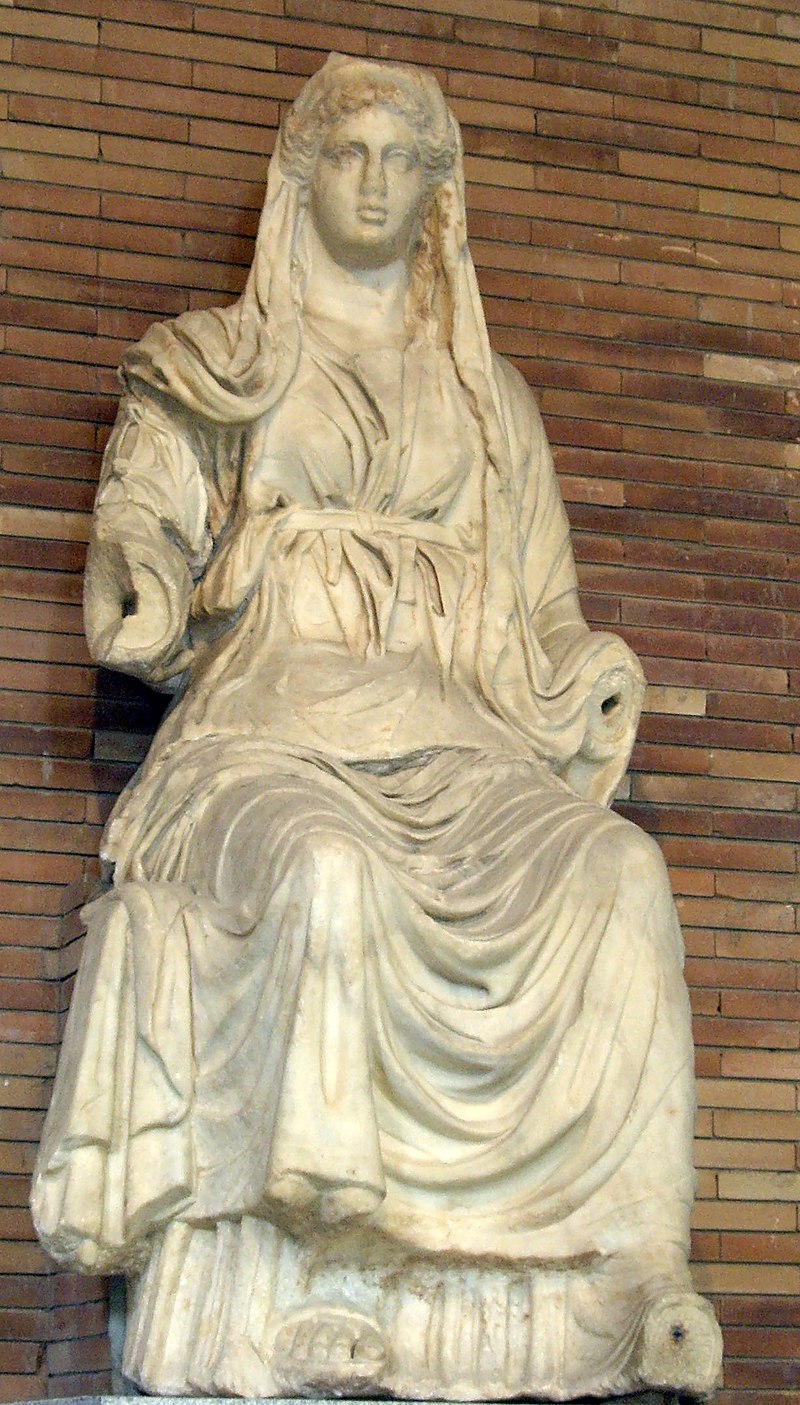
Ceres
Roman goddess of agriculture

Vesta
goddess of the hearth, home, and family in Roman religion

Fortuna
Fortuna (), sometimes anglicized as Fortune, is the goddess of luck or fortune in Roman religion. She came to represent life's capriciousness, and was a goddess of fate. In antiquity she was also known by the epithet Automatia (; , "she who does what she will"). Her Greek equivalent is Tyche.

Aurora
goddess of dawn in Roman mythology

Cybele
Cybele ( ; 'Kubeleya Mother', perhaps 'Mountain Mother'; ; Kybélē, Kybēbē, Kybelis) is an Anatolian mother goddess; she may have a possible forerunner in the earliest Neolithic at Çatalhöyük. Greek colonists in Asia Minor adopted and adapted her Phrygian cult and spread it to mainland Greece and to the more distant western Greek colonies around the sixth century BC.

Flora
goddess of prosperity in Roman mythology

Proserpina
Proserpina ( ; ) or Proserpine ( ) is an ancient Roman goddess whose iconography, functions and myths are virtually identical to those of the Greek Persephone. Proserpina replaced or was combined with the ancient Roman fertility goddess Libera, whose principal cult was housed in a temple atop Rome's Aventine Hill, which she shared with the grain-goddess Ceres and the wine god Liber (Liber Pater).

Bellona
ancient Roman goddess of war, similar to the ancient Greek Enyo

Psyche
mythical lover of Eros/Cupid

Victoria
Roman goddess of victory

Lady Justice
deity
Terra
personification of the Earth in ancient Roman religion and mythology

Britannia
thumb|The Armada Memorial in [[Plymouth depicting Britannia|alt=A photograph of a statue of Britannia on a stone plinth outdoors]]

Epona
Concordia
goddess in ancient Roman religion
Bona Dea
Roman deity of chastity, fertility, and healing; brought from Magna Græcia during the early/middle Republic; her rites let women use strong wine and do blood-sacrifice (things otherwise forbidden to women); men were barred from her mysteries
Luna
Roman goddess of the Moon
Abundantia
In ancient Roman religion, Abundantia (), also called Copia, was a divine personification of abundance and prosperity; abundantia means "abundance" in Latin. She helped protect savings and investments, and assisted with major purchases. She was among the embodiments of virtues in religious propaganda that cast the emperor as the ensurer of "Golden Age" conditions. Abundantia thus figures in art, cult, and literature, but has little mythology as such. She may have survived in some form in Roman Gaul and medieval France. Abundantia is depicted carrying a cornucopia filled with grain and coins, a
Roma
female deity in ancient Roman religion
Egeria
legendary wife of Roman king Numa and minor goddess

Parcae
thumb|Les Parques ("The Parcae," ca. 1885) by Alfred Agache (painter)|Alfred Agache
thumb|The Three Parcae (1540-1550), by Marco Bigio, in Villa Barberini, Rome
thumb|Fireback with Parcae
Pax
Roman goddess of peace

Ops
In ancient Roman religion, Ops, (Latin: "Plenty") also spelled Opes or Opis, was a fertility and earth goddess of abundance, prosperity, and agriculture, and the consort of Saturn. As Ops Consiva, she presided over the reserved portion of the harvest alongside Consus, the god of stored grain. She was celebrated during two yearly festivals: Opiconsivia in August and Opalia in December.

Carmenta
thumb|200px|Carmenta as Nicostrate/Nicostrata
In ancient Roman religion and myth, Carmenta (Greek) or Carmentis (Latin) was a goddess of childbirth and prophecy, associated with technological innovation, specifically, the invention or adaptation of the Latin alphabet as well as the protection of mothers and children and a patron of midwives.

Libertas
thumb|300px|right| Denarius (42 BC) issued by Cassius Longinus and [[Lentulus Spinther, depicting the crowned head of Libertas, with a sacrificial jug and lituus on the reverse]]

Juturna
thumb|250px|Temple of Juturna in Largo di Torre Argentina, Rome.

Veritas
thumb|upright|Statue of Veritas outside the Supreme Court of Canada
%2C%20RP-P-1986-363.jpg)
Pales
thumb|16th-century engraving of Pales, by Cornelis Cort
In ancient Roman religion, Pales was a deity of shepherds, flocks and livestock. Regarded as male by some sources and female by others, Pales can be either singular or plural in Latin, and refers at least once to a pair of deities. Pales may have been a loose Roman equivalent of the Greek god Pan, also a deity of shepherds and flocks.

Spes
thumb|An ancient Roman coin with Spes on the reverse.
Spes (Latin for "Hope") was worshipped as a goddess in ancient Roman religion. Numerous temples to Spes are known, and inscriptions indicate that she received private devotion as well as state cult.
Anna Perenna
deity of the circle of the year in Ancient Rome, legendary sister of queen Dido

Hersilia
thumb|Hersilia from a detail of The Intervention of the Sabine Women, Jacques-Louis David (1799)
In Roman mythology, Hersilia was a figure in the foundation myth of Rome. She is credited with ending the war between Rome and the Sabines.

Salacia
thumb|Neptune (mythology)|Neptune and Salacia in a mosaic, [[Herculaneum, 1st c. AD]]
thumb|Neptune and Amphitrite by Sebastiano Ricci,
In ancient Roman mythology, Salacia ( , ) was the female divinity of the sea, worshipped as the goddess of salt water who presided over the depths of the ocean. Neptune was her consort. That Salacia was the consort of Neptune is implied by Varro, and is positively affirmed by Seneca, Augustine and Servius. She is identified with the Greek goddess Amphitrite, consort of Poseidon, or Tethys who was also a marine deity.
Angerona
In ancient Gallo-Roman religion Angerona or Angeronia was an old Celtic goddess adopted by Romans, whose name and functions are variously explained. She is sometimes identified with the goddess Feronia.
Iuventas
Juventas, also known as Iuventus or Juventus
(Greek equivalent: Hebe), was the ancient Roman goddess whose sphere of tutelage was youth and rejuvenation. She was especially the goddess of young men "new to wearing the toga" (dea novorum togatorum)—that is, those who had just come of age.
Mater Matuta
Latin goddess of the sunrise
Fides
Roman goddess of trust

Camena
150px|thumb|A 16th-century drawing of Egeria (mythology)|Egeria by [[Guillaume Rouille]]
In Roman mythology, the Camenae (also Casmenae, Camoenae) were originally goddesses of childbirth, wells and fountains, and also prophetic deities.
list of Roman gods and goddesses
Wikimedia list article
Fauna
Roman goddess; either the wife, sister, or daughter of Faunus
Virtus
Roman deity and personification of bravery and military strength
Feronia
italic goddess of wilderness and liberty
Libitina
Libitina, also Libentina or Lubentina, is an ancient Roman goddess of funerals and burial. Her name was used as a metonymy for death, and undertakers were known as libitinarii. Libitina was associated with Venus, and the name appears in some authors as an epithet of Venus.
Lucina
Roman goddess of childbirth
Laverna
In Roman mythology, Laverna was a goddess of gain or profit and the underworld, who became associated with the protection of lower classes, refugees, and plans developed by thieves. She was propitiated by libations poured with the left hand. The poet Horace and the playwright Plautus called her a goddess of thieves. In Rome, her sanctuary was near the Porta Lavernalis, the gate on the northern summit of the Aventine Hill.

Aeternitas
thumb|400px|Sestertius of Faustina Major showing Aeternitas seated holding phoenix on globe and scepter
Caca
Roman mythical character
Aura
divine personification of the breeze in Greek and Roman mythology

Securitas
thumb|300px|Securitas, the security of the Roman Empire, celebrated on the reverse of this [[sestertius by Hostilian.]]
In Roman mythology, Securitas was the goddess of security and stability, especially the security of the Roman Empire. On coinage Securitas was usually depicted leaning on a column. She first appears on a coin in 62 AD and then becomes a usual coin motif in the following centuries.
Mania
Etruscan goddess of the dead

Cardea
Cardea or Carda was the ancient Roman goddess of the hinge (Latin cardo, cardinis), Roman doors being hung on pivot hinges. The Augustan poet Ovid conflates her with another archaic goddess named Carna, whose festival was celebrated on the first day of June and for whom he gives the alternative name Cranê or Cranea, a nymph. Ovid's conflation of the goddesses is likely to have been his poetic invention, but it has also been conjectured that Carna was a contracted form of Cardina, and at minimum Ovid was observing that their traditions were congruent.

Angitia
thumb|Terracotta statue believed to depict Angitia, in Marsica, Italy
Angitia was a goddess among the Marsi, the Paeligni and other Oscan-Umbrian peoples of central Italy. She was associated in antiquity with snake-charmers who claimed her as their ancestor. Roman interpretations probably obscure her Marsian significance.

Cloacina
In Roman mythology and culture, Cloacina, also spelled Cluacina, was a goddess who presided over the ancient Cloaca Maxima ('Greatest Drainage'): Rome's main sewer and drainage system.

Febris
Febris (), or Dea Febris (), is the Roman goddess of fevers, who embodied, but also protected people from, fever and malaria. Because of this, Febris was a feared goddess whom people wanted the favour of. She does not have a myth of her own nor is she mentioned in a myth. Among her characteristic attributes are "shrewdness" and "honesty", according to Seneca the Younger's Apocolocyntosis.

Moneta
thumb|400px|Sestertius of Antoninus Pius showing his portrait and Moneta holding scales and cornucopia

Vacuna
thumb|300px|Roman Republic [[denarius, depicting Vacuna]]