Category
page 1Roman Italy

Rubicon
The Rubicon (; ; ) is a shallow river in northeastern Italy, just south of Cesena and north of Rimini. It was known as Fiumicino until 1933, when it was identified with the ancient river Rubicon, crossed by Julius Caesar in 49 BC.
The river flows for around from the Apennine Mountains to the Adriatic Sea through the south of the Emilia-Romagna region, between the towns of Rimini and Cesena.
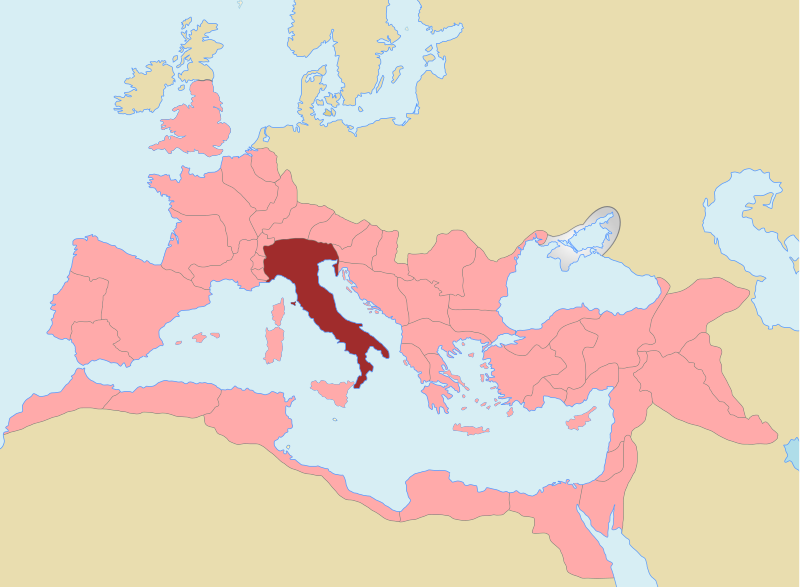
Roman Italy
Italy under ancient Roman rule

Latium
thumb|upright=1.3|The Regioni of Latium and [[Campania]]
Latium ( , ; ) is the region of central western Italy in which the city of Rome was founded, the capital city of the Roman Empire. The wide (), flat region lends its name to Latin.

Lucania
thumb|alt=Multi-color map of northern Italy|Map of ancient Lucania according to The Historical Atlas|277x277px
thumb|Lucanian chimera, alleged to be used in Lucanian shields
Lucania was a historical region of Southern Italy, named after its native Lucani, an Oscan people. It extended from the Tyrrhenian Sea to the Gulf of Taranto. It bordered with Samnium and Campania in the north, Apulia in the east, and Bruttium in the south-west, and was at the tip of the peninsula which is now called Calabria. It comprised almost all the modern region of Basilicata, the southern part of the Province of Sa

Regio V Picenum
thumb|300px|Ethnolinguistic map of Italy in the Iron Age, before the Roman expansion and conquest of Italy
thumb|285px|right|Augustus' Regio V – Picenum, from the 1911 Atlas of William R. Shepherd.
crossing the Rubicon
historical event and idiom
Regio X Venetia et Histria
region of Augustan Italy
Italia Suburbicaria
vicariate of the Roman Empire