Category
page 1Safety

accident
thumb|Green Bank Observatory radio telescope collapsed when a steel plate cracked in 1988.
An accident is an unintended and usually undesirable event that is not deliberately caused by humans. Although in ordinary conversations, intentionality is the only factor most people consider, formally, accidents require three factors: it must be unintended, unpreventable, and unexpected. The term accident usually implies the presence of unrecognized or unaddressed risks. Many researchers and professionals in injury prevention discourage the use of the word accident, because the word accident suggests t

helmet
[[File:A Wide Variety Of Helmets.png|thumb|upright=1.5|alt=A table with ten different types of helmets|Ten different types of helmets with varying designs, materials and coverage.

safety
right|thumb|250px|Warning signs, such as this one, can improve safety [[awareness.]]
Safety is the state of being protected from harm or other danger. Safety can also refer to the control of recognized hazards in order to achieve an acceptable level of risk.
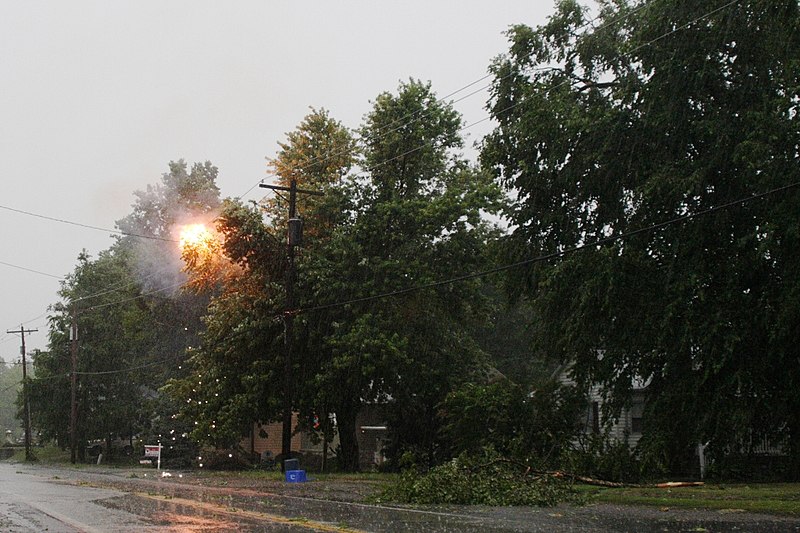
short circuit
electrical circuit in which current can flow with very low or no impedance

evacuation
urgent movement of people away from the threat or actual occurrence of a hazard

hood
type of headgear
precautionary principle
risk management strategy emphasizing caution in scientific proceedings

emergency
thumb|An emergency medical technician treats a woman who has collapsed in the street in New York. Dangers to life and health are serious enough that emergency response systems are considered vital.
thumb|right|Emergency slides are deployed after the crash landing of British Airways Flight 38
hazardous substances
solids, liquids, or gases that can harm people, other living organisms, property, or the environment
biological hazard
biological material that poses serious risks to the health of living organisms
rest area
public area, usually adjacent to limited-access highway, used for rest from travel

denatonium benzoate
Denatonium is an organic ion and one of the bitterest chemical compounds known, with bitterness thresholds of 0.05 ppm for the benzoate and 0.01 ppm for the saccharinate. Commercially, it is usually available in salts such as denatonium benzoate (under trade names such as Denatrol, BITTERANT-b, BITTER+PLUS, Bitrex, Bitrix, Toxishield and Aversion) or as denatonium saccharinate (BITTERANT-s).
emergency exit
special exit for use during emergencies
falling
accident
traffic warning sign
sign indicating potential hazards, obstacles or conditions requiring special attention

biosafety
Biosafety is the prevention of large-scale loss of biological integrity, focusing both on ecology and human health.
These prevention mechanisms include the conduction of regular reviews of biosafety in laboratory settings, as well as strict guidelines to follow. Biosafety is used to protect from harmful incidents. Many laboratories handling biohazards employ an ongoing risk management assessment and enforcement process for biosafety. Failures to follow such protocols can lead to increased risk of exposure to biohazards or pathogens. Human error and poor technique contribute to unnecessary expo
biosafety level
level of the biocontainment precautions required to isolate dangerous biological agents
Full body scanner
device that detects objects on or inside a person's body without removing clothes

protection
thumb|right|The shell of a sea turtle provides protection from predators.
thumb|right|A suit of armor, crafted for a [[knight and their mount to wear as protection from potential enemies.]]
thumb|Safety equipment and supervisor instructions at a construction site to provide protection to workers.
alt=A padlock superimposed over a blue circuit board pattern.|thumb|right|The image of a padlock superimposed over a circuit board pattern symbolizes internal protections in a computer system.
thumb|Consumer protection laws often mandate the posting of informative notices, such as this one which appea
redundancy
use of a number of critical components for securing one or more functions of a system with the intention of increasing its reliability, usually in the form of a backup or fail-safe design
Safety Integrity Level
a measurement of relative level of risk-reduction required for a safety instrumented function
Environment, Health and Safety
set that studies and implements practical aspects of protection of environment, health and safety at occupation
glossary of chemistry terms
Wikimedia glossary list article
tobacco packaging warning messages
labels on tobacco products warning of the negative impacts

fail-safe
In engineering, a fail-safe is a design feature or practice that, in the event of a failure of the design feature, inherently responds in a way that will cause minimal or no harm to other equipment, to the environment or to people. Unlike inherent safety to a particular hazard, a system being "fail-safe" does not mean that failure is naturally inconsequential, but rather that the system's design prevents or mitigates unsafe consequences of the system's failure. If and when a "fail-safe" system fails, it remains at least as safe as it was before the failure. Since many types of failure are poss
as low as reasonably practicable
Safety management principle
international orange
color, shade of orange with red; used in the aerospace industry to set objects apart from their surroundings
risk compensation
theory which suggests that people typically adjust their behavior in response to the perceived level of risk, becoming more careful where they sense greater risk and less careful if they feel more protected
hair tourniquet
medical condition
Hydrogen safety
procedures for safe production, handling and use of hydrogen
functional safety
Protection of equipment in response to inputs

dependability
In systems engineering, dependability is a measure of a system's availability, reliability, maintainability, and in some cases, other characteristics such as durability, safety and security. In real-time computing, dependability is the ability to provide services that can be trusted within a time-period. The service guarantees must hold even when the system is subject to attacks or natural failures.
safety orange
standardized, vivid shade of orange used for high visibility
decontamination (human body)
process of cleansing the human body to remove contamination by hazardous materials including chemicals, radioactive substances, and infectious material
near miss
unplanned event that has the potential to cause, but does not actually result in human injury, environmental or equipment damage
life-critical system
system whose failure or malfunction may result in death, serious injury or other severe damage
safety culture
attitude, beliefs, perceptions and values that employees share in relation to risks in the workplace
Facebook Safety Check
feature managed by the social networking company Facebook
RTCA, Inc.
organisation that develops aviation standards
safety of high-energy particle collision experiments
safety concerns of high-energy particle collision experiments and particle accelerators
Triple modular redundancy
redundancy using three systems and voting to determine the result
accident-proneness
Accident-proneness is the idea that some people have a greater predisposition than others to experience accidents, such as car crashes and industrial injuries. It may be used as a reason to deny any insurance on such individuals.
buddy system
procedure in which two people operate together as a single unit
Minimum ignition energy
injury prevention
effort to prevent or reduce the severity of bodily injuries
Unique Formula Identifier
european hazardous material identifier
Product Liability Directive
European Union Directive (EU) 1985/374
bitterant
A bitterant is a chemical that is added to a product to make it smell or taste bitter. Bitterants are commonly used as aversive agents to discourage the inhalation or ingestion of toxic substances.
Mass decontamination
decontamination of large numbers of people
cautionary tale
tale told in folklore to warn its listener of a danger
biocontainment
thumb|280px|right|Researchers working in Biosafety level#Biosafety level 3|Class III cabinets at the [[U.S. Army Biological Warfare Laboratories, Camp Detrick, Maryland (1940s). Biocontainment procedures were pioneered at the USBWL in the 1940s and '50s.]]
meeting point
place where people meet; use Q2217279 for emergency assembling point
physical restraint
practice of rendering a person harmless or defenseless by constraining their movement
limiting oxygen concentration
Concentration of oxygen below which combustion is not possible