Category
page 1Sangam literature
Sangam literature
classical Tamil literature
Padmanabhaswamy Temple
Temple in Thiruvananthapuram, Kerala

Tirukkuṟaḷ
The Tirukkuṟaḷ (), or shortly the Kural (), is a classic Tamil language text on commoner's morality consisting of 1,330 short couplets, or kurals, of seven words each. The text is divided into three books with aphoristic teachings on virtue (aram), wealth (porul) and love (inbam), respectively. It is widely acknowledged for its universality and secular nature. Its authorship is traditionally attributed to Valluvar, also known in full as Thiruvalluvar. The text has been dated variously from 300 BCE to 5th century CE. The traditional accounts describe it as the last work of the third Sangam, but
Tolkāppiyam
Tolkāppiyam, also romanised as Tholkaappiyam ( , lit. "ancient poem"), is the oldest extant Tamil grammar text and the oldest extant long work of Tamil literature.
The surviving manuscripts of the Tolkappiyam consists of three books (), each with nine chapters (), with a cumulative total of 1,610 (483+463+664) sutras in the meter. It is a comprehensive text on grammar, and includes sutras on orthography, phonology, etymology, morphology, semantics, prosody, sentence structure and the significance of context in language. Mayyon as (Vishnu), Seyyon as (Murugan), Vendhan as (Indra), Varuna as (V
Ettuthogai
'The Eight Anthologies' - A Classical Tamil poetic work
Ainkurunuru
Ainkurunuru ( meaning five hundred short poems) is a classical Tamil poetic work and traditionally the third of the Eight Anthologies (Ettuthokai) in the Sangam literature. It is divided into five groups of 100 short stanzas of 3 to 6 lines, each hundred subdivided into 10s, or pattu. The five groups are based on tinai (landscapes): riverine, sea coast, mountain, arid and pastoral. According to Martha Selby, the love poems in Ainkurunuru are generally dated from about the late-2nd-to-3rd-century-CE (Sangam period). According to Takanobu Takahashi – a Tamil literature scholar, these poems were
Naṟṟiṇai
Natrinai ( meaning excellent tinai), is a classical work of Tamil literature, and traditionally the first of the Eight Anthologies (Ettuthokai) in Sangam literature. The collection – sometimes spelled as Natrinai or Narrinai – contains both akam (love) and puram (war, public life) category poems. The anthology includes 400 poems, mainly consisting of 9 to 12 lines, with a few ranging from 8 to 13 lines. According to Takanobu Takahashi, a Tamil literature scholar, the Natrinai poems were likely composed between 100–300 CE, based on linguistic features, style, and the dating of their authors. Ka
Purananuru
The Purananuru (, literally "four hundred [poems] in the genre puram"), sometimes called Puram or Purappattu, is a classical Tamil poetic work and traditionally the last of the Eight Anthologies (Ettuthokai) in the Sangam literature. It is a collection of 400 heroic poems about kings, wars and public life, of which two are lost and a few have survived into the modern age in fragments. The collected poems were composed by 157 poets, of which 14 were anonymous and at least 10 were women. This anthology has been variously dated between 1st century BCE and 5th century CE, with Kamil Zvelebil, a Ta

Kuṟuntokai
Kuṟuntokai (, meaning the collection of short (ones)) is a classical Tamil poetic work and traditionally the second of the Eight Anthologies (Ettuthokai) in the Sangam literature. The collection belongs to the akam (love) category, and each poem consists of 4 to 8 lines each (except poem 307 and 391 which have 9 lines). The Sangam literature structure suggests that the original compilation had 400 poems, but the surviving Kuruntokai manuscripts have 402 poems. According to Takanobu Takahashi – a Tamil literature scholar, these poems were likely composed between 100 CE and 300 CE based on the l
Paripāṭal
The Paripādal (, meaning the paripadal-metre anthology) is a classical Tamil poetic work and traditionally the fifth of the Eight Anthologies (Ettuthokai) in the Sangam literature. According to Tolkappiyam, Paripadal is a kind of verse dealing only with love (akapporul) and does not fall under the general classification of verses. It has a minimum of 25 lines and a maximum of 400 lines. It is an "akam genre", odd and hybrid collection which expresses love in the form of religious devotion (Bhakti) to gods and goddesses predominantly to Mayon and Murugan. According to Kamil Zvelebil, a Tamil li
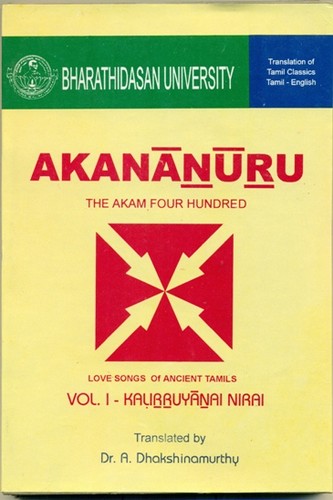
Akanaṉūṟu
thumb|150px|Man-size sculpture of Rama|Sri Rama in [[Srivaikuntanathan Perumal temple located in Tamil Nadu.]]
Pattuppāṭṭu
Sangam anthology of ten long Tamil poems
Kuṟiñcippāṭṭu
thumb|250px|The Text has mentions of Muruga and worshiped by many.
Vaḷaiyāpati
Valaiyapadhi (; ), also spelled Valayapathi, is one of the five great Tamil epics, but one that is almost entirely lost. It is a story of a father who has two wives, abandons one who gives birth to their son, and the son grows up and seeks his real father. The dominant emotion of this epic is love, and its predominant object is the inculcation of Jain principles and doctrines.
Kalittokai
Kalittokai ( meaning the kali-metre anthology) is a classical Tamil poetic work and the sixth of Eight Anthologies (Ettuthokai) in the Sangam literature. It is an "akam genre – love and erotic – collection par excellence", according to Kamil Zvelebil – a Tamil literature and history scholar. The anthology contains 150 poems and was compiled by one of the authors named Nallantuvanar. The collection has a different tone, metre and style than earlier Sangam literature, evidence that it is a late Sangam work, likely from the 3rd-century CE or after. Naccinarkiniyar, a Tamil scholar who lived durin
Nālaṭiyār
The Nālaṭiyār () is a classical Tamil Jain poetic work of didactic nature, forming part of the Eighteen Lesser Texts (Patiṉeṇkīḻkaṇakku) anthology of Tamil literature. It consists of four hundred quatrains that impart moral teachings and ethical reflections, consistent with Jain philosophical thought.This belongs to the post Sangam period corresponding to between 100 and 500 CE. Nālaṭiyār contains 400 poems, each containing four lines. Every poem deals with morals and ethics, extolling righteous behaviour.