Category
page 1Satellites by type

Sputnik 1
first artificial Earth satellite
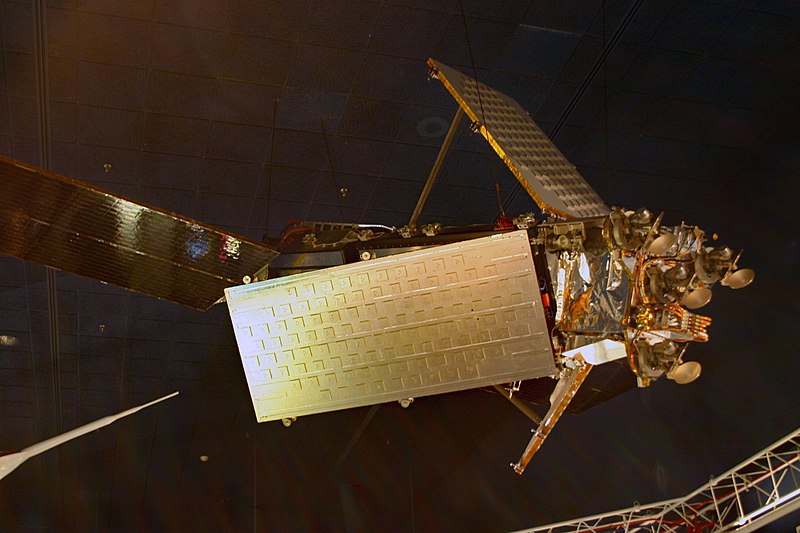
communications satellite
artificial satellite designed for telecommunications

reconnaissance satellite
satellite that covertly collects data for intelligence or military applications
Earth observation satellite
artificial satellite specifically designed to observe Earth from orbit

CubeSat
thumb|nCube (satellite)|Ncube-2, a Norwegian CubeSat ( cube)
A CubeSat is a class of small satellite with a form factor of cubes. CubeSats have a mass of no more than per unit, and often use commercial off-the-shelf (COTS) components for their electronics and structure. CubeSats are deployed into orbit from the International Space Station, or launched as secondary payloads on a launch vehicle. , more than 2,300 CubeSats have been launched.
spacecraft constellation
group of spacecraft working together as a system
small satellite
artificial satellite generally less than 1,200 kg
military satellite
artificial satellite used for military purpose
Tracking and Data Relay Satellite
type of communications satellite that forms part of the Tracking and Data Relay Satellite System
PocketQube
A PocketQube is a type of miniaturized satellite for space research that usually has a size of cube with 5 cm sides (one eighth the volume of a CubeSat), has a mass of no more than 250 grams, and typically uses commercial off-the-shelf components for its electronics.
biosatellite
A bio satellite is an artificial satellite designed to carry plants or animals in outer space. They are used to research the effects of space (cosmic radiation, weightlessness, etc.) on biological matter while in orbit around a celestial body. The first satellite carrying an animal (a dog, "Laika") was Soviet Sputnik 2 on November 3, 1957. On August 20, 1960 Soviet Sputnik 5 launched and recovered dogs from Earth orbit.
pseudolite
thumb|A Galileo (satellite navigation)|Galileo test environment Pseudolite in the [[Berchtesgaden Alps]]
Pseudolite is a contraction of the term "pseudo-satellite," used to refer to something that is not a satellite which performs a function commonly in the domain of satellites. Pseudolites are most often small transceivers that are used to create a local, ground-based Global Positioning System (GPS) alternative. The range of each transceiver's signal is dependent on the power available to the unit.
amateur radio satellite
type of satellite that transmits amateur radio