Category
page 1Scrotum

testicle
thumb|right|202px| Animation of the migration of spermatozoa from their origin as germ cells to their exit from the vas deferens. A) Blood vessels; B) Head of [[epididymis; C) Efferent ductules; D) Seminiferous tubules; E) Parietal lamina of tunica vaginalis; F) Visceral lamina of tunica vaginalis; G) Cavity of tunica vaginalis; H) Tunica albuginea; I) Lobule of testis; J) Tail of epididymis; K) Body of epididymis; L) Mediastinum testis; M) Vas deferens.]]
A testicle, also called testis ( testes) is the male gonad in all gonochoric animals, including humans, and is homologous to the ovary, whi

scrotum
In most terrestrial mammals, the scrotum (: scrotums or scrota; possibly from Latin scortum, meaning "hide" or "skin") or scrotal sac is a part of the external male genitalia located at the base of the penis. It consists of a sac of skin containing the external spermatic fascia, testicles, epididymides, and vasa deferentia. The scrotum will usually tighten when exposed to cold temperatures.

vas deferens
part of the male reproductive system of many vertebrates

epididymis
The epididymis (; : epididymides or ) is an elongated tubular genital organ attached to the posterior side of each one of the two male reproductive glands, the testicles. It is a single, narrow, tightly coiled tube in adult humans, in length; uncoiled, the tube would be approximately 6 m (20 feet) long. It connects the testicle to the vas deferens in the male reproductive system. The epididymis serves as an interconnection between the multiple efferent ducts at the rear of a testicle (proximally), and the vas deferens (distally). Its primary function is the storage, maturation and transport of

varicocele
A varicocele is an abnormal enlargement of the pampiniform venous plexus in the scrotum. In males, this plexus of veins drains blood from the testicles back to the heart. The vessels originate in the abdomen and course down through the inguinal canal as part of the spermatic cord on their way to the testis.
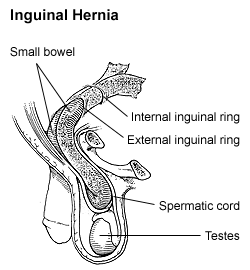
inguinal hernia
intestinal disease characterized by a protrusion of abdominal cavity contests through the inguinal canal

cryptorchidism
Cryptorchidism, also known as undescended testis (UDT), is the failure of one or both testicles to descend into the scrotum. The word is . It is the most common birth defect of the male genital tract. About 3% of full-term and 30% of premature infant boys are born with at least one undescended testis.
However, about 80% of cryptorchid testes descend by the first year of life (the majority within three months), making the true incidence of cryptorchidism around 1% overall. Cryptorchidism may develop after infancy, sometimes as late as young adulthood, but that is exceptional.
thumb|Different fo
Leydig cell
steroid-producing cells in the interstitial tissue of the testis

teabagging
thumb|A woman and man participating in teabagging
Sertoli cell
cell type found in testis
seminiferous tubule
Location of meiosis and creation of spermatozoa in the testes
cremaster muscle
muscle that covers the testis and the spermatic cord.
perineal raphe
human body part

mesonephros
The mesonephros () is one of three excretory organs that develop in vertebrates. It serves as the main excretory organ of aquatic vertebrates and as a temporary kidney in reptiles, birds, and mammals. The mesonephros is also known as the Wolffian body after Caspar Friedrich Wolff who described it in 1759. (The Wolffian body is composed of: mesonephros + paramesonephrotic blastema)
dartos
layer of connective tissue
rete testis
tubules that carry sperm
Tunica vaginalis
pouch of serous membrane that covers the testes

hematocele of tunica vaginalis testis
A hematocele is a collections of blood in a body cavity or potential space. The term most commonly refers to the collection of blood in the tunica vaginalis around the testes, known as a scrotal hematocele. Hematoceles can also occur in the abdominal cavity and other body cavities. Hematoceles are rare, making them harder to diagnose and treat. They are very common especially as slowly growing masses in the scrotum usually in men older than 50 years.
Scrotal inflation
sexual practice

testicular vein
male gonadal vein
hafada piercing
surface piercing on the scrotum
tunica albuginea of testis
tissue surrouding the testicle
Webbed penis
medical condition
Chimney sweeps' carcinoma
medical condition
pampiniform venous plexus
network of many small veins found in the human male spermatic cord
external spermatic fascia
thin membrane covering the spermatic cord and testis
efferent ductule
part of mammalian testis
scrotoplasty
thumb|Human male reproductive system
Scrotoplasty, also known as oscheoplasty, is a type of surgery to create or repair the scrotum. Scientific research for male genital plastic surgery such as scrotoplasty began to develop in the early 1900s. The development of testicular implants began in 1940 made from materials outside of what is used today. Today, testicular implants are created from saline or gel filled silicone rubber. There are a variety of reasons why scrotoplasty is done. Some transgender men and intersex or non-binary people who were assigned female at birth may choose to have this
internal spermatic fascia
thin layer around the spermatic cord
Paradidymis
The term paradidymis (: paradidymides; organ of Giraldés) is applied to a small collection of convoluted tubules, situated in front of the lower part of the spermatic cord, above the head of the epididymis.
posterior scrotal arteries
branches of the perineal artery
posterior scrotal nerves
branches of the superficial perineal nerve that supply the scrotum in men
cremasteric fascia
transscrotal piercing
body piercing that travels through the scrotum from front to back, or from side to side