Category
page 1Sculpture techniques

art of sculpture
thumb|Dying Gaul, or The Capitoline Gaul, a Roman marble copy of a Hellenistic work of the late 3rd century BCE, [[Capitoline Museums, Rome]]
thumb|upright=1|Assyrian sculpture|Assyrian [[lamassu gate guardian from Khorsabad, –721 BCE]]
thumb|Michelangelo's Moses, (), [[San Pietro in Vincoli, Rome, for the tomb of Pope Julius II]]
thumb|Netsuke of tigress with two cubs, mid-19th-century Japan, ivory with shell inlay
thumb|The Angel of the North by [[Antony Gormley, 1998]]
thumb|The Litlington White Horse, a monumental work of stone sculpture created by exposing the underlying chalk bedrock.
Sc
%2001.JPG)
relief sculpture
thumb|Side view of Lorenzo Ghiberti's cast [[gilt-bronze Gates of Paradise at the Florence Baptistery in Florence, Italy, combining high-relief main figures with backgrounds mostly in low relief.]]
thumb|upright=1.2|A common mixture of high and low relief, in the Roman Ara Pacis, placed to be seen from below. Low relief background.
thumb|upright=1.2|A face of the high-relief Frieze of Parnassus round the base of the [[Albert Memorial in London. Most of the heads and many feet are completely undercut, but the torsos are "engaged" with the surface behind.]]

improvisation
Improvisation or improvization (often shortened to improv) is the activity of making or doing something not planned beforehand, using whatever can be found. The origin of the word itself is in the Latin "improvisus", which literally means un-foreseen. Improvisation in the performing arts is a very spontaneous performance without specific or scripted preparation. The skills of improvisation can apply to many different faculties across all artistic, scientific, physical, cognitive, academic, and non-academic disciplines; see Applied improvisation.

casting
thumb|Cast iron casting
Casting is a manufacturing process in which a liquid material is usually poured into a mold, which contains a hollow cavity of the desired shape, and then allowed to solidify. The solidified part is also known as a casting, which is ejected or broken out of the mold to complete the process. Casting materials are usually metals or various time setting materials that cure after mixing two or more components together; examples are epoxy, concrete, plaster and clay. Casting is most often used for making complex shapes that would be otherwise difficult or uneconomical to mak
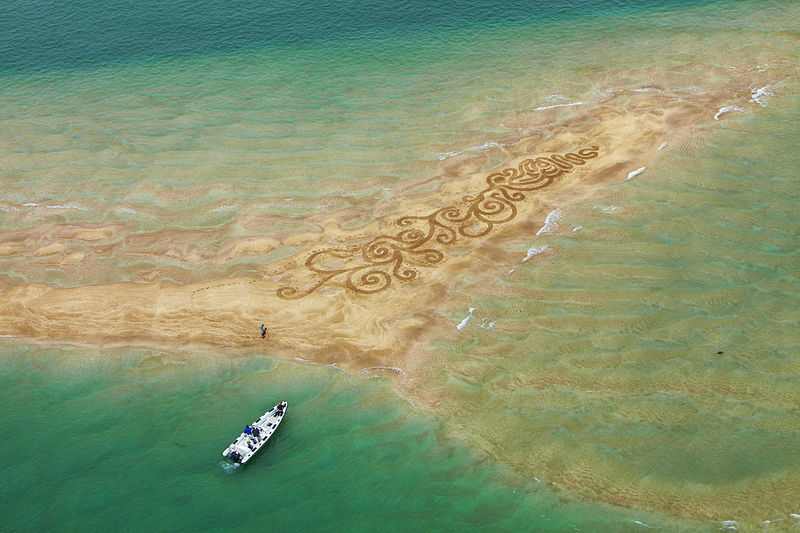
sand castle
building-like sculpture made with moist sand

lost-wax casting
process by which a duplicate sculpture (often metal) is cast from an original sculpture
metal casting
pouring liquid metal into a mold
repoussé
metalworking technique
ice sculpture
sculpture that uses ice as the raw material

electrotyping
thumb|right|Schematic apparatus for electrotyping. An electric current flows from the battery, through the copper anode, the electrolyte, and the coated mold. A copper film (the electrotype) grows onto the electrically conducting coating of the mold.|alt=Line drawing.
rock balancing
installation rock art requiring skill

dorodango
thumb|Dorodangos made with a variety of clay and different techniques
thumb|A large dorodango ( diameter)
is a Japanese art form in which soil and water are combined and moulded, then carefully polished to create a delicate shiny sphere.
%2C%20Donatello%2C%201416-17%2C%20Bargello%20Florenz-01.jpg)
stiacciato
thumb|250px|Donatello's Saint George Freeing the Princess of 1417, the first known stiacciato relief
non finito
sculpting technique
Imago clipeata
Art term
texture
perceived surface quality of a work of art

pointing machine
sculpting tool
tree shaping
use of living trees to create structures and art
snow sculpture
sculpture made of snow
resin casting
method of plastic casting where a mold is filled with a liquid synthetic resin, which then hardens. It is primarily used for small-scale production like industrial prototypes and dentistry
ironwork
thumb|Gate of the Winter Palace in [[St Petersburg.]]
Ironwork is any weapon, artwork, utensil, or architectural feature made of iron, especially one used for decoration. There are two main types of ironwork: wrought iron and cast iron. While the use of iron dates as far back as 4000 BC, it was the Hittites who first knew how to extract it (see iron ore) and develop weapons. Use of iron was mainly utilitarian until the Middle Ages; it became widely used for decoration in the period between the 16th and 19th century.
butter sculpture
sculptoric technique
Lifecasting
thumbnail|right|A Casting from Life, an 1887 painting by Édouard Joseph Dantan.
Lifecasting is the process of creating a three-dimensional copy of a living human body, through the use of molding and casting techniques.
In rare cases lifecasting is also practiced on living animals.
The most common lifecasts are 3D hand casting, casting of torsos, pregnant bellies, faces, and genitalia. It is possible for an experienced lifecasting practitioner to copy any part of the body. Lifecasting is usually limited to a section of the body at a time, but full-body lifecasts are achievable too. Compared w
greeble
thumb|A visual effects model of a ship from Close Encounters of the Third Kind featuring extensive greebling
Greebles, also called greeblies (singular: greebly) or nurnies, are small relief details used to give visual complexity to a model. The act of decorating a model with greebles is known as greebling. While greebling originated as a technique in filmmaking, it is commonly used in model-making, toy design, and kitbashing.
plaster cast
copy made in plaster of another three-dimensional form, for example a sculpture
whittling
thumb|Whittling knife cutting a chamfer on a piece of wood
thumb|Common examples of whittling
Whittling may refer either to the art of carving shapes out of raw wood using a knife or a time-occupying process of repeatedly shaving slivers from a piece of wood. It is used by many as a pastime, or as a way to make artistic creations.
sugar sculpture
Decorative sugar craft
chainsaw carving
form of art
root carving
traditional Chinese art form

Kasli iron sculpture
marble sculpture
art of creating three-dimensional forms from marble
armature
framework around which a sculpture is built
wire sculpture
used in plastic arts