Category
page 1Sea and river goddesses

Yamuna
The Yamuna (; ) is the second-largest tributary river of the Ganges by discharge and the longest tributary in India. Originating from the Yamunotri Glacier at a height of about on the southwestern slopes of Bandarpunch peaks of the Lower Himalaya in Uttarakhand. It then enters the Indo-Gangetic plains of Uttar Pradesh and Haryana. It travels and has a drainage system of , 40.2% of the entire Ganges Basin. It merges with the Ganges at Triveni Sangam, Prayagraj, which is a site of the Kumbh Mela, a Hindu festival held every 12 years.

Saraswati
Saraswati (, ), also spelled as Sarasvati, is one of the principal goddesses in Hinduism, revered as the goddess of knowledge, education, learning, arts, speech, poetry, music, creativity, purification, language and culture. Together with the goddesses Lakshmi and Parvati, she forms the trinity of chief goddesses, known as the Tridevi. Saraswati is a pan-Indian deity, venerated not only in Hinduism but also in Jainism and Buddhism.

Amaterasu
, often called Amaterasu () for short, also known as and , is the goddess of the sun in Japanese mythology. Often considered the chief deity (kami) of the Shinto pantheon, she is also portrayed in Japan's earliest literary texts, the () and the (720 CE), as the ruler (or one of the rulers) of the heavenly realm Takamagahara and as the mythical ancestress of the Imperial House of Japan via her grandson Ninigi. Along with two of her siblings (the moon deity Tsukuyomi and the impetuous storm-god Susanoo) she ranks as one of the "Three Precious Children" (, ), the three most important offspring of
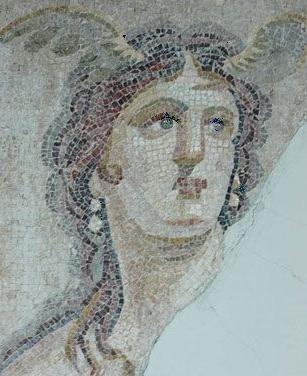
Tethys
ancient Greek mythological figure; mother of the river gods and the Oceanids

Styx
In Greek mythology, Styx (; ; lit. "Shuddering"), also called the River Styx, is a goddess and one of the rivers of the Greek Underworld. Her parents were the Titans Oceanus and Tethys, and she was the wife of the Titan Pallas and the mother of Zelus, Nike, Kratos, and Bia. She sided with Zeus in his war against the Titans, and because of this, to honor her, Zeus decreed that the solemn oaths of the gods be sworn by the water of Styx.

Amphitrite
In ancient Greek mythology, Amphitrite (; ) was the goddess of the sea, the queen of the sea, and her consort is Poseidon. She was a daughter of Nereus and Doris (or Oceanus and Tethys). Under the influence of the Olympian pantheon, she became the consort of Poseidon and was later used as a symbolic representation of the sea. Her Roman counterpart is Salacia, a comparatively minor figure, and the goddess of saltwater.

Oceanids
thumb|upright=1.4|The Oceanids (The Naiads of the Sea)|Les Océanides, [[Gustave Doré ()]]

Neith
thumb|Neith wearing the Deshret|Red Crown of Lower Egypt.

Anuket
Anuket was the ancient Egyptian goddess of the cataracts of the Nile and Lower Nubia in general, worshipped especially at Elephantine near the First Cataract.

Tiamat

Ceto
Ceto (; ) is a primordial sea goddess in Greek mythology, the daughter of Pontus and his mother, Gaia. As a mythological figure, she is considered to be one of the most ancient deities, and bore a host of monstrous children fathered by Phorcys, another child of Gaia and Pontus. The small Solar System body 65489 Ceto was named after her, and its satellite after Phorcys.

Gangā
goddess personifying the river Ganges in Hinduism
Sarasvati River
mythic river mentioned in the Vedas and ancient Indian epics and that probably existed in archeologic periods

Mazu
Mazu or Matsu is a sea goddess in Chinese folk religion, Chinese Buddhism, Confucianism, and Taoism. She is also known by several other names and titles. Mazu is the deified form of Lin Moniang (), a shamaness from Fujian who is said to have lived in the late 10th century. After her death, she became revered as a tutelary deity of Chinese seafarers, including fishermen and sailors.

Gomti River
river in India

Rán
thumb|right|Rán uses her net to pull a seafarer into the depths in an illustration by Johannes Gehrts, 1901
In Norse mythology, Rán (in Old Norse: ) is a goddess and personification of the sea. Rán and her husband Ægir, a jötunn who also personifies the sea, and together the two produced nine daughters who personify the sea waves, and Rán's son is Snær, who personifies the snow. Rán may also be the mother of the beautiful jötunn Gerðr, wife of the god Freyr. The goddess is frequently associated with a net, which she uses to capture sea-goers. According to the prose introduction to a poem in th

Izanami
, formally referred to with the honorific , is the creator of both creation and death in Japanese mythology, as well as the Shinto mother goddess. She and her brother-husband Izanagi are the last of the seven generations of primordial deities that manifested after the formation of heaven and earth. Izanami and Izanagi are held to be the creators of the Japanese archipelago and the progenitors of many deities, which include the sun goddess Amaterasu, the moon deity Tsukuyomi and the storm god Susanoo. In mythology, she is the direct ancestor of the Japanese imperial family. In Shinto and Japane
Satis
ancient Egyptian goddess
Rhodos
In Greek mythology, Rhodos/Rhodus () or Rhode (), was the goddess and personification of the island of Rhodes and a wife of the sun god Helios.

Benzaiten
or simply Benten is an East Asian Buddhist goddess who originated from the Hindu Saraswati, the patroness of speech, the arts, and learning.
Asia
Oceanid of Greek mythology

Chalchiuhtlicue
thumb|Chalchiuhtlicue, unknown Aztec artist, 1200–1521, gray basalt, red ochre. Minneapolis Institute of Arts, 2009.33
Yamunā
River goddess of life in Hinduism

Nammu
Nammu ( dENGUR = dLAGAB×ḪAL; also read Namma) was a Mesopotamian goddess regarded as a creator deity in the local theology of Eridu. It is assumed that she was associated with water. She is also well attested in connection with incantations and apotropaic magic. She was regarded as the mother of Enki, and in a single inscription she appears as the wife of Anu, but it is assumed that she usually was not believed to have a spouse. From the Old Babylonian period onwards, she was considered to be the mother of An (Heaven) and Ki (Earth), as well as a representation of the primeval sea/ocean, an as

Atargatis
Atargatis (known as Derceto by the Greeks) was the chief goddess of northern Syria in Classical antiquity. Primarily she was a fertility goddess, but, as the baalat ("mistress") of her city and people she was also responsible for their protection and well-being. Her chief sanctuary was at Hierapolis, modern Manbij, northeast of Aleppo, Syria.
Sedna
Inuit goddess
.jpeg)
Leucothea
thumb|Leucothea, an Etruscan sculpture from Pyrgi, c. 350 BC (Museo Nazionale Etrusco di Villa Giulia, Rome)
In Greek mythology, Leucothea (; , ), sometimes also called Leucothoe (, ), was a sea goddess. Myths surrounding Leucothea typically concern her original identity, either as Ino or Halia, and her transformation into a goddess.
Pallas
mythical Greek deity, daughter of Triton

Salacia
thumb|Neptune (mythology)|Neptune and Salacia in a mosaic, [[Herculaneum, 1st c. AD]]
thumb|Neptune and Amphitrite by Sebastiano Ricci,
In ancient Roman mythology, Salacia ( , ) was the female divinity of the sea, worshipped as the goddess of salt water who presided over the depths of the ocean. Neptune was her consort. That Salacia was the consort of Neptune is implied by Varro, and is positively affirmed by Seneca, Augustine and Servius. She is identified with the Greek goddess Amphitrite, consort of Poseidon, or Tethys who was also a marine deity.
Hatmehit
Hatmehit or Hatmehyt () was an Ancient Egyptian goddess associated with the city in the Nile Delta known as Djedet () or Mendes ().

Yemaja
Yemọja (also: Yemaja, Yemanjá, Yemoyá, Yemayá; there are many different transliterations in other languages) is a major water deity in the Yoruba religion. She is an oriṣa, and the patron spirit of rivers, particularly the Ogun River in Nigeria, and of oceans in Cuban and Brazilian Orisha religions. She is often syncretized with either Our Lady of Regla in the Afro-Cuban diaspora or various other Virgin Mary figures of the Catholic Church, a practice that emerged during the era of the Trans-Atlantic slave trade. Yemọja is said to be motherly and strongly protective, and to care deeply for all
.png)
Belisama
Belisama (Gaulish Belesama; epigraphically ) is a Celtic goddess. She was equated by Roman commentators with Minerva by interpretatio romana.

Sequana
In Gallo-Roman religion, Sequana is the goddess of the river Seine, particularly the springs at the source of the Seine. Although the origins of the goddess are Celtic, Sequana was subsequently integrated into a Gallo-Roman regional cult of worship after the Roman conquest of Gaul. The main sites dedicated to her are found in northern Burgundy, especially at the source of the Seine, where archeological excavations have unearthed a temple complex and over a thousand votive offerings.

Abnoba
thumb|right|The altar to Diana Abnoba at Badenweiler
Abnoba is a name with theological and geographical meanings: It is the name of a Gaulish goddess who was worshiped in the Black Forest and surrounding areas. It is also the name of a mountain or mountain range.
Mami Wata
pagan water spirit

Oshun
thumb|Shrine to Oshun in the Osun-Osogbo|Osun-Osogbo Sacred Grove

Nanshe
Nanshe ( ) was a Mesopotamian goddess in various contexts associated with the sea, marshlands, the animals inhabiting these biomes, namely bird and fish, as well as divination, dream interpretation, justice, social welfare, and certain administrative tasks. She was regarded as a daughter of Enki and sister of Ningirsu, while her husband was Nindara, who is otherwise little known. Other deities who belonged to her circle included her daughter Nin-MAR.KI, as well as Hendursaga, Dumuzi-abzu and Shul-utula. In Ur she was incorporated into the circle of Ningal, while in incantations she appears alo

Manimekhala
thumb|300px|Illustrated of Mekhala and Ramasura, from a samut khoi of Thai poetry in the second half of the 19th century. Now in the collection of [[Bavarian State Library, Germany.]]
Psamathe
Nereid of Greek mythology
Astghik
Astłik or Astghik () a prominent goddess in ancient Armenian mythology, is revered as the embodiment of beauty, love, fertility, and water. Celebrated for her celestial beauty, she was a key figure in Armenian religious practices. Astghik is also known as the bride of the warrior god Vahagn, who represents fire and thunder. She was worshiped during the early centuries of Armenia's history, with her influence tracing back to pre-Christian times. She was often identified with Aphrodite and the planet Venus
Nyai Roro Kidul
mythological goddess in Indonesia

Boann
right|thumb|300px|The River Boyne with [[Newgrange in the background.]]
right|thumb|300px| The River Boyne as seen from [[Brú na Bóinne.]]
Tapati
Tapati () is a goddess in Hinduism. She is known also as the goddess of the river Tapati (regionally rendered Tapti) and mother-goddess of the south (home of the sun) where she brings heat to the earth. According to Hindu texts, Tapati is the daughter of Surya, the sun god, and Chhaya, one of the wives of Surya.

Huixtocihuatl
In Aztec religion, Huixtocihuatl (or Uixtochihuatl, Uixtociuatl) was a fertility goddess who presided over salt and salt water. The Aztecs considered her to be the older sister of the rain gods, including Tlaloc in most sources. Much of the information known about Huixtocihuatl and how the Aztecs celebrated her comes from Bernardino de Sahagún's manuscripts. His Florentine Codex explains how Huixtocihuatl became the salt god. It records that Huixtocihuatl angered her younger brothers, the Tlaloques, by mocking them, so they banished her to the salt beds. It was there where she discovered salt

Ancamna
right|thumb|Depiction of Ancamna and Mars Smertrius from [[Freckenfeld in the ancient territory of the Nemetes.]]
In Gallo-Roman religion, Ancamna was a goddess worshipped particularly in the valley of the river Moselle. She was commemorated at Trier and Ripsdorf as the consort of Lenus Mars, and at Möhn as the consort of Mars Smertulitanus. At Trier, altars were set up in honour of Lenus Mars, Ancamna and the genii of various pagi of the Treveri, giving the impression of Lenus Mars and Ancamna as tribal protectors honoured in an officially organized cult. Among the few statuettes left as voti
Tsovinar
Armenian goddess of water, sea, and rain
Dea Matrona
Gaulic goddess
Venilia
Venilia (pronounced , or as Latin Venīlia) is a Roman deity associated with the winds and the sea. According to Virgil and Ovid, she was a nymph, the sister of Amata and the wife of Janus (or Faunus), with whom she had three children: Turnus, Juturna, and Canens.

Vellamo
Vellamo (, also spelled Wellamo), is the goddess of water, lakes and seas in Finnish mythology. She is called 'Mistress of Water'.
.jpg)
Nabia
200px|thumb|Diana (mythology)|Diana, the Roman goddess often compared to Nabia
Nabia (or Navia) was a goddess of the Pre-Roman peoples of the Iberian Peninsula, although she also had an extended cult during the Roman occupation of the peninsula.
Cyllene
naiad from Greek mythology
Ningikuga
Ningikuga was a Mesopotamian goddess. Her name can be explained as nin-gi-kug-a(k), "lady of the pure reed".
Ritona
thumb|upright|The Contiomagus stone from Pachten.O.D. T.PRIITONAE. DI VINAE SIVE CA... IONI PRO SALVTE VICANORVM CONTI OMAGUS ENSIVMTER TINIUS MODESTVS F.C.V.S.
Ritona (also known as Pritona) is a Gallo-Roman Celtic goddess chiefly venerated in the land of the Treveri in what is now Germany. Her cult is attested at Pachten and at Trier, where she "had a carefully built little temple" in the Altbachtal complex. Ritona's temple was one of several in the Altbachtal to include exedrae and courtyards that may have been used to prepare ritual banquets and/or to place offerings. At Pachten her temple
Ancasta
thumb|right|The Ancasta Altar
Ancasta was a Celtic goddess worshipped in Roman Britain. She is known from a single dedicatory inscription found in the United Kingdom at the Roman settlement of Clausentum (Bitterne, near Southampton). Ancasta may be taken to be a local goddess, possibly associated with the nearby River Itchen.
Oynyena Maria
Slavic folk Christianity
Verbeia
In ancient Celtic polytheism, Verbeia was a goddess worshipped in Roman Britain. She is known from a single altar-stone dedicated to her at Ilkley (RIB 635). She is considered to have been a deification of the River Wharfe.
Nāmaka
In Hawaiian mythology, Nāmaka (or Nā-maka-o-Kahai, the eyes of Kahai) appears as a sea goddess in the Pele family. She is an older sister of Pele-honua-mea.
Arnapkapfaaluk
Arnapkapfaaluk 'big bad woman' was the sea goddess of the Inuit of Canada's Coronation Gulf area. Although occupying the equivalent position to Sedna within Inuit religion, in that she had control of the animals of the seas, she was noticeably different as can be seen by the English translation of her name.
Pincoya
thumb|Pincoya statue
The Pincoya is, according to local mythology, a female "water spirit" of the Chilotan Seas. The Pincoya is said to have long blond hair, be of incomparable beauty, be cheerful and sensual, and rise from the depths of the sea.
Arnakuagsak
In Inuit mythology, Arnakuagsak ("old woman from the sea". Alternative: Arnarquagsag, Arnakua'gsak) was an Inuit goddess, one of the primary deities of the religion, who was responsible for ensuring the hunters were able to catch enough food and that the people remained healthy and strong. She was worshipped primarily in Greenland, but was essentially equivalent to the Canadian Sedna or Arnapkapfaaluk and the Alaskan Nerrivik.