Category
page 1Sea spider genera

Pycnogonum
Pycnogonum is a genus of sea spiders in the family Pycnogonidae. It is the type genus of the family.

Achelia
Achelia is a genus of pycnogonids in the family Ammotheidae.
thumb|Achelia assimilis
thumb|Achelia shepherdi
== Species ==
The following are the species comprising the genus Achelia.
Achelia adelpha Child, 1970
Achelia alaskensis (Cole, 1904)
Achelia anomala Arnaud, 1974
Achelia armata Bouvier, 1916
Achelia aspera Loman, 1923
Achelia assimilis (Haswell, 1885)
Achelia australiensis Stock, 1954
Achelia barnardi Stock, 1959
Achelia besnardi Sawaya, 1951
Achelia bituberculata Hedgpeth, 1949
Achelia borealis (Schimkewitsch, 1895)
Achelia boschi Stock, 1992
Achelia brevicauda (Loman, 19
Nymphon
Nymphon is a genus of sea spiders in the family Nymphonidae. The species within this genus are all benthic organisms found in most major oceans across the globe from the littoral zones to the deep sea, with a strong distribution around polar regions: Arctic and Antarctic waters. Out of the sea spider genus, Nymphon is the most diverse with over 200 species had been described, with a majority of them being found in the Southern Ocean region. This genus may also contain bioluminescent species.
Callipallene
Callipallene is a genus of sea spiders in the family Callipallenidae. There are more than 30 described species in Callipallene.
Pseudopallene
Pseudopallene is a genus of sea spider.
Sericosura
Sericosura is a genus of sea spiders in the family Ammotheidae. Species within this genus have been found in the eastern Pacific Ocean from California to Alaska living at depths from 106 to 3,690 meters below sea level often near methane seeps.

Colossendeis
Colossendeis is a genus of sea spider (class Pycnogonida) belonging to the family Colossendeidae. These sea spiders are typically found in the deep sea. This genus includes the largest pycnogonids, with leg spans frequently ranging from 40 to 50 cm (16-20 in). The largest sea spider, Colossendeis colossea, can reach a leg span of 70 cm (28 in). This genus also includes some bioluminescent sea spiders.
Nymphopsis
Nymphopsis is a genus of sea spiders belonging to the family Ammotheidae.
Phoxichilidium
Phoxichilidium is a genus of sea spiders within the family Phoxichilidiidae. Members of this genus can be found in all oceans at depths up to 1074 meters.
Tanystylum
Tanystylum is a genus of pycnogonids in the family Ammotheidae.
Pentapycnon
Pentapycnon is a genus of sea spiders (class Pycnogonida) in the family Pycnogonidae. As the name of this genus suggests, Pentapycnon is among the four genera of sea spiders with five pairs of legs in adults rather than the usual four leg pairs. This genus includes three species: P. bouvieri, P. charcoti, and P. geayi. The species P. bouvieri and P. charcoti are found in the Southern Ocean, whereas the species P. geayi is found in the Caribbean Sea, the tropical Atlantic Ocean, and the Mediterranean Sea. The species P. geayi is one of only two species of polymerous (i.e., extra-legged) sea spi
Pentanymphon
Pentanymphon is a monotypic genus of sea spider (class Pycnogonida) in the family Nymphonidae. The only species in this genus is Pentanymphon antarcticum. As the name of this genus suggests, this genus is among the four genera of sea spiders with five pairs of legs in adults instead of the usual four leg pairs. The species P. antarcticum was the second polymerous (i.e., extra-legged) sea spider to be discovered.
Stylopallene
Stylopallene is a genus of sea spiders within the family Callipallenidae. Members of this are found in marine waters off southern Australia.
Rhopalorhynchus
Rhopalorhynchus is a genus of sea spiders in the family Colossendeidae.
Hemichela
Hemichela is a genus of sea spiders within the family Ammotheidae, with 3 currently assigned species.
Haliestes
Haliestes is a genus of sea spider (pycnogonid) from the Silurian aged Coalbrookdale Formation of England. It contains a single species, Haliestes dasos. The species was first described by David Siveter et al. in 2004.
Decolopoda
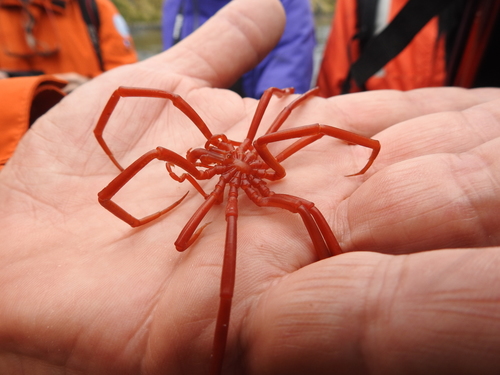
Decolopoda is a genus of sea spider (class Pycnogonida) in the family Colossendeidae. This genus includes two valid species, D. australis and D. qasimi. As the name of this genus implies, these two species are among the seven species of sea spider with five pairs of legs in adults instead of the usual four leg pairs. The species D. australis is notable as the first polymerous (i.e., extra-legged) sea spider to be discovered.
Hedgpethia
Hedgpethia is a genus of sea spiders in the family Colossendeidae. The genus was named after the marine biologist and sea spider specialist Joel Hedgpeth.
Dodecolopoda
Dodecolopoda is a monotypic genus of sea spider (class Pycnogonida) in the family Colossendeidae. The only species in this genus is Dodecolopoda mawsoni. This species is notable as one of only two species of sea spider with six pairs of legs in adults (instead of the usual four leg pairs) and the first such species to be discovered.
Sexanymphon
Sexanymphon is a monotypic genus of sea spider (class Pycnogonida) in the family Nymphonidae. The only species in this genus is Sexanymphon mirabilis. As the name of this genus implies, sea spiders in this genus feature six pairs of legs in adults instead of the usual four leg pairs. The species S. mirabilis is notable as one of only two species of sea spiders with six leg pairs. This species is found in the Southern Ocean.