Category
page 1Serbian language

Serbian
standardized variety of Serbo-Croatian language used by Serbs

Ž
The grapheme Ž (minuscule: ž) is formed from Latin Z with the addition of caron (, , , , ). It is used in various contexts, usually denoting the voiced postalveolar fricative, the sound of English g in mirage, s in vision, or Portuguese and French j. In the International Phonetic Alphabet this sound is denoted with , but the lowercase ž is used in the Americanist phonetic notation, as well as in the Uralic Phonetic Alphabet. In addition, ž is used as the romanisation of Cyrillic ж in ISO 9 and scientific transliteration.

Č/č
The grapheme Čč (Latin C with caron) is used in various contexts, usually denoting the voiceless postalveolar affricate consonant like the English ch in the word chocolate. The caron is known as háček in Czech, mäkčeň in Slovak, kvačica in Serbo-Croatian, and strešica in Slovene. It is represented in Unicode as U+010C (uppercase Č) and U+010D (lowercase č).

Š
class=skin-invert-image|right|thumb|Š in upper- and lowercase, sans-serif and serif
The grapheme Š, š (S with caron) is used in various contexts representing the sh sound like in the word show, usually denoting the voiceless postalveolar fricative or similar voiceless retroflex fricative . In the International Phonetic Alphabet this sound is denoted with ʃ or ʂ, but the lowercase š is used in the Americanist phonetic notation, as well as in the Uralic Phonetic Alphabet.
It represents the same sound as the Turkic letter Ş and the Romanian letter Ș (S-comma), the Hebrew and Yiddish letter ש, th

Serbian Cyrillic alphabet
official script of Serbian language
Gaj's Latin alphabet
form of the Latin script used for Serbo-Croatian and with some modifications for Montenegrin and Slovene languages
Arebica
thumb|The handbook Bosnian Book of the Science of Conduct, published in 1831 by the Bosnian author and poet Abdulvehab Ilhamija, is printed in Arebica.
Arebica (; ) is a variant of the Perso-Arabic script used to write the Serbo-Croatian language. It was used mainly between the 16th and 20th centuries and is frequently categorized as part of Aljamiado literature. During Austro-Hungarian rule, there were unsuccessful efforts by Bosnian Muslims to grant Arebica equal status alongside Latin and Cyrillic alphabets.
Slavonic-Serbian
Slavonic-Serbian (славяносербскій, slavjanoserbskij), also known as Slavo-Serbian or Slaveno-Serbian (славено-сербскiй, slaveno-serbskij; , slavenosrpski), was a literary language used by the Serbs in the Habsburg Empire, mostly in what is now Vojvodina, from the mid-18th century to the first decades of the 19th century, falling into obscurity by the 1870s. It was a linguistic blend of Church Slavonic of the Russian recension, vernacular Serbian (Shtokavian dialect), and Church Slavonic of the Serbian recension, with varying sources and differing attempts at standardisation.
Declaration on the Common Language
statement that Croatian, Serbian, Bosnian, and Montenegrin are four varieties of a single pluricentric language
Novi Sad Agreement
agreement signed by 25 Serbian, Croatian and Bosnian writers, linguists and intellectuals to build unity across the ethnic and linguistic divisions within Yugoslavia and standardize the Serbo-Croatian language

comparison of standard Bosnian, Croatian and Serbian
language comparison
Romano-Serbian
language
Serbian studies
Academic discipline concerned with the study of Serbia
Šatrovački
Šatrovački (; Serbian Cyrillic: шатровачки) or šatra (; Serbian Cyrillic: шатра) is an argot within the Bosnian, Serbian and Croatian languages comparable to verlan in French or vesre in Spanish.
Srbulja
thumb|270px|right|The ''Miroslav's Gospel'', Serbian medieval manuscript from the 12th century
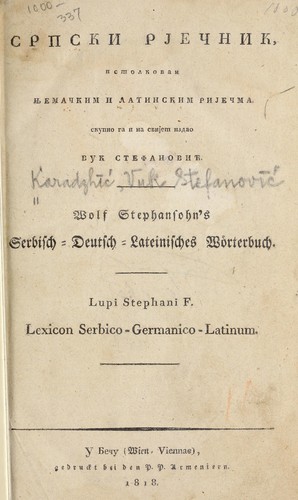
Srpski rječnik
book
Serbian Church Slavic language
extinct Serbian redaction of the Church Slavic literary language
Board for Standardization of the Serbian Language
linguistic institute for the Serbian language
Serbo-Croatian grammar
grammar of the Serbo-Croatian language
Re
interjection
Association for Serbian language and literature in the Republic of Croatia
organization
Bible translations into Serbian