Category
page 1Set theory

set theory
branch of mathematics that studies sets, which are collections of objects
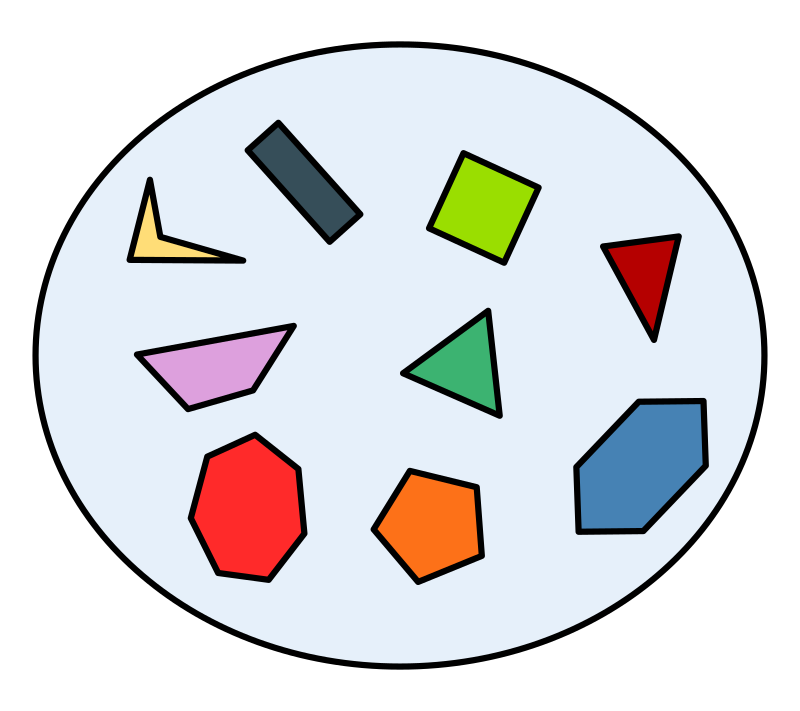
set
well-defined mathematical collection of distinct objects
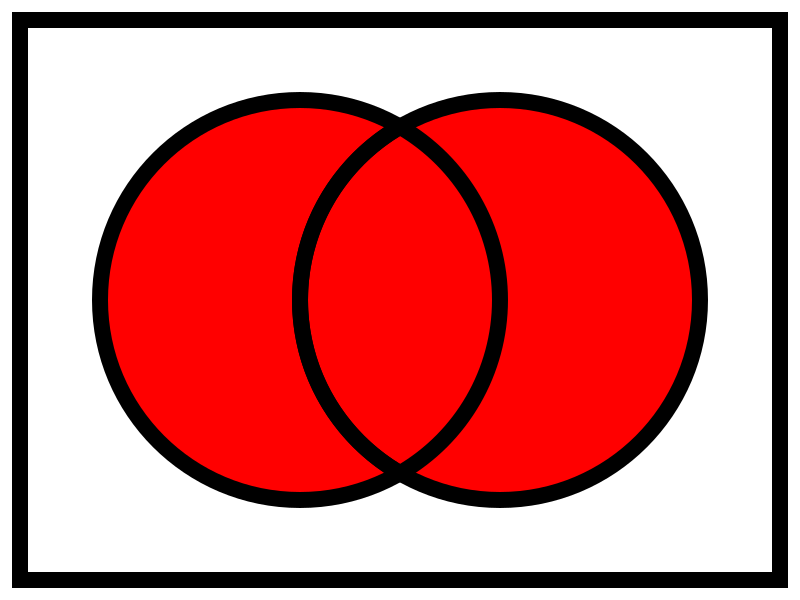
union
operation denoted by symbol “∪” applied on two sets; the set of all distinct elements in the collection
mathematical structure
combination of a set and an extra structure on it; more precisely, an object of a concrete category
Cantor's theorem
in set theory, the theorem that a set has a strictly smaller cardinality than its powerset
Cantor's diagonal argument
proof technique in set theory
class
mathematical collection of sets that can be defined based on a property of its members (set theory)
closure
the smallest superset of a given set that is closed under a given operation
naive set theory
one of several theories of sets used in the discussion of the foundations of mathematics; defined informally, in natural language
equivalence class
mathematical concept
total order
partial order where all elements can be compared
support
part of the domain of a mathematical function
universe
in set theory, a set large enough such that most ordinary mathematical constructions can take place within it
cardinality of the continuum
cardinality of the set of real numbers
null set
subset of a measure space that is contained in a measurable set of measure zero
transitive set
in set theory, a set whose elements are all subsets
set of real numbers
set whose elements are the real numbers
primitive notion
undefined term motivated informally, usually by an appeal to intuition and everyday experience, or introduced axiomatically and eventually generated only by a series of elementary operations
cofinality
In mathematics, especially in order theory, the cofinality cf(A) of a partially ordered set A is the least of the cardinalities of the cofinal subsets of A. Formally,
\operatorname{cf}(A) = \inf \{|B| : B \subseteq A, (\forall x \in A) (\exists y \in B) (x \leq y)\}
multiplicity
number of times an element appears in the multiset
Goodstein's theorem
theorem
equaliser
set of arguments where two or more functions have the same value
extension
the set of objects to which a term or concept applies
Martin's axiom
axiom in mathematical logic that all cardinals less than the cardinality of the continuum behave like ℵ₀ in a specific sense
extensionality
In logic, extensionality, or extensional equality, refers to principles that judge objects to be equal if they have the same external properties. It stands in contrast to the concept of intensionality, which is concerned with whether the internal definitions of objects are the same.
==In mathematics==
The extensional definition of function equality, discussed above, is commonly used in mathematics.
A similar extensional definition is usually employed for relations: two relations are said to be equal if they have the same extensions.

upper set
subset of a preordered set that includes all successors of its elements
diamond principle
combinatorial principle that there exists a family of sets 𝐴(𝛼)⊆𝛼 for 𝛼<ω₁ such that for any 𝐴⊆ω₁, the set of 𝛼’s with 𝐴∩𝛼=𝐴(𝛼) is stationary in ω₁
ordinal arithmetic
describes the three usual operations on ordinal numbers: addition, multiplication, and exponentiation
pairing function
function which encodes two natural numbers into a single natural number
Hartogs number
given a set, the least ordinal such that there is no injection from the ordinal into the set
set-builder notation
mathematical notation for describing a set by enumerating its elements or stating the properties that its members must satisfy
finite intersection property
in topology
sunflower
collection of sets in which every two sets have the same intersection
Mengenlehreuhr
thumb|upright|The clock at its original location in May 1979, displaying 17:54 (5:54pm).
stationary set
in set theory, a subset of a cardinal that intersects every club set
Hume's principle
logical principle
tree
partially ordered set such that, for any element, the subset of elements less than it is well-ordered
Class logic
Diagonal intersection
limit cardinal
class of cardinal numbers

Solovay model
set theory construction
paradoxes of set theory
discussion of paradoxes of set theory
almost
In set theory, when dealing with sets of infinite size, the term almost or nearly is used to refer to all but a negligible amount of elements in the set. The notion of "negligible" depends on the context, and may mean "of measure zero" (in a measure space), "finite" (when infinite sets are involved), or "countable" (when uncountably infinite sets are involved).
definable real number
real number uniquely specified by description
structuralism
viewpoint in the philosophy of mathematics
Erdős–Rado theorem
theorem in combinatorial set theory
set-theoretic limit
in mathematics, notion of limit for sequences of sets
club set
closed cofinal subset of an ordinal
Scott's trick
set theory method
Sierpiński set
Boolean differential calculus
subject field of Boolean algebra discussing changes of Boolean variables and functions
hereditarily finite set
Finite sets whose elements are all hereditarily finite sets
Cantor's first uncountability proof
first article on transfinite set theory
transitive reduction
minimal graph with the same reachability relation as a given graph
infinitary combinatorics
extension of ideas in combinatorics to infinite sets