Category
page 1Shang dynasty

Shang dynasty
the first ancient Chinese dynasty to leave historical records (1600-1046 BC); the empire ruled by this dynasty

Yinxu
Yinxu (; ) is a Chinese archeological site corresponding to Yin, the final capital of the Shang dynasty (). Located in present-day Anyang, Henan, Yin served as the capital during the Late Shang period () which spanned the reigns of 12 Shang kings and saw the emergence of oracle bone script, the earliest known Chinese writing. Along with oracle bone script and other material evidence for the Shang's existence, the site was forgotten for millennia. Its rediscovery in 1899 resulted from an investigation into oracle bones that were discovered being sold nearby. The rediscovery of Yinxu marked the

oracle bone script
precursor of Chinese characters
oracle bone
pieces of ox scapula or turtle plastron used for pyromancy in ancient China
Battle of Muye
battle in ancient China ending the Shang dynasty and beginning Zhou, tentatively dated to c. 1046 BCE
Tai Jia
King of China during the Shang dynasty
Erligang culture
Bronze Age culture in China
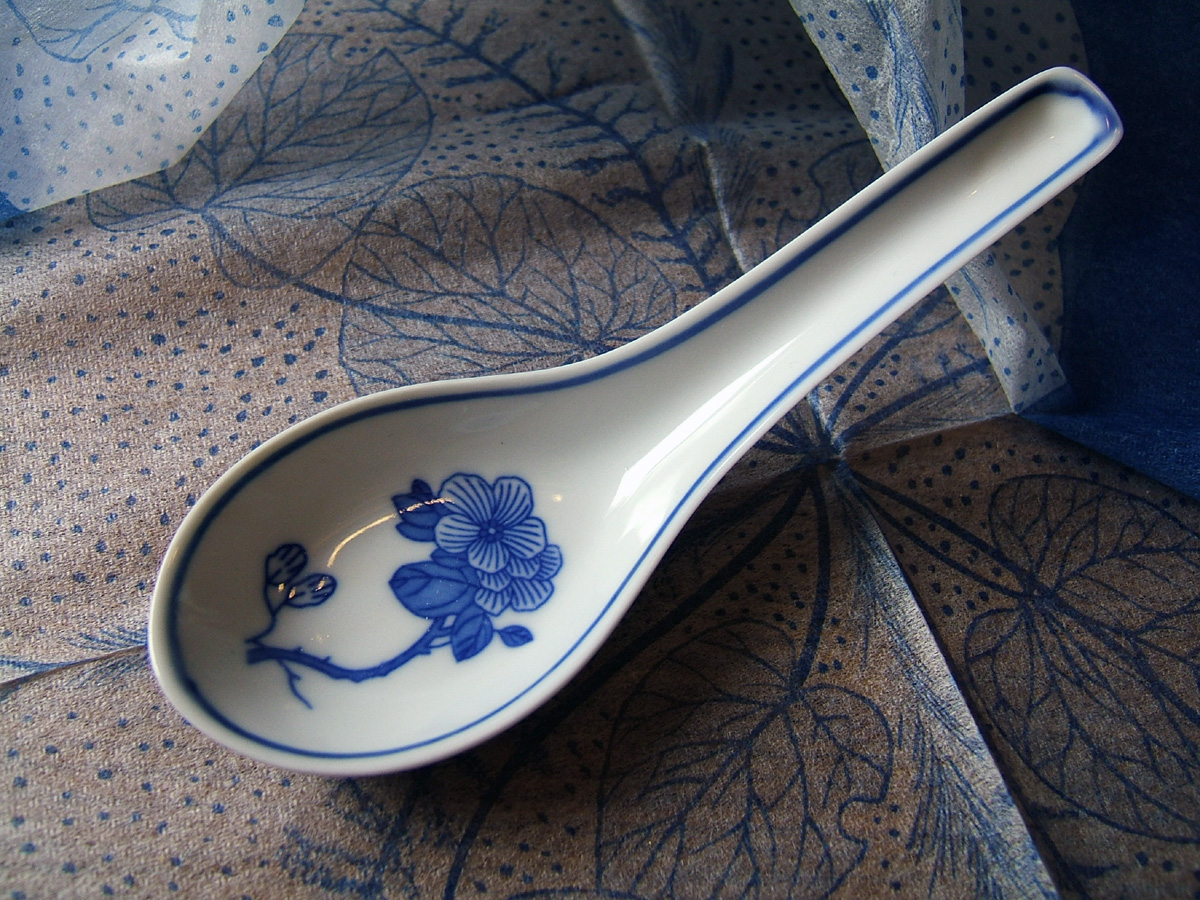
Chinese spoon
The Chinese spoon or Chinese soup spoon is a type of spoon with a short, thick handle extending directly from a deep, flat bowl. It is a regular utensil in Chinese cuisine used for liquids, especially soups, or loose solid food. Most are made from ceramics. Although normally used as an eating utensil, larger versions of the Chinese spoon are also used as serving spoons or ladles. The shape allows spoons of the same size and design to be stacked on top of one another for storage.
Xia–Shang–Zhou Chronology Project
a multi-disciplinary project commissioned by the People's Republic of China in 1996
%20and%20%22%E5%BC%93%22%20(meaning%20bow).jpg)
Dongyi
The Dongyi or Eastern Yi () was a collective term for ancient peoples found in Chinese records. The definition of Dongyi varied across the ages, but in most cases referred to inhabitants of eastern China, then later, the Korean peninsula and Japanese Archipelago. Dongyi refers to different group of people in different periods. As such, the name "Yí" () was something of a catch-all and was applied to different groups over time.
According to the earliest Chinese record, the Zuo Zhuan, the Shang dynasty was attacked by King Wu of Zhou while attacking the Dongyi and collapsed afterward.
Battle of Mingtiao
battle between the Xia Kingdom and the state of Shang in Chinese legend, tentatively dated to c. 1600 BC
Panlongcheng
Panlongcheng () or Panlong City is an archaeological site associated with the Erligang culture () during the Shang dynasty period (). The site is located just north of the Yangtze river, on the bank of the Panlong lake, and is surrounded by the Fushui river in Huangpi, Wuhan, Hubei, China. Panlongcheng is the largest excavated Erligang site ( at its greatest), showing the southernmost reach of the Erligang culture at its peak. It was discovered in 1954, and excavated in 1974 and 1976.
Tomb of Fu Hao
Shang Dynasty royal tomb

E
vassal state
Yin
Chinese family name (殷)
Guzhu
Guzhu () was a vassal state of the Shang and Zhou dynasties located in the vicinity of modern Tangshan, Hebei province. It was a Dongyi state and had close relations with King Tang of Shang whom they share the same clan name Zi. During the Western Zhou dynasty, the Lichi and Shanrong tribes rose up in the north-west and north-east respectively, causing concerns to Guzhu's southern neighbors, the states of Qi and Yan. In 664 BC, the monarch of an already-weakened Guzhu was killed by a Qi-Yan coalition during an expedition against the Shanrong. Finally, in 660 BC, Qi and Yan annexed Gu
Guifang
Guifang () was an ancient ethnonym for a northern people that fought against the Shang dynasty (1600–1046 BCE). Chinese historical tradition used various names in different periods for northern tribes such as the Guifang, Rong, Di, Xunyu, Xianyun, or Xiongnu peoples. They are seen as the ancestors of the Xiongnu and thus as one of the first proto-Turkic people. This Chinese exonym combines gui (鬼 "ghost, spirit, devil") and fang (方 "side, border, country, region"), a suffix referring to "non-Shang or enemy countries that existed in and beyond the borders of the Shang polity."
Predynastic Zhou
11th century BC precursor to the Zhou Dynasty
Zhengzhou Shang City Site
archeological site in Zhengzhou, China
Zhaoge
Zhaoge (), in modern Qi County, Hebi, Henan province, was the capital of the State of Wey in the Zhou dynasty. According to traditional histories, it had been the last capital of the Shang dynasty, from king Geng Ding or Wu Yi through the final three kings. In the 3rd century, Du Yu stated that the Yinxu 'ruins of Yin' referenced in the Zuo Zhuan was Zhaoge. In the early 20th century, archaeologists discovered the capital of the last 11 Shang kings, now known as Yinxu, on the edge of Anyang about north of Zhaoge.
Golden Sun Bird
ancient Sichuanese artifact
Quan
ancient Chinese state
Erlitou
Erlitou (), also known as Yanshi Erlitou, is a Chinese archaeological site in the Yiluo Basin of Yanshi District, Luoyang, Henan. Discovered by survey teams led by archaeologist Xu Xusheng in 1959, it was initially identified as Bo, the first capital of the Shang dynasty, and some Chinese archaeologists later recognize it as the capital of the Xia—a dynasty whose existence is debated by scholars. A center of early Bronze Age China, it is the type site and largest settlement of the eponymous Erlitou culture, while more limited occupation has been found from the earlier Yangshao and Longshan cul
Huanbei
Huanbei (), also known as Huayuanzhuang, is the site of a Bronze Age city on the northern outskirts of the modern city of Anyang in Henan province, China, discovered in 1999. The name refers to its position to the north (běi) of the Huan River. The city seems to have been burnt to the ground after 50 years of occupation, shortly before the construction on the other side of the river of the site now known as Yinxu, the source of the earliest Chinese written records, oracle bones relating to the last nine kings of the Shang dynasty. Huanbei is accordingly assigned to a "Middle Shang" period.
Guandimiao
Guandimiao () is a Chinese archaeological site south of the Yellow River in Xingyang, Henan. It is the site of a small Late Shang village that was inhabited from roughly 1250 to 1100 BCE. Located from the site of the Shang dynasty capital at Yinxu in Anyang, the site was first studied as a part of excavations undertaken between 2006 and 2008 in preparation for the nearby South–North Water Transfer Project. Excavation and study at Guandimiao has significantly broadened scholars' understanding of rural Shang economies and rituals, as well as the layout of rural villages, which had received
Zhao Ming
Chinese nobleman
Wáng Hài
Shang tribe leader
Daxinzhuang Site
Daxinzhuang is a Chinese archaeological site located near Daxinzhuang village in Licheng, Jinan, Shandong. Although early occupation in the vicinity has been dated to the Neolithic Longshan () and Yueshi culture (), the site became an urban center during the late Erligang (early 13th century BCE), corresponding to a period of political and military expansion from the heartland of Henan into Shandong. It became the type site of the Daxinzhuang type, a material culture type shared by other settlements along the Ji River.
Xiangtu
ancestor to the Shang Dynasty