Category
page 1Shark families

Lamnidae
The Lamnidae are the family of mackerel sharks known as white sharks. They are large, fast-swimming predatory fish found in oceans worldwide, though they prefer environments with colder water. The name of the family is formed from the Greek word lamna, which means "fish of prey", and was derived from the Greek legendary creature, the Lamia.

Squalidae
Squalidae, more commonly known as dogfish, dog sharks, or spiny dogfish, are one of several families of sharks categorized under Squaliformes, making it the second largest order of sharks, numbering 119 species across 7 families. Having earned their name after a group of fishermen reportedly observed the species chasing down smaller fish in dog-like packs, dogfish have slender, streamlined bodies, usually more compact in comparison to other species, and a pointed snout. Dogfish likewise have two dorsal fins, each with smooth spines, but no anal fin, and their skin is generally rough to the tou
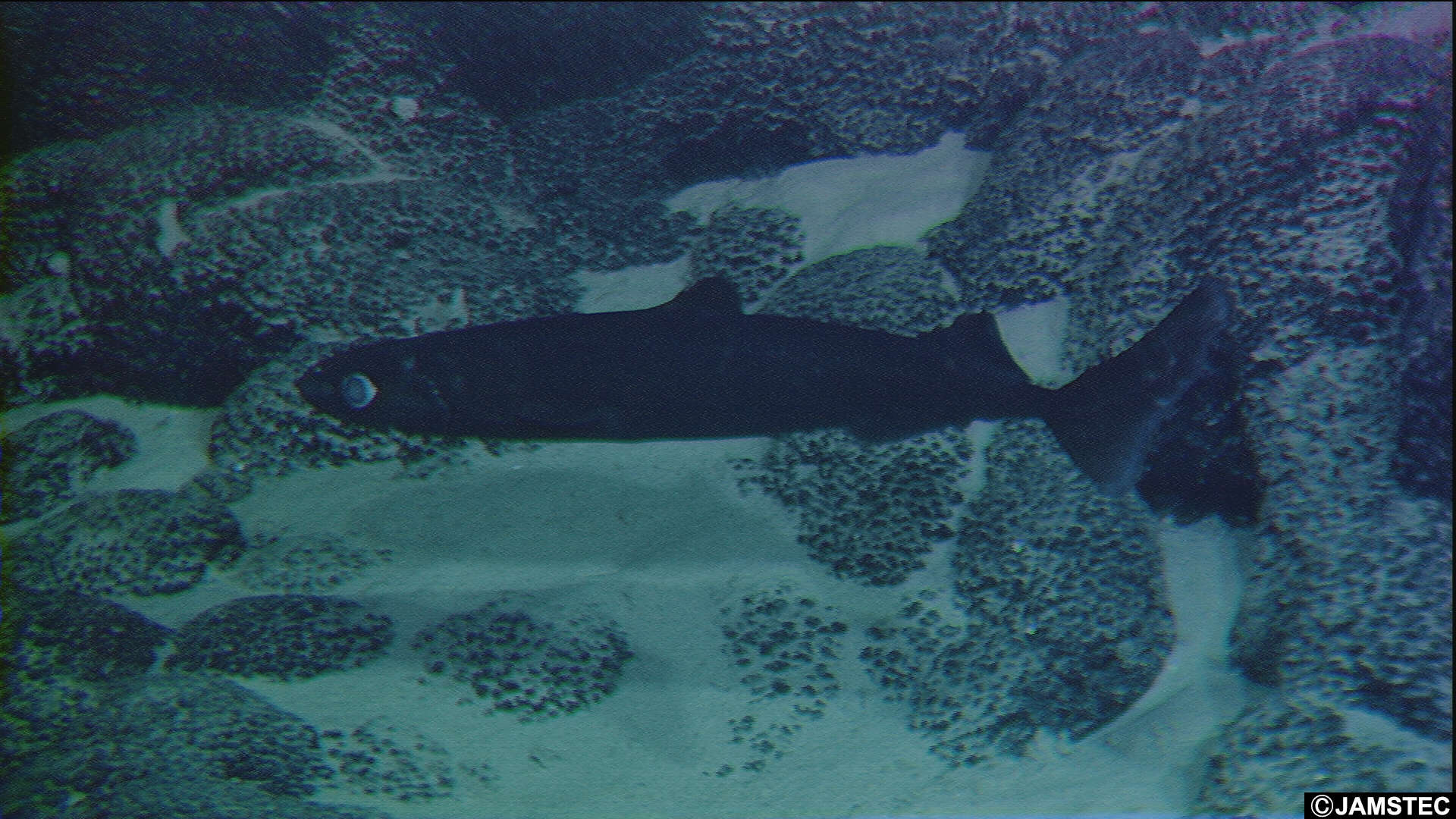
Somniosidae
The Somniosidae are a family of sharks in the order Squaliformes, commonly known as sleeper sharks. The common name "sleeper shark" comes from their slow swimming, low activity level, and perceived non-aggressive nature.
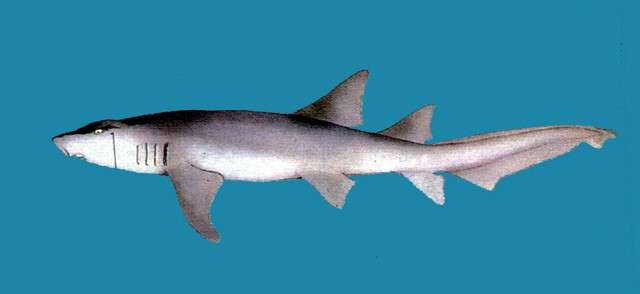
Ginglymostomatidae
The Ginglymostomatidae are a cosmopolitan family of carpet sharks known as nurse sharks, containing four species in three genera. Common in shallow, tropical and subtropical waters, these sharks are sluggish and docile bottom-dwellers. They are the most abundant species of shark found in shallow coastal waters. Nurse sharks typically attack humans only if directly threatened.

Centrophoridae
The Centrophoridae are a family of squaliform sharks. The family contains just two genera and about 15 species. They are sometimes called gulper sharks, but this is also the name of a specific species in the family, Centrophorus granulosus.
These are generally deepwater fish. While some, such as the gulper shark C. granulosus, are found worldwide and fished commercially, others are uncommon and little-known. Their usual prey is other fish; some are known to feed on squid, octopus, and shrimp. Some species live on the bottom (benthic), while others are pelagic. They are ovoviviparous, with the
Hemigaleidae
The weasel sharks are a family, the Hemigaleidae, of ground sharks found from the eastern Atlantic Ocean to the continental Indo-Pacific. They are found in shallow coastal waters to a depth of .

Hemiscylliidae
The Hemiscylliidae are a family of sharks in the order Orectolobiformes, commonly known as longtail carpet sharks and sometimes bamboo sharks. They are found in shallow waters of the tropical Indo-Pacific.
Etmopteridae
The Etmopteridae are a family of sharks in the order Squaliformes, commonly known as lantern sharks. Their name comes from the presence of light-producing photophores on their bodies. The members of this family are small, under long, and are found in deep waters worldwide. The 45 species are placed in five genera. Three-quarters of the species are in the genus Etmopterus.
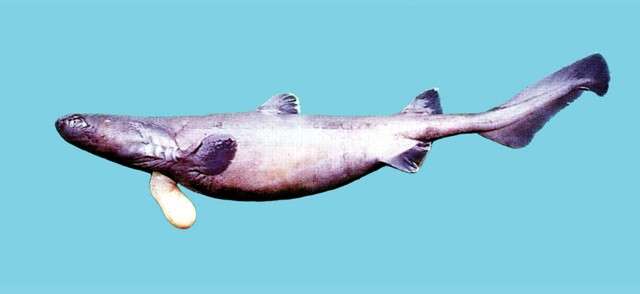
Dalatiidae
The Dalatiidae are the family of kitefin sharks of the order Squaliformes (the term "kitefin shark" also refers specifically to the species Dalatias licha). Members of this family are small, under long, and are found worldwide.
They have cigar-shaped bodies with narrow heads and rounded snouts. Several species have specialized bioluminescent organs. Though eight genera are in this family, four of them are monotypic.
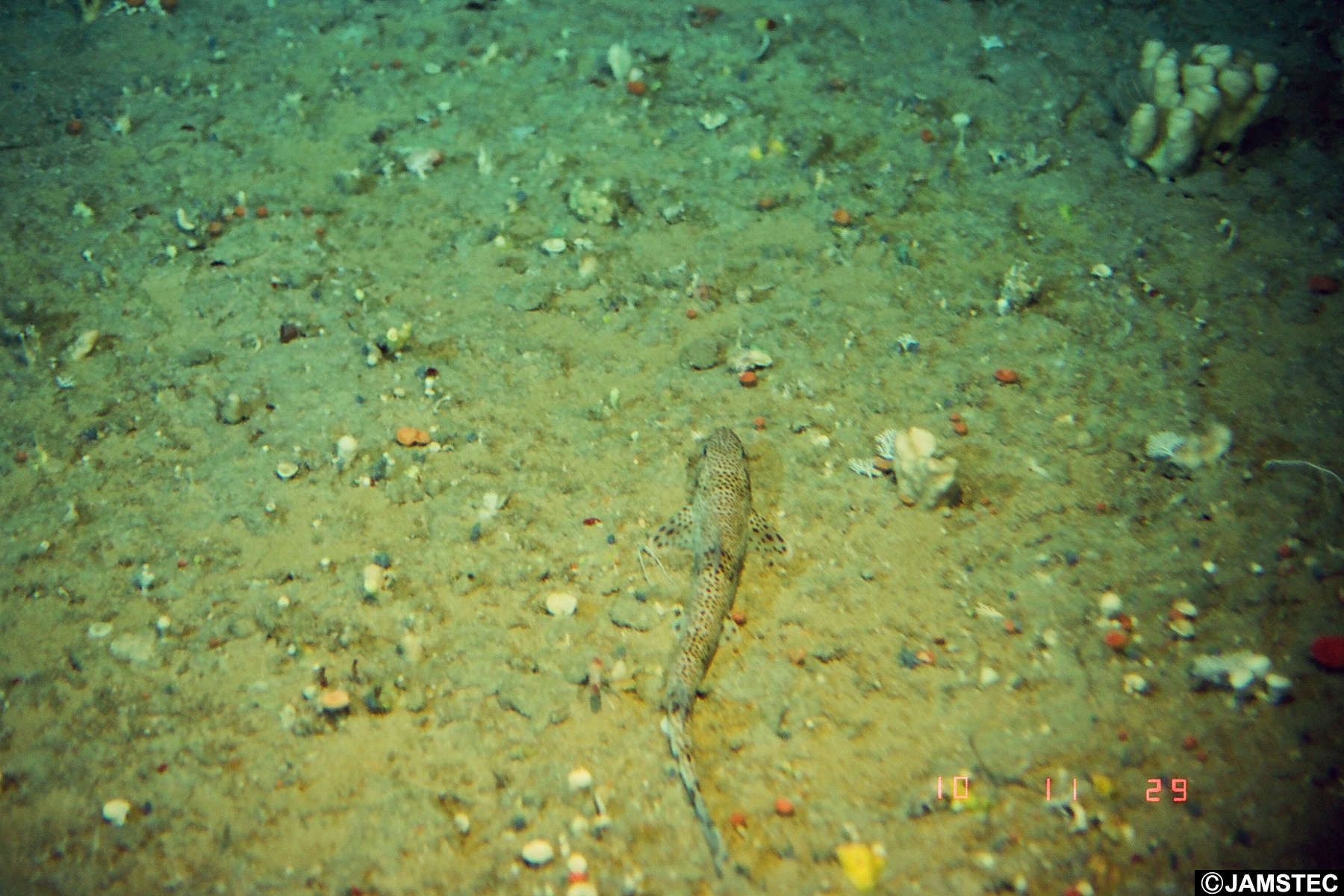
Proscylliidae
The finback catsharks are a small family, the Proscylliidae, of ground sharks. They can be found in warm seas worldwide and are often the most numerous and common shark in tropical regions. They are generally less than 1 m in length, and are slow-moving predators that feed on bony fish and small invertebrates. Although some bear live young, the majority lay eggs with almost fully developed young; these egg cases, known as "mermaid's purses", are unique in appearance to each species.
Pseudotriakidae
The Pseudotriakidae are a small family of ground sharks, belonging to the order Carcharhiniformes, containing the false catsharks (genera Pseudotriakis and Planonasus) and gollumsharks (genus Gollum). It contains the only ground shark species that exhibit intrauterine oophagy, in which developing fetuses are nourished by eggs produced by their mother.

Parascylliidae
Parascylliidae, or the collared carpet sharks, is a family of sharks in the order Orectolobiformes, which are only found in shallow waters of the western Pacific. The family Parascylliidae contains two genera, Cirrhoscyllium and Parascyllium. They are relatively small sharks, with the largest species reaching no more than 91.0 cm in adult length. They have elongated, slender bodies, cat-like eyes, and barbels behind their chins. They feed on small fish and invertebrates.
left|thumb|Fossil specimen of Pararhincodon from [[Lebanon]]
The oldest known member of the group is the stem group-parascyl
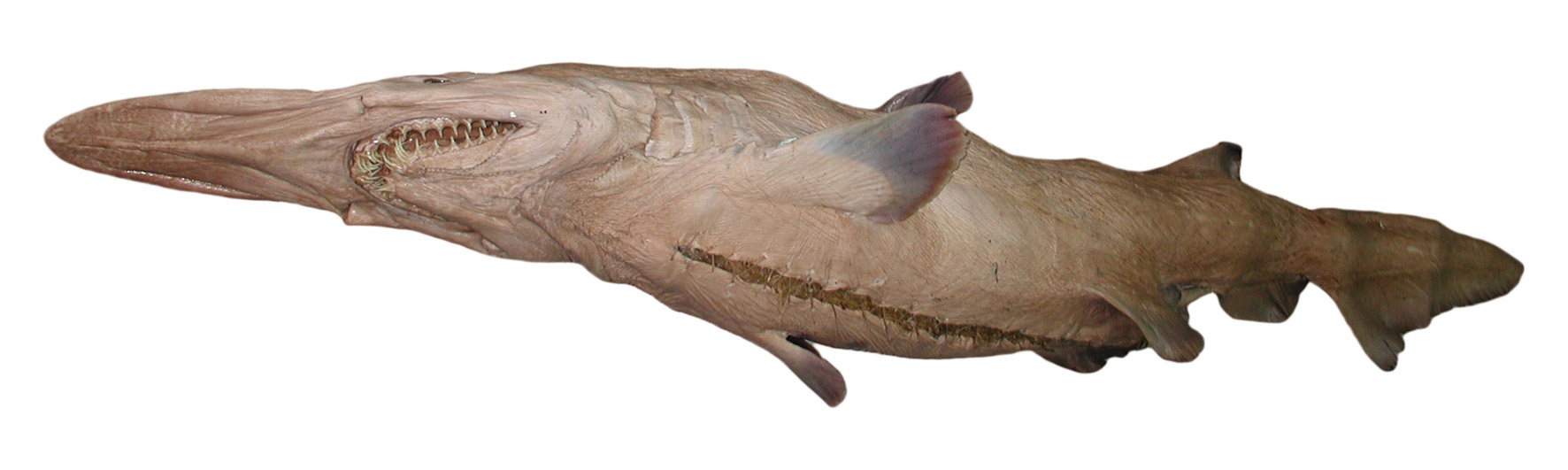
Mitsukurinidae
Mitsukurinidae is a family of sharks with one living genus, Mitsukurina, and four fossil genera: Anomotodon, Protoscapanorhynchus, Scapanorhynchus, and Woellsteinia, though some taxonomists consider Scapanorhynchus to be a synonym of Mitsukurina. The only known living species is the goblin shark, Mitsukurina owstoni.
Otodontidae
Otodontidae is an extinct family of sharks belonging to the order Lamniformes. Its members have been described as megatoothed sharks. They lived from the Early Cretaceous to the Pliocene, and included genera such as Otodus, including the giant megalodon. Although traditionally classified under Carcharocles, studies of the genus Megalolamna indicate that the megatoothed sharks were likely members of Otodus. The genus Cretalamna which lived from the mid-Cretaceous-Paleogene is believed to be directly ancestral to Otodus, and thus to megalodon.

Brachaeluridae
REDIRECT Brachaelurus
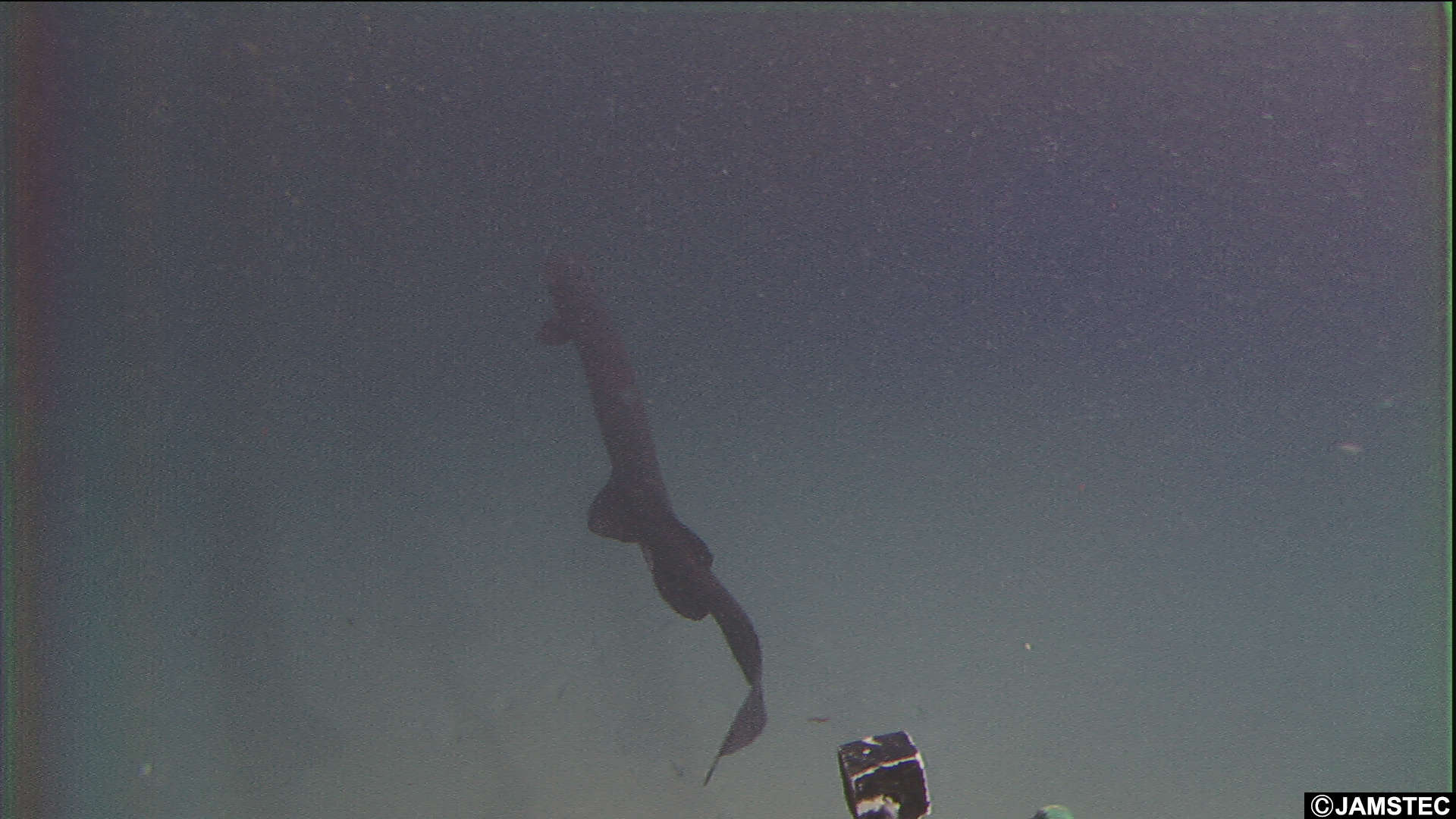
Chlamydoselachidae
Chlamydoselachidae is a family of primitive deep-sea sharks in the order Hexanchiformes. They are one of only two extant families in the order alongside the cow sharks in the family Hexanchidae, and the only members of the suborder Chlamydoselachoidei.
Echinorhinidae
REDIRECT Echinorhinus
Rhincodontidae
Rhincodontidae is a shark family which includes the whale shark, the sole extant member and the largest living fish. A single extinct genus, Palaeorhincodon, is known from the Paleocene and Eocene as well.
Cetorhinidae
Cetorhinidae is a family of filter feeding mackerel sharks, whose members are commonly known as basking sharks. It includes the extant basking shark, Cetorhinus, as well as two extinct genera, Caucasochasma and Keasius.
Alopiidae
Alopiidae is a family of large mackerel sharks (order Lamniformes). The only extant genus is the thresher shark (Alopias). The extinct genera Anotodus, Paranomotodon, and Trigonotodus have been proposed as members of this family.
Cardabiodontidae
Cardabiodontidae is an extinct family of lamniform sharks. Confirmed members of this family include Cardabiodon and Dwardius, both which are genera which existed in Australia, North America, and Europe during the Late Cretaceous period. It has been suggested that Parotodus could also belong to this family, but the authors that originally made this proposal expressed a weakening of rationale for it.

Anacoracidae
Anacoracidae is a family of extinct mackerel sharks that lived during the Cretaceous. It includes four valid genera: Nanocorax, Ptychocorax, Scindocorax, and Squalicorax. Two previously-included genera, Galeocorax and Pseudocorax, were reassigned to the family Pseudocoracidae.
Cretoxyrhinidae
REDIRECT Cretoxyrhina
Atelomycteridae
Atelomycteridae, the coloured catsharks, is a family of sharks belonging to the order Carcharhiniformes. These sharks are found in the Indian, Pacific and Western Atlantic Oceans.